| Also known as | known lately as 101-107 Rosslyn St. |
|---|---|
| Previous Address | |
| Constructed | |
| Style | |
| Architect | |
| Builder |
Timelapse Building Images
No Entries Found
Land Details
Building Details
No Entries Found
Subsequent Building Alterations
No Entries Found
Architectural Features
No Entries Found
Heritage Significance and Listings
| Heritage Listings and Explanatory Notes |
|---|
Owners
No Entries Found
Residents
| From | To | Resident | More Info | Data Source |
|---|---|---|---|---|
| to date | Private | Hatcher Index | ||
| 1970 | 1974 | Seeburg (Aust} P/L music background, Owen Prntng Plates P/L photo engrvrs, Photo-Litho Servs P /L lithogrphrs | Sands & McDougall directory, transcribed by Stephen Hatcher 2024 | |
| 1965 | Lyell-Owen Py Ld, photo engravers | Sands & McDougall directory, transcribed by Stephen Hatcher 2024 | ||
| 1955 | D.H.A. (Vic) Py Ld factory (101) | Sands & McDougall directory, transcribed by Stephen Hatcher 2024 | ||
| 1950 | Felton, Grimwade & Duerdins Py Ld factory (101) | https://adb.anu.edu.au/biography/grimwade-edward-norton-6495 | Sands & McDougall directory, transcribed by Stephen Hatcher 2024 | |
| 1940 | 1944/5 | Wishart, Gordon (house 101) | Sands & McDougall directory, transcribed by Stephen Hatcher 2024 | |
| 1935 | Sullivan, Arthur (house 101) | Sands & McDougall directory, transcribed by Stephen Hatcher 2025 | ||
| 1925 | 1930 | Bruce, James J. (house 101) | Sands & McDougall directory, transcribed by Stephen Hatcher 2025 | |
| 1920 | Peet, Richard (house 101) | Sands & McDougall directory, transcribed by Stephen Hatcher 2025 | ||
| 1915 | Peet, James (house 101) | Sands & McDougall directory, transcribed by Stephen Hatcher 2025 | ||
| 1910 | Bienvenue, Miss A. (house 101) | Sands & McDougall directory, transcribed by Stephen Hatcher 2025 | ||
| 1905 | Wallace, T. R. (house 101) | Sands & McDougall directory, transcribed by Stephen Hatcher 2025 | ||
| 1900 | Ambrose, Alex G. (house 101) | Sands & McDougall directory, transcribed by Stephen Hatcher 2025 | ||
| 1890 | 1895 | Walker, Joseph (house 101) | Sands & McDougall directory, transcribed by Stephen Hatcher 2025 | |
| 1889 | vacant (house 101) | Sands & McDougall directory, transcribed by Stephen Hatcher 2025 |
Social History
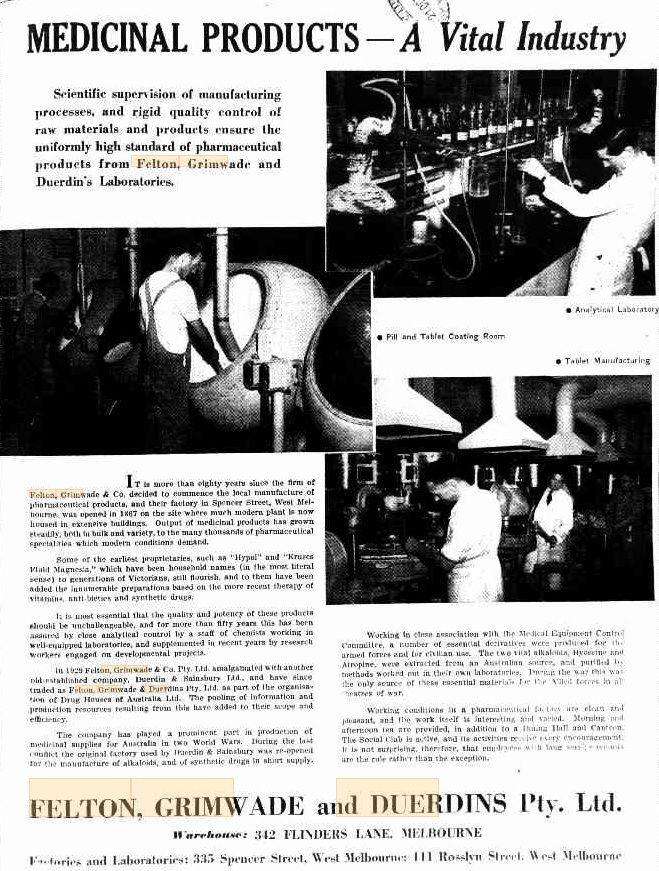
MEDICINAL PRODUCTS—A Vital Industry
Scientific supervision of manufacturing
processes, and rigid quality control of
raw materials and products ensure the
uniformly high standard of pharmaceutical
products from Felton, Grimwade and
Duerdin’s Laboratories.
IT is more than eighty years since the firm of Felton, Grimwade & Co. decided to commence the local manufacture of
pharmaceutical products, and their factory in Spencer Street, West Melbourne was opened in 1867 on the site where much modern plant is now housed in extensive buildings. Output of medicinal products has grown steadily, both in bulk and variety, to the many thousands of pharmaceutical specialities which modern conditions demand.
Some of the earliest proprietaries, such as “Hypol” and “Kruses Fluid Magnesia,” which have been household names (in the most literal
sense) to generations of Victorians, still flourish, and to them have been added the innumerable preparations based on the more recent therapy of vitamins, anti-biotics and synthetic drugs.
It is most essential that the quality and potency of these products should be unchallengeable, and for more than fifty years this has been
assured by close analytical control by a staff of chemists working in well-equipped laboratories, and supplemented in recent years by research workers engaged on developmental projects.
In 1929 Felton, Grimwade & Co. Pty. Ltd. amalgamated with another old-established company, Duerdin & Sainsbury Ltd., and have since
traded as Felton, Grimwade & Duerdins Pty. Ltd. as part of the organisation of Drug Houses of Australia Ltd. The pooling of information and production resources resulting from this have added to their scope and efficiency.
The company has played a prominent part in production of medicinal supplies for Australia in two World Wars. During the last
conflict the original factory used by Duerdin & Sainsbury was re-opened for the manufacture of alkaloids, and of synthetic drugs in short supply.
Working in close association with the Medical Equipment Control Committee, a number of essential derivatives were produced for the
armed forces and for civilian use. The two vital alkaloids, Hyoscine and Atropine, were extracted from an Australian source, and purified by
methods worked out in their own laboratories. During the war this was the only source of these essential materials for the Allied forces in all theatres of war.
Working conditions in a pharmaceutical factory are clean and pleasant, and the work itself is interesting and varied. Morning and
afternoon tea are provided, in addition to a Dining Hall and Canteen.
The Social Club is active, and its activities receive every encouragement.
It is not surprising, therefore, that employees with long service records are the rule rather than the exception.
FELTON, GRIMWADE and DUERDINS Pty. Ltd.
Warehouse – 342 FLINDERS LANE, MELBOURNE
Factories and Laboratories: 335 Spencer Street, West Melbourne; Rosslyn Street. West Melbourne
http://nla.gov.au/nla.news-article249779462
Context and Streetscape
| Precinct |
|---|
| Zoning |
|---|
| Streetscape |
|---|
Other Information
No Entries Found