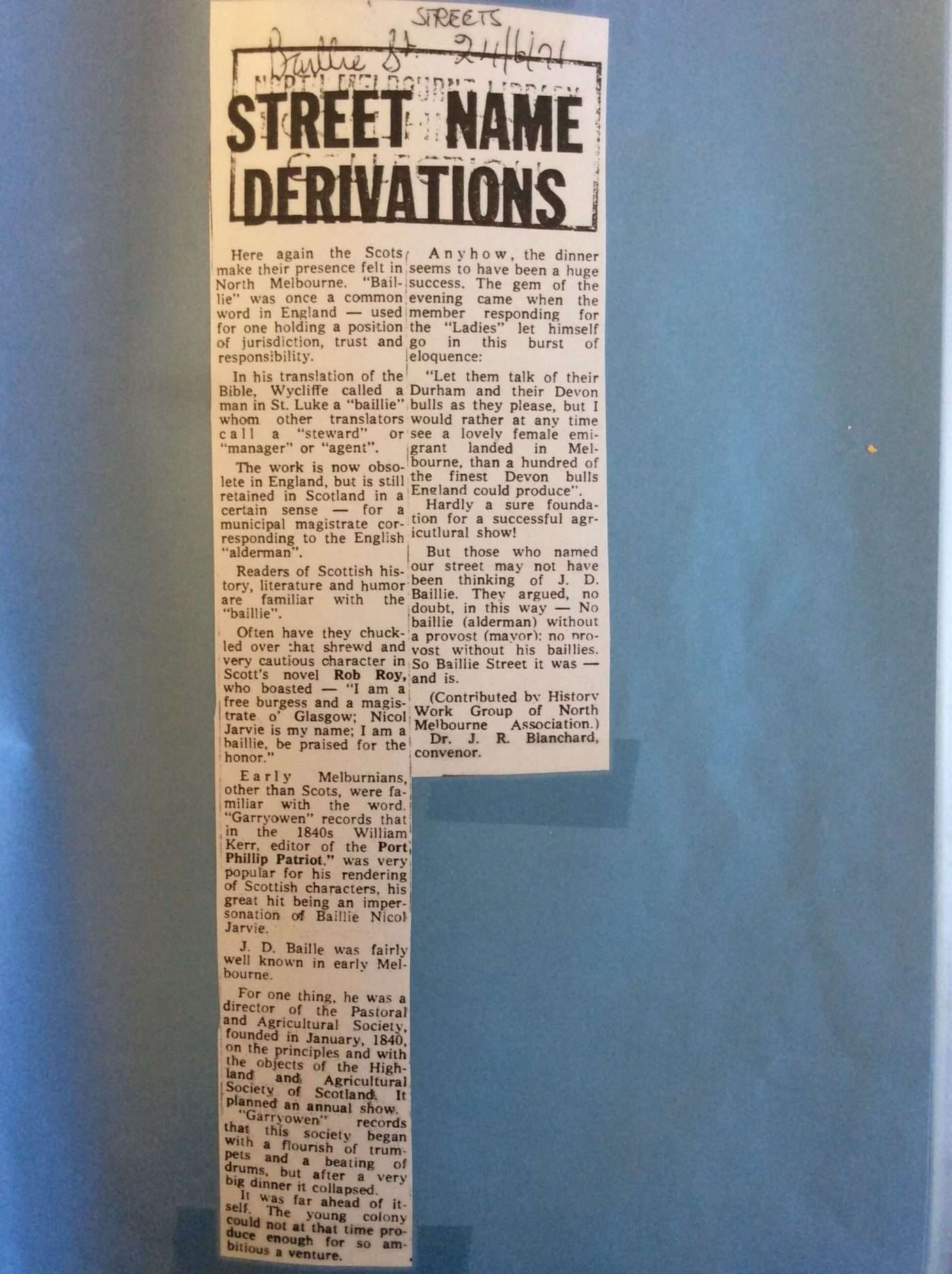
Here again the Scots make their presence felt in North Melbourne. “Baillie” was once a common in England — used for one holding a position of jurisdiction, trust and responsibility. In his translation of the Bible, Wycliffe called a man in St. Luke a “baillie” whom other translators call a “steward” or “manager” or “agent”. The work is now obsolete in England, but is still retained in Scotland in a certain sense — for a municipal magistrate corresponding to the English “alderman”. Readers of Scottish history, literature and humor are familiar with the Baillie. Often have they chuckled over that shrewd and very cautious character in Scott’s novel Rob Roy, who boasted — “I am a free burgess and a magistrate o’ Glasgow; Nicol Jarvie is my name; I am a be praised for the honor.” Early Melburnians, other than Scots, were familiar with the word. “Garryowen” records that in the 1840s William Kerr, editor of the Port Phillip Patriot.” was very, popular for his rendering: of Scottish characters, his great hit being an impersonation of Baillie Nicol Jarvie. J. D. Baillie was fairly well known in early Melbourne. For one thing, he was a director of the Pastoral’ and …
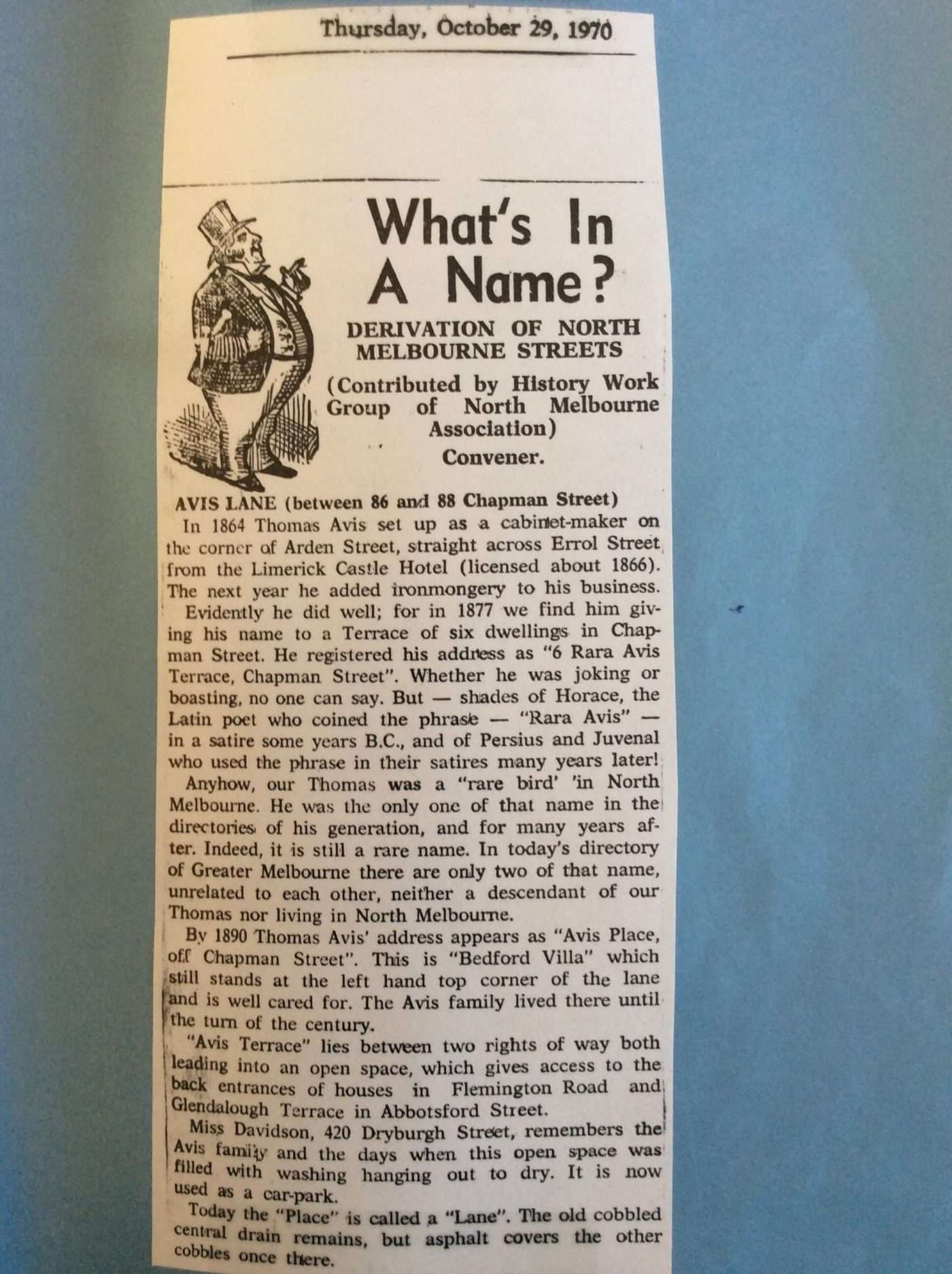
Avis Lane
(between 86 and 88 Chapman Street) Named after Thomas Avis who in 1864 set up as a cabiniet-maker on the corner of Arden Street, straight across Errol Street from the Limerick Castle Hotel (licensed about 1866). Miss Davidson, 420 Dryburgh Street, remembers the Avis family and the days when this open space was filled with washing hanging out to dry. It is now used as a car-park. Today the “Place” is called a “Lane”. The old cobbled central drain remains, but asphalt covers the other cobbles once there.(1) Source. (1) Northern Advertiser Thursday, October 29. 1970. Blanchard collection, “What’s in a Name” at North Melbourne Library.
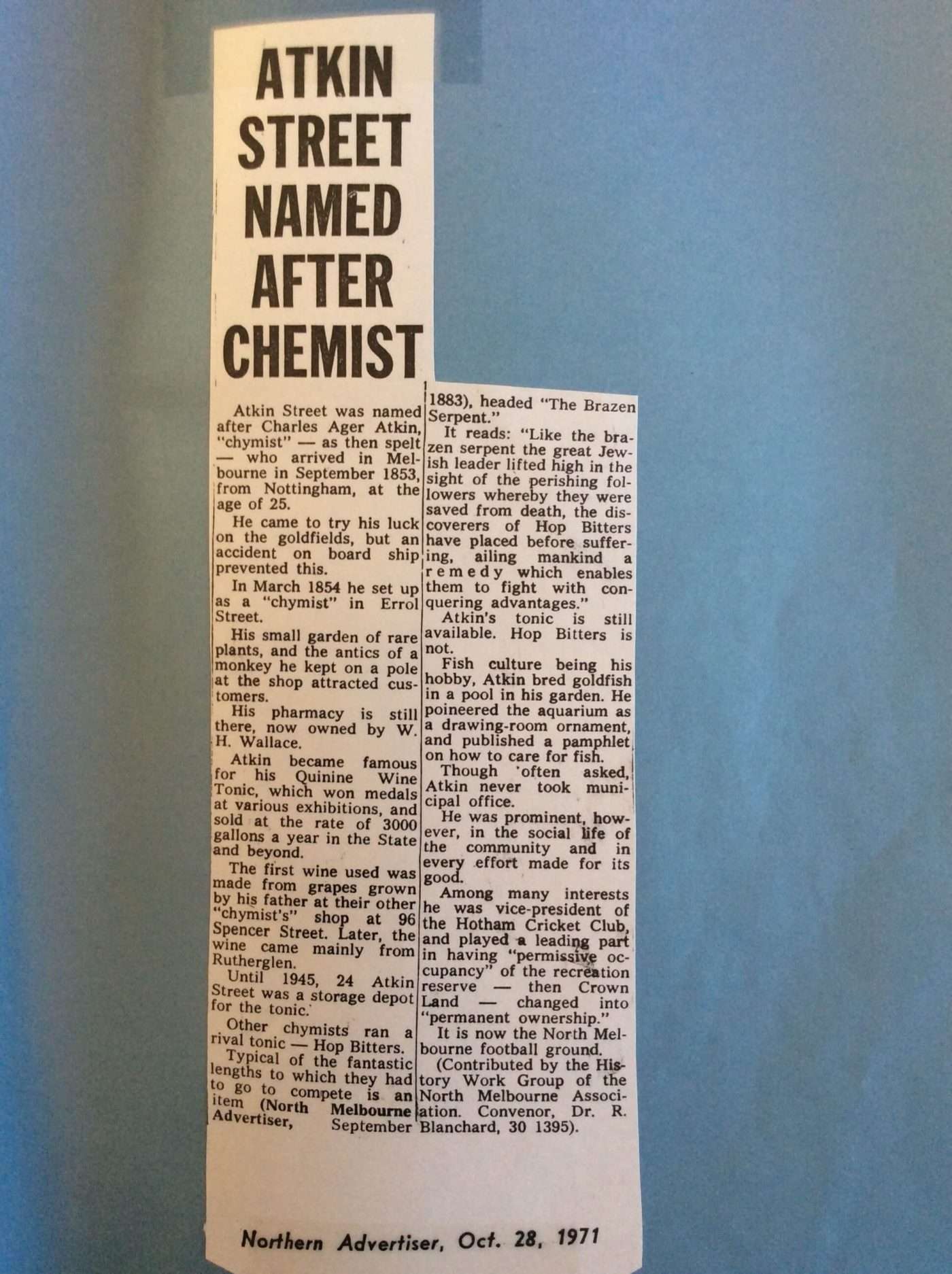
Atkin Street
Atkin Street North Melbourne was named after Charles Ager Atkin, “chymist” — as then spelt — who arrived in Melbourne in September 1853, from Nottingham, at the age of 25. He came to try his luck on the goldfields, but an accident on board the ship prevented this.(1) Source. (1) Northern Advertiser, Oct. 28, 1971. Blanchard collection, “What’s in a Name” at North Melbourne Library.
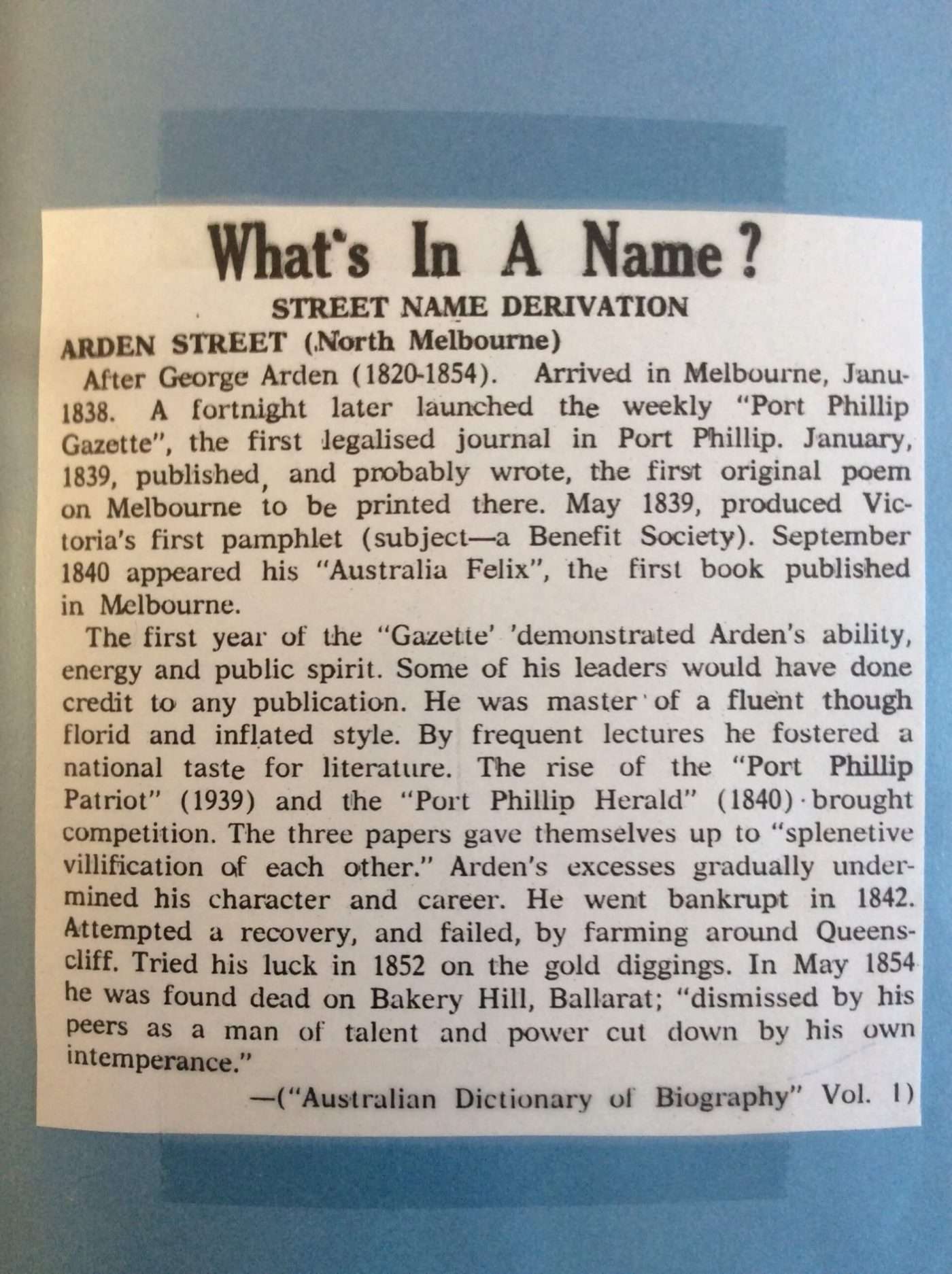
Arden Street
Named after George Arden (1820-1854). He arrived in Melbourne, January 1838. A fortnight later launched the weekly “Port Phillip Gazette”, the first legalised journal in Port Phillip.(1) Source. (1) Northern Advertiser. Blanchard collection, “What’s in a Name” at North Melbourne Library and “Australian Dictionary of Biography” Vol. 1
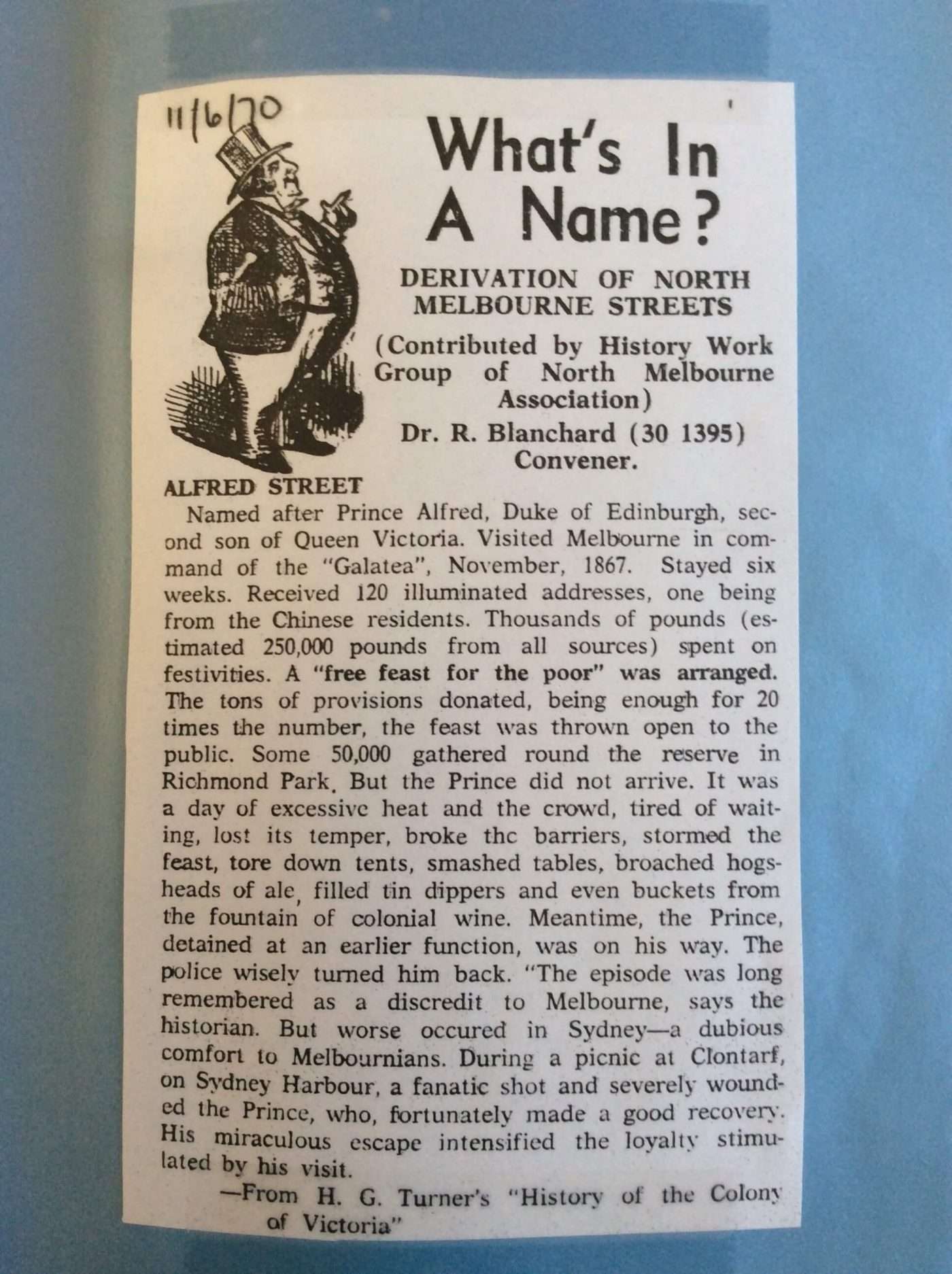
Alfred Street
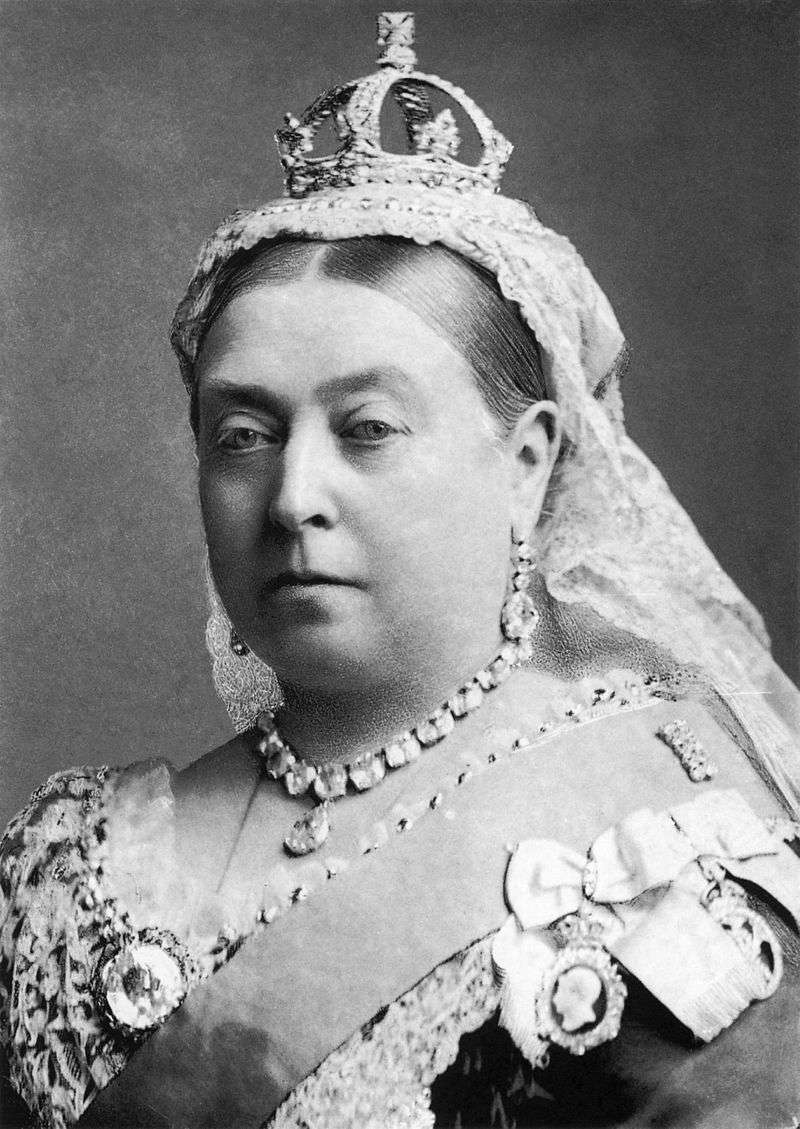
Named after Prince Alfred, Duke of Edinburgh, second son of Queen Victoria. Visited Melbourne in command of the “Galatea”, November, 1867. Stayed six weeks. Received 120 illuminated addresses, one being from the Chinese residents. Thousands of pounds (estimated 250,000 pounds from all sources) spent on festivities. A “free feast for the poor” was arranged. The tons of provisions donated, being enough for 20 times the number, the feast was thrown open to the public. Some 50,000 gathered round the reserve in Richmond Park. But the Prince did not arrive. It was a day of excessive heat and the crowd, tired of waiting, lost its temper, broke the barriers, stormed the feast, tore down tents, smashed tables, broached hogs-heads of ale, filled tin dippers and even buckets from the fountain of colonial wine. Meantime, the Prince, detained at an earlier function, was on his way. The police wisely turned him back. “The episode was long remembered as a discredit to Melbourne, says the historian. But worse occurred in Sydney—a dubious comfort to Melbournians. During a picnic at Clontarf, on Sydney Harbour, a fanatic shot and severely wounded the Prince, who, fortunately made a good recovery. His miraculous escape intensified the loyalty …
Abbotsford Street
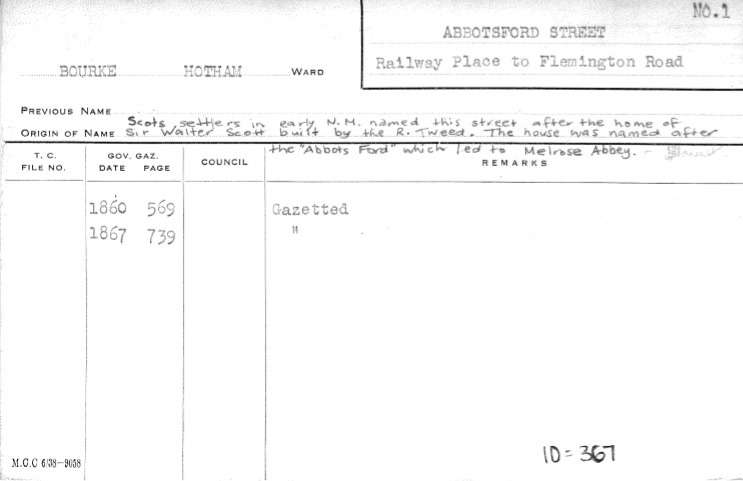
Abbotsford Street runs like a spine through North and West Melbourne. Its unusual name springs from a connection with famous Scottish novelist Sir Walter Scott and his home in the Scottish Boarders. In about 1811, Scott bought his 100-acre Cartley Hole farm on the river Tweed. The site had a personal significance for him as it was close to the site of a final clan battle involving his forebears in 1526. In 1824, he built a new home on the farm, which he called Abbotsford House. The name was inspired by a nearby abbot’s ford across the shallows of the Tweed, used by Cistercian monks from the neighbouring Melrose Abbey, as they moved their cattle safely across the river. The Abbotsford Street we know today has its own rich history far removed from its namesake in Scotland. It was, like the rest of Melbourne, in an area of open bushland occupied by the Boon Wurrung and Wurundjeri peoples of the Kulin Nation. Some of the earliest homes in Abbotsford Street went up as early as 1859. Number 86 Abbotsford was built by Robert Bentley, an Englishman from Staffordshire, after he married Martha Redfern in 1841. They were both about 23 …
King Street
Street named after Captain Philip Gidley King, governor of New South Wales 1802-06, or King William IV, reigning monarch.
Victoria Street
Named after Queen Victoria.
Errol Street
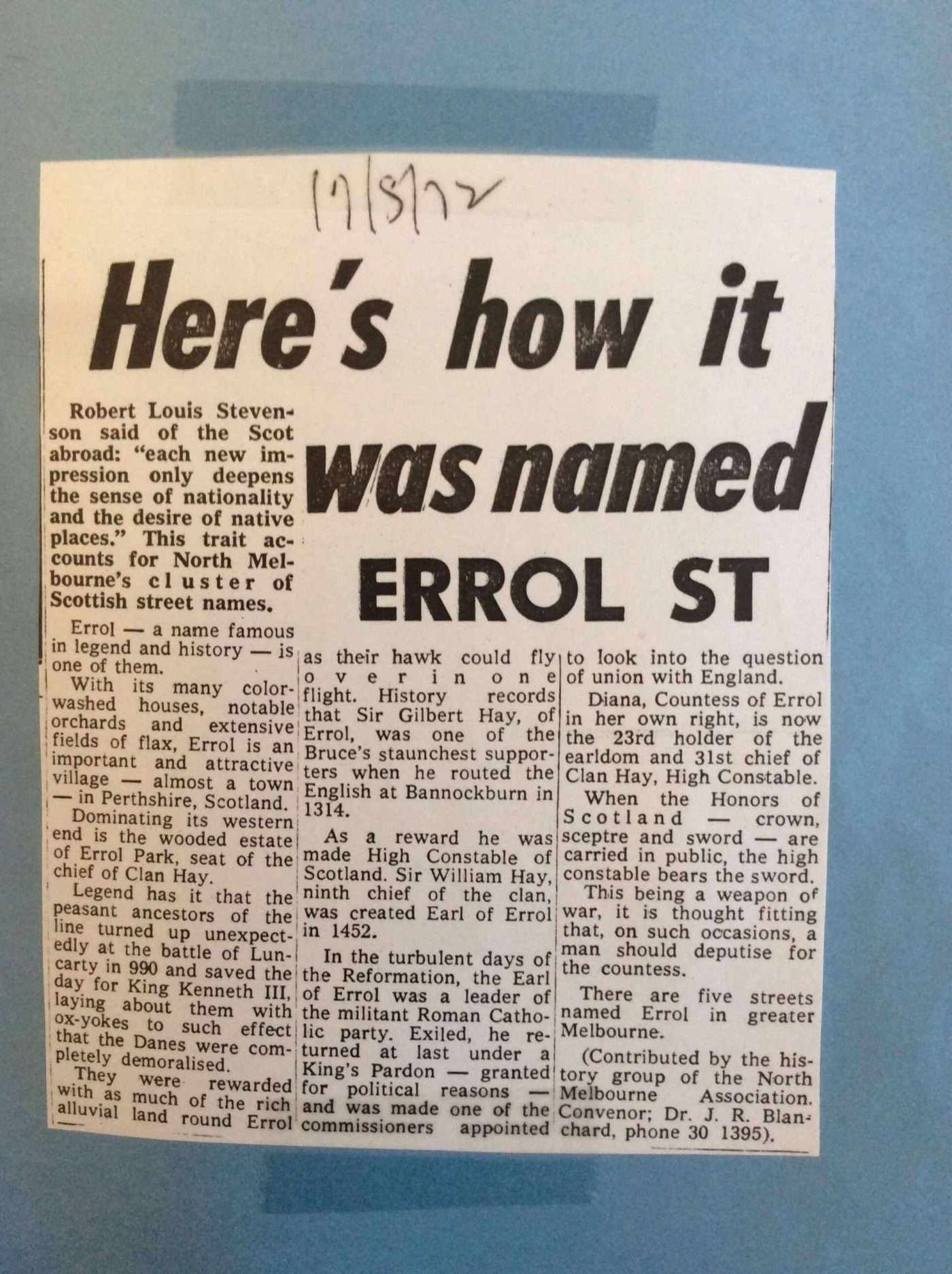
Robert Louis Stevenson said of the Scot abroad: “each new impression only deepens the sense of nationality , and the desire of native places.” This trait accounts for North Melbourne’s cluster of Scottish street names. Errol — a name famous in legend and history — is one of them. With its many color-washed houses, notable orchards and extensive, fields of flax, Errol is an important and attractive village — almost a town — in Perthshire, Scotland. Dominating its western, end is the wooded estate of Errol Park, seat of the chief of Clan Hay. Legend has it that the peasant ancestors of the line turned up unexpectedly at the battle of Luncarty in 990 and saved the day for King Kenneth III, laying about them with ox-yokes to such effects that the Danes were completely demoralised. They were rewarded with as much of the rich alluvial land around Errol as their hawke could fly over in one flight. History records that Sir Gilbert Hay, of Errol, was one of the Bruce’s staunchest supporters when he routed the English at Bannockburn in 1314. As a reward he was made High Constable of Scotland. Sir William Hay, ninth chief of the clan, …
Hawke Street
The street is thought to have been named after Edward Hawke. In the early 1850’s this area was wide open and unobstructed bush land unlike its built form of today. It was free of buildings and the land would have had easy sight of Port Phillip bay and the ships therein. W.M. Tennent writes “ Hawke street is most desirably situated, is a most healthy and elevated position and commands extensive views of the shipping in the bay and of all surrounding districts” The Argus October 6th 1853. Hawke street has 4 cross streets that intersect with it, them being King street, Spencer street, Adderley street and Railway Place. When the founding fathers of Melbourne came up with the names of the new streets, naming Hawke street as they did makes perfect sense. King street is thought to have been named after the then reigning monarch of England, Spencer street is thought to have been named after Lord Spencer, head of the Whig party in the English house of commons. Adderley street is thought to have been named after Charles Bowyer Adderley, an old Staffordshire family and his wife, the daughter of Sir Edmund Craddock-Hartop, 1st Baronet Adderley and …