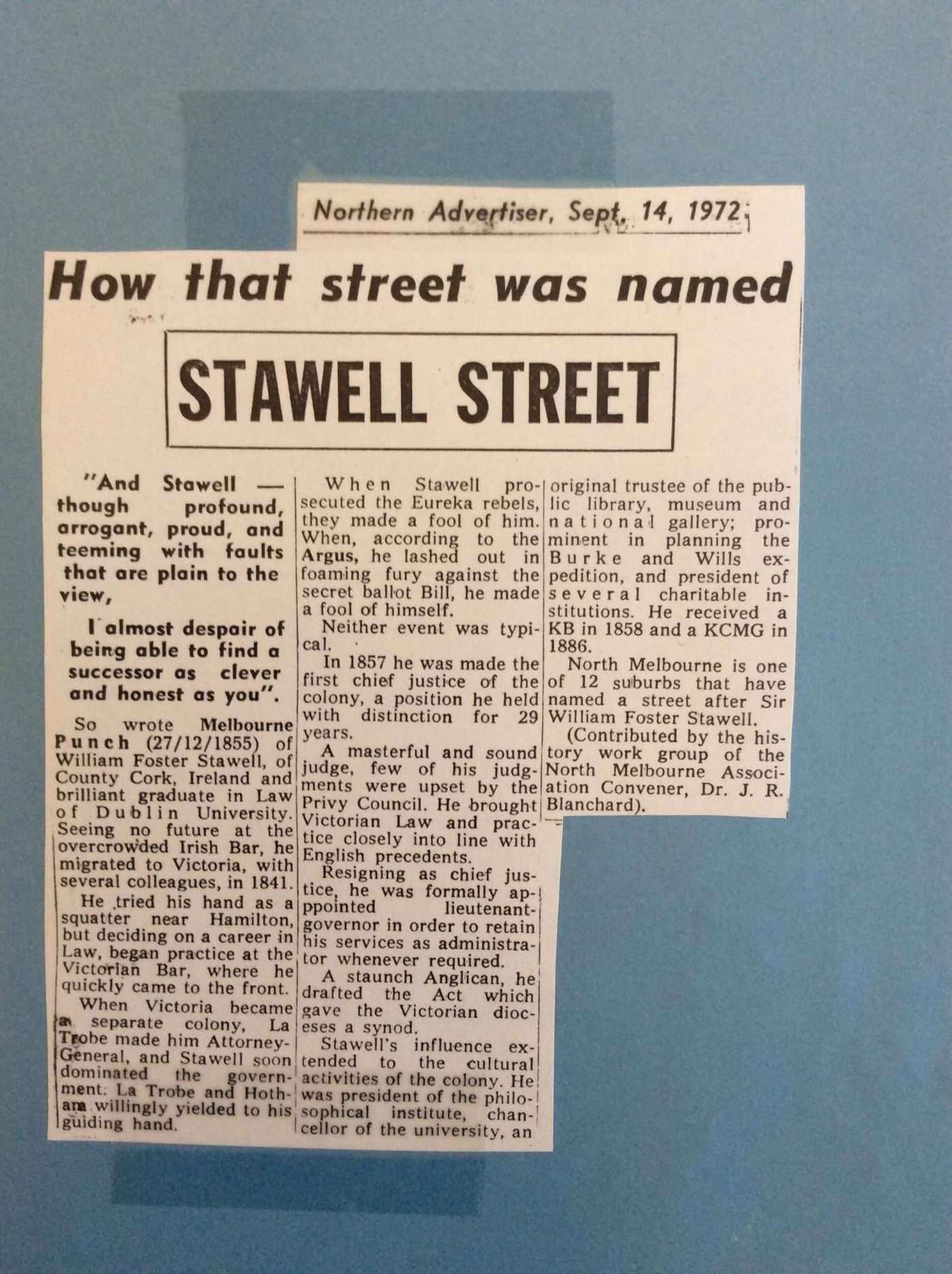
The suffix “berry,” (Old Eng. “beorg”) is obsolete for “hill”. It suggests a fortified hill. In the Douglas country of the Scottish Lowlands there is Queensberry hill of (2285 ft.) and near it another called “Little Queensberry,” They were probably fortified hills in the border wars with England. Sir William Douglas was the first Duke of Queensberry (1633). He spent 10 years and a small fortune in building a palace close to the above hills. It is said to be “one of the grandest homes in of Scotland”. He occupied it for only one night… His son was made a Marquis (1682) and as Lord High Treasurer of Scotland wielded great power. His son, the second Duke of Queensberry, was one of the architects of the Treaty of Union with England (1707). The third Duke, also fourth Marquis and sixth Earl, was the Keeper of the Great Seal of Scotland and Lord Justice General. His Lady — Catherine — was renowned for her patronage of poets, her eccentric behavior and her revolutionary detestation of eating from the point of a knife. The fourth Duke was notable in the racing world. To pay his gambling debts he sold most of the …
Provost Street
J. W. Cross, George Eliot’s husband, writing to his mother in April 1872, commented on ‘the Scottish atmosphere’ of Melbourne. The comment could almost be made of a certain part of North Melbourne, with its ordered sequence of Scottish street names, ‘Provost’ is one of them. The word, from Latin through French, is used of one set over others. It is used by ecclesiastical and secular officials. The Dean of a Cathedral is sometimes called, not Dean but, Provost as in Derby, England. It may denote the head of a college. The officer in charge of military police is also called Provost. The word prevails in Scotland for one called elsewhere, a Mayor. Scotland can boast of many famous Provosts in its romantically rich history. George Drummon, a formidable personality of the 18th century was six times Lord Provost of Edinburgh. Justly he can be called the architect of the New Town of that city – the square mile north of Princes Street, with its fine streets and Georgian buildings. Drummond was the powerful force which pushed it towards creation. Time has taken its toll on these buildings. But efforts are being made today to raise £15,000,000 for the restoration …
O’Shanassy Street
O’Shanassy Street (pronounced O’Shawnassy), North Melbourne, was named after John O’Shanassy (Long John or Big Jack) who left Tipperary for Sydney in 1839, and later made his way to Melbourne.(1) Source. (1) Northern Advertiser, Nov. 18, 1971. Blanchard collection, What’s in a Name” at North Melbourne Library.
O’Connell Street
In 1864 the cattle yards on the north-west corner of Elizabeth and Victoria Streets, North Melbourne’s front door, were divided into five blocks and sold. Three new streets were needed, and why shouldn’t the Irish have had first say in naming them? In the Legislative Council of 1852, John O’Shanassy (fined sixpence for punching an Orangeman’s head on July 12, 1846) sought authority for the sale of land north of Victoria Street. The settlement of North Melbourne began, and the Irish named its front door streets. These streets were called O’Connell, Cobden and Peel — a triology of famous names center of many stormy scenes in the English Commons. Daniel O’Connell, pacifist champion of Catholic emancipation and of all Ireland’s troubles, was hailed in his day as “liberator” of his “most distressful country”. The Irish certainly gave North Melbourne something to live up to when they hoisted their green banner at its front door.(1) O’Connell Street North Melbourne was therefore named in honor of Daniel O’Connell. Source. (1) Northern Advertiser, 23/9/1971. Blanchard collection,”What’s in a Name” at North Melbourne Library.
Murphy Street
Named after Sir Francis Murphy (1809-1891); born at Cork in Southern Ireland; educated at Trinity College, Dublin, and the Royal College of Surgeons in London.(1) Source. (1) Northern Advertiser, 10/12/1970, Blanchard collection “What’s in a Name” and from The Australian Encyclopaedia at North Melbourne Library.
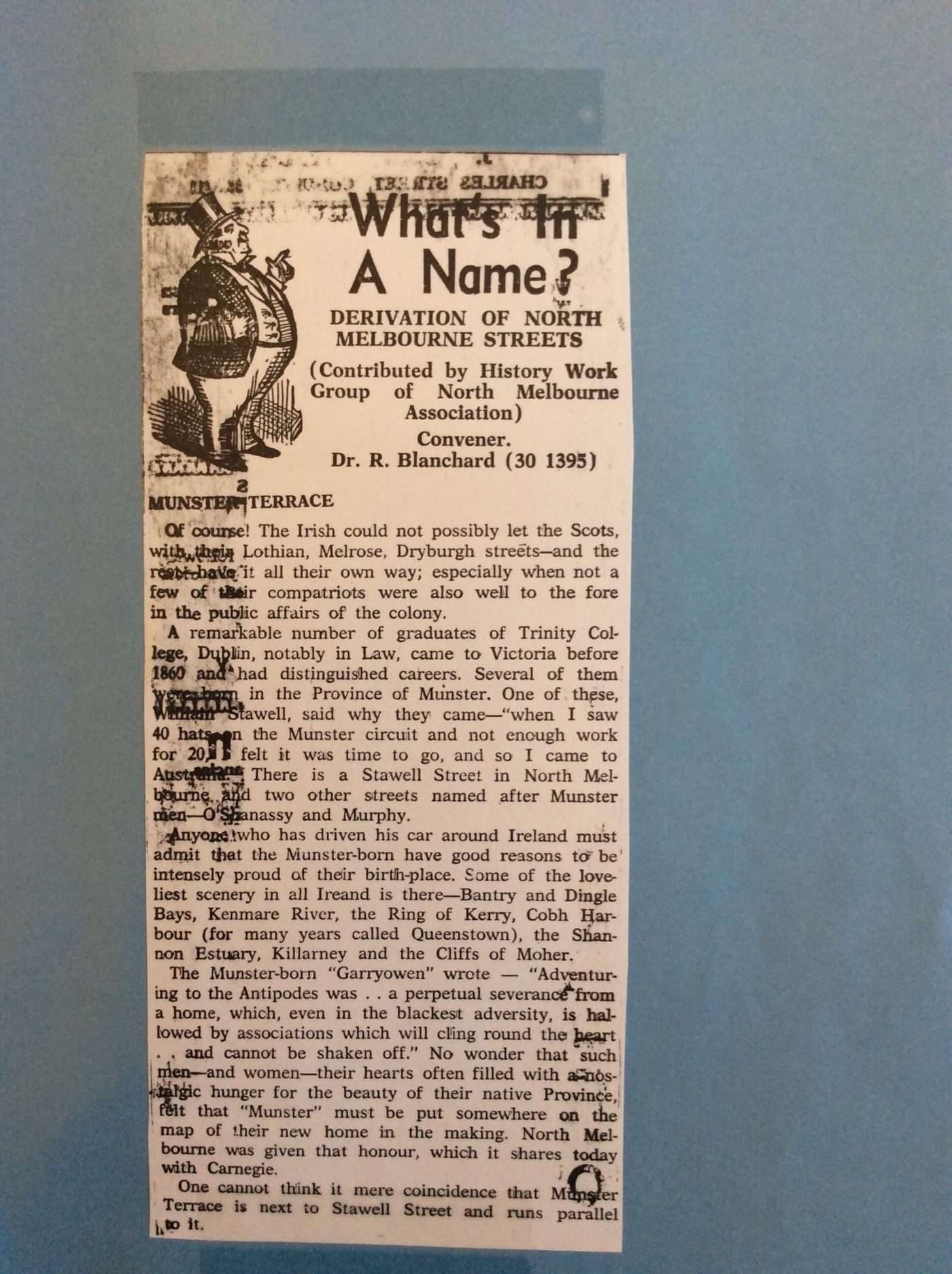
Munster Terrace
Of curse the Irish could not possibly let the Scots, with their Lothian, Melrose, Dryburgh streets—and the rest have it all their own way; especially when not a few of their compatriots were also well to the fore in the public affairs of the colony of Victoria. A remarkable number of graduates of Trinity College, Dublin, notably in Law, came to Victoria before 1860 and had distinguished careers. Several of them were born in the Province of Munster. One of these, William Stawell, said why they came—”when I saw 40 hats on the Munster circuit and not enough work for 20, I felt it was time to go, and so I came to Australia”. There is a Stawell Street in North Melbourne, and two other streets named after Munster men – O’Shanassy and Murphy. Anyone who has driven his car around Ireland must admit that the Munster-born have good reasons to be intensely proud of their birth-place. Some of the loveliest scenery in all Ireland is there—Bantry and Dingle Bays, Kenmare River, the Ring of Kerry, Cobh Harbour (for many years called Queenstown), the Shannon Estuary, Killarney and the Cliffs of Moher. The Munster-born “Garryowen” wrote — “Adventuring to the …
Molesworth Street
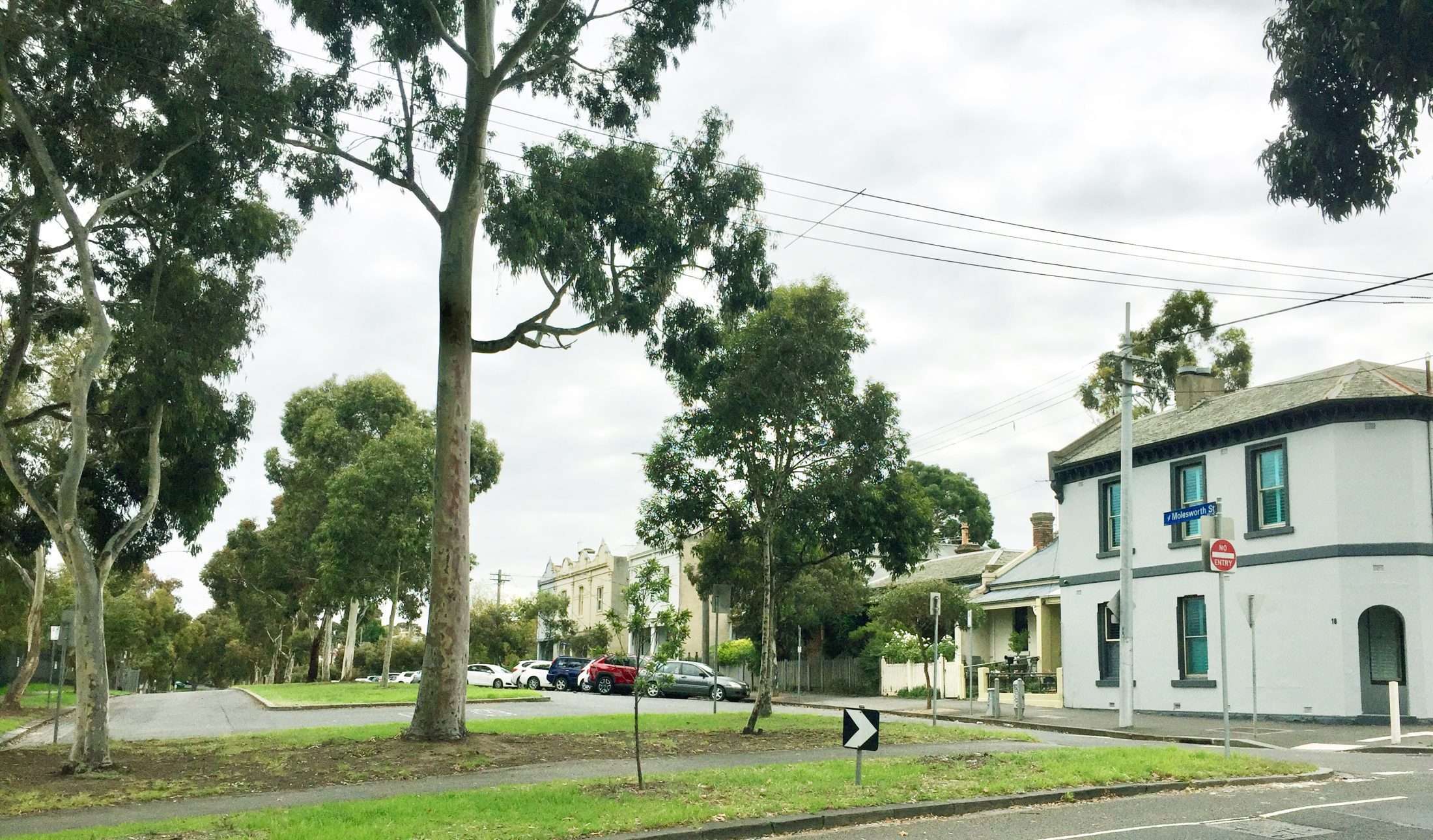
Molesworth, a Meritorious Melbourne Magistrate. Molesworth the street begins at Haines Street and ends at Abbotsford Street and according to North Melbourne historian Dr. J.R. Blanchard, the street is thought to have been named after Sir Robert Molesworth (1806-1890). Robert was born and raised in Ireland, he had a promising legal career on the Munster Circuit, and married a Reverend’s daughter in 1840. They set sail for Australia in the 1850s and established a legal practice in Melbourne at the dawn of the Victorian Gold Rush. By age 47, Robert was appointed acting Chief Justice in 1853 after William à Beckett stood aside due to illness. Molesworth’s career skyrocketed within a short space of time. Appointed Solicitor-General of Victoria by 1855, under Premier Haines. In 1856 Molesworth was appointed, a Supreme Court Judge and remained at the bar until retirement in 1886, aged 80. A hard worker, it was said he never took leave except for Court vacations. Noted for his industry, courtesy, learning and expedition; few of his legal decisions were successfully challenged in court. Chief Justice Griffith remarked in 1897, ‘It is a well-known fact that the mining law of Australia was practically made by the decisions of …
Melrose Street
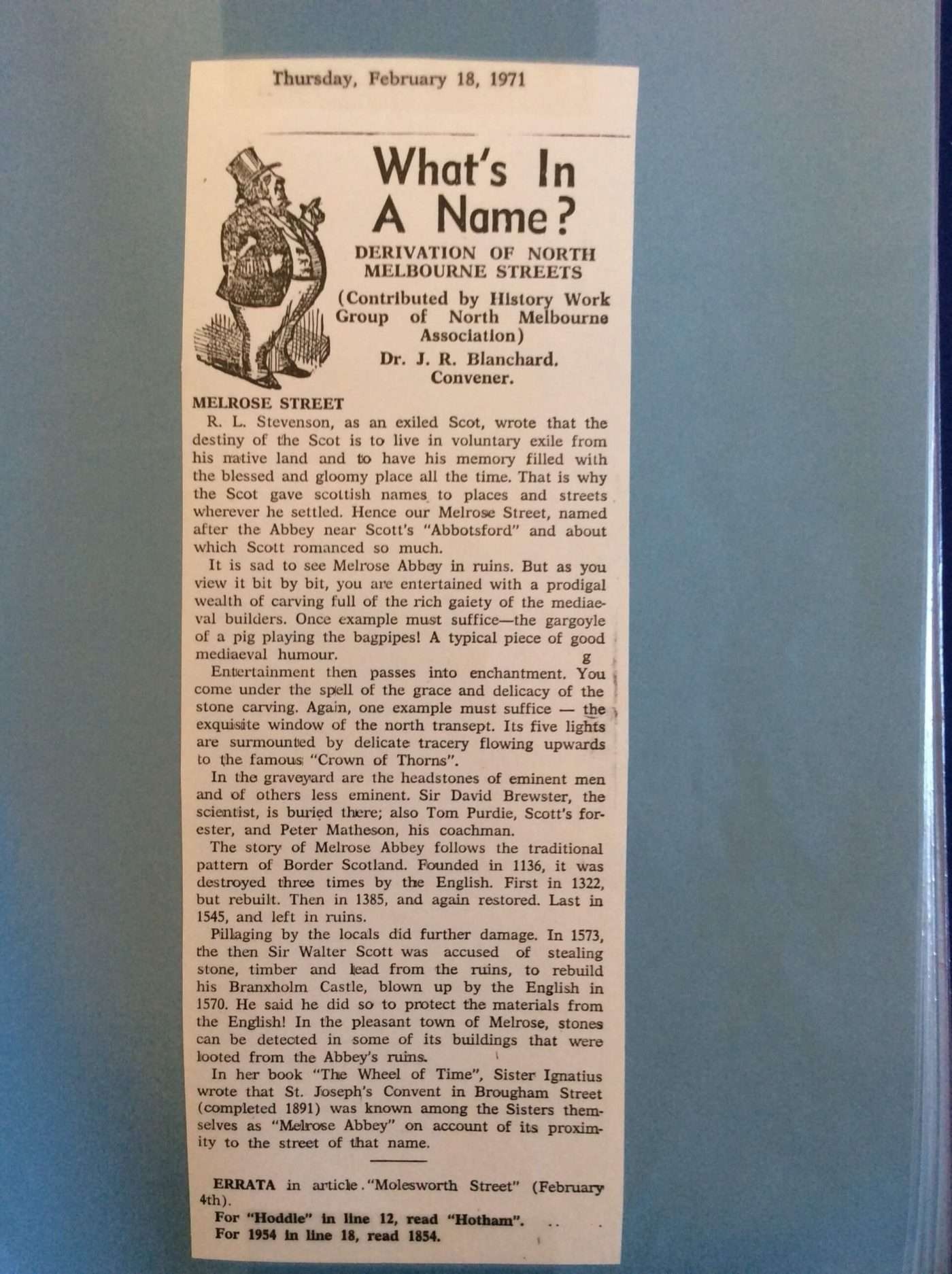
R. L. Stevenson, as an exiled Scot, wrote that the destiny of the Scot is to live in voluntary exile from his native land and to have his memory filled with the blessed and gloomy place all the time. That is why the Scot gave Scottish names to places and streets wherever he settled. Hence our Melrose Street, named after the Abbey near Scott’s “Abbotsford” and about which Scott romanced so much. It is sad to see Melrose Abbey in ruins. But as you view it bit by bit, you are entertained with a prodigal wealth of carving full of the rich gaiety of the medieval builders. Once example must suffice—the gargoyle of a pig playing the bagpipes! A typical piece of good medieval humour. Entertainment then passes into enchantment. You come under the spell of the grace and delicacy of the stone caning. Again, one example must suffice — the exquisite window of the north transept. Its five lights are surmounted by delicate tracery flowing upwards to the famous; “Crown of Thorns”. In the graveyard are the headstones of eminent men and of others less eminent. Sir David Brewster, the scientist, is buried there; also Tom Purdie, Scott’s forester, …
Mark Street
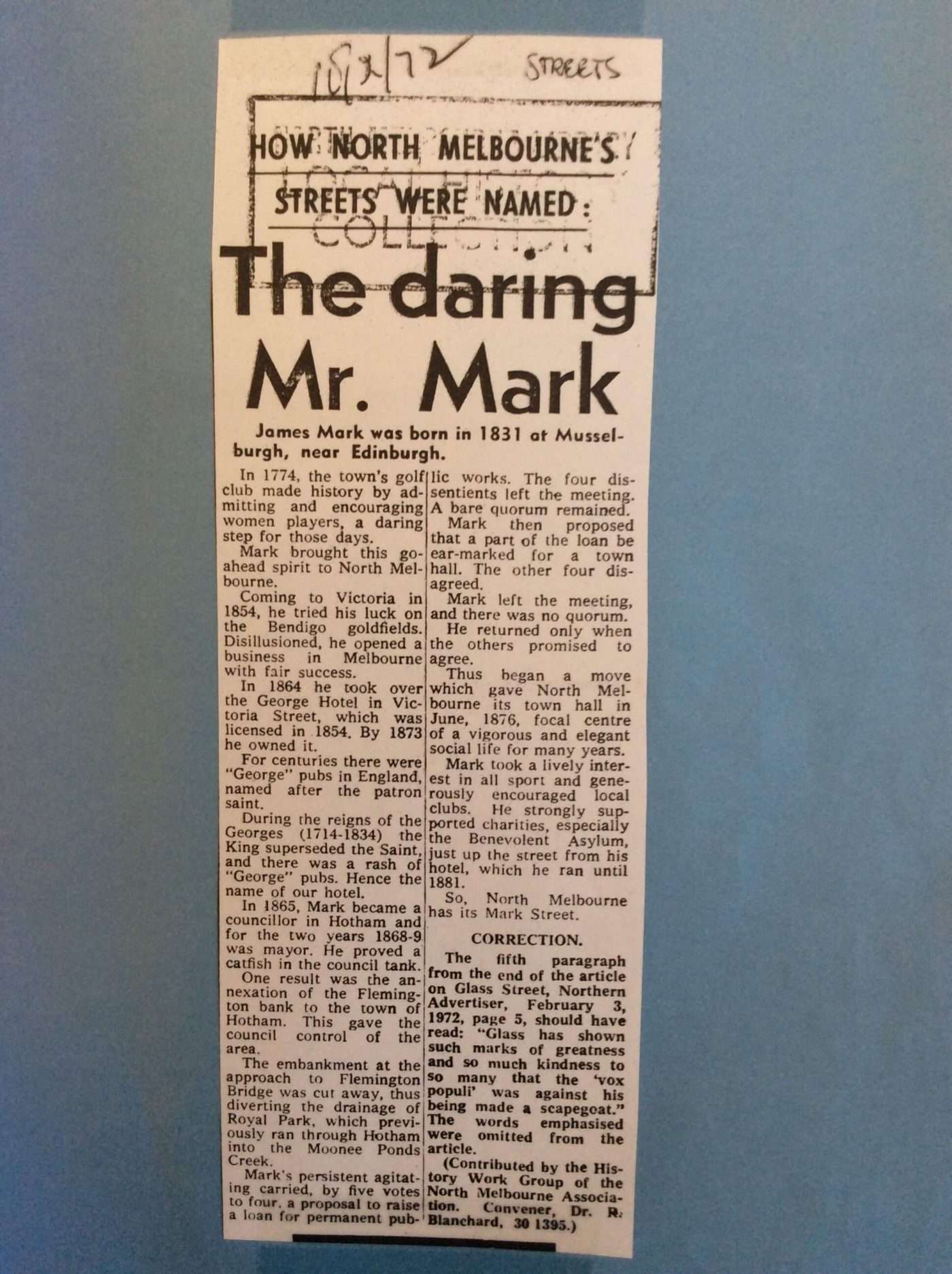
Named after James Mark who was born in 1831 at Musselburgh, near Edinburgh.(1) Source. Northern Advertiser, 10/2/1972. Blanchard collection, “What’s in a Name” at North Melbourne Library.
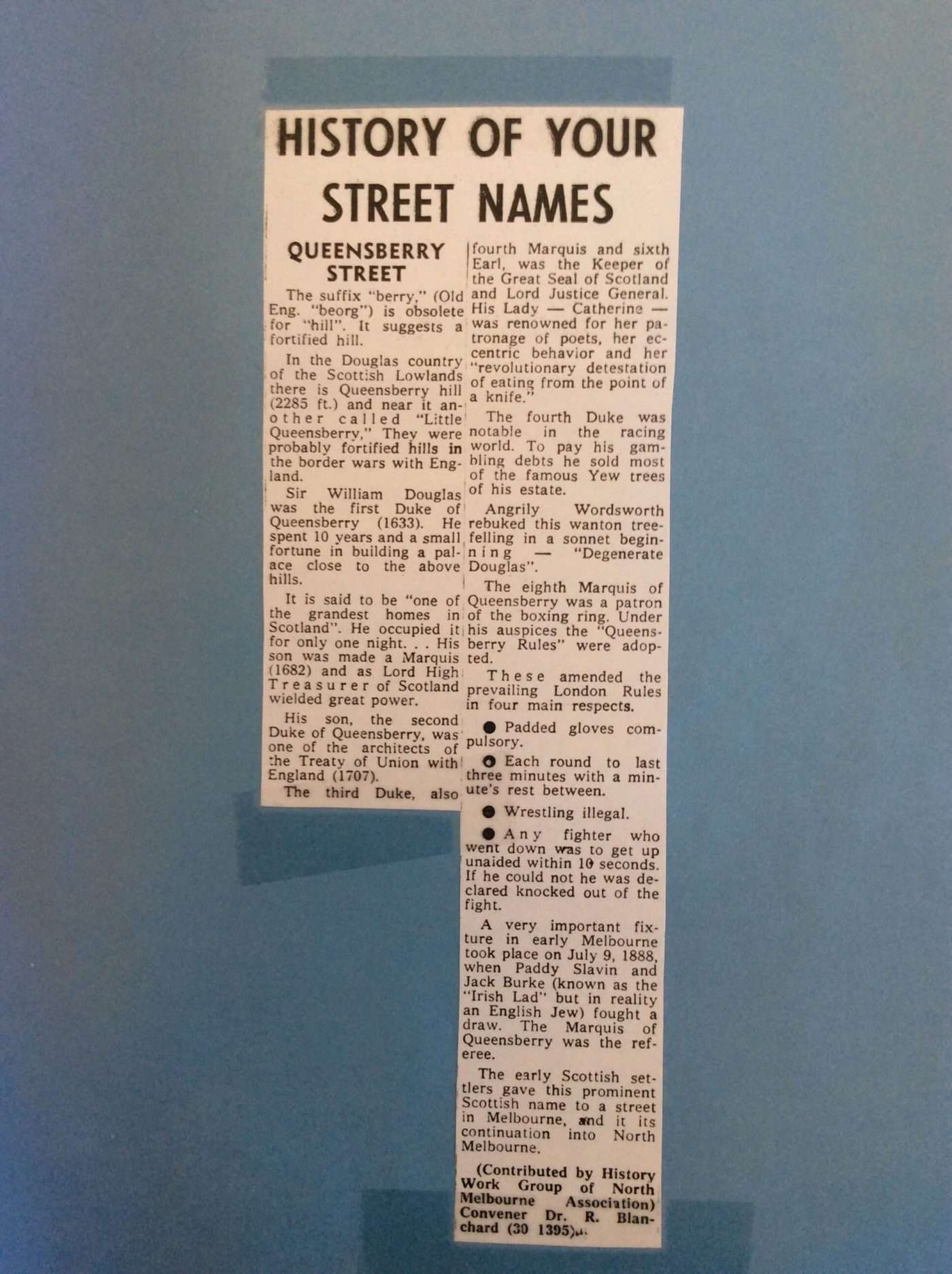
Stawell Street
Named after Sir William Foster Stawell. North Melbourne is one of 12 suburbs that have named a street after Sir William Faster Stawell. Source. (1) Northern Advertiser, 14/9/1972. Blanchard collection, “What’s in a Name” at North Melbourne Library.