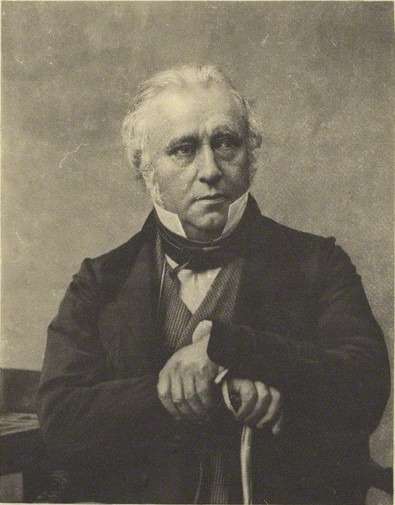
The names of at least 16 famous writers designate 10 streets in Greater Melbourne. Macaulay is one of them. In North Melbourne it adds to the number and fits into a pattern of Scottish street names. Beginning at Dryhurgh Street, it runs parallel to Shiel Street and provides an entrance to the southern end of Buncle (a Scot) Street. If Shiel Street recalls the Jacobites, Macaulay Road reminds one of its namesake’s detestation of Jacobitism. Thomas Bahington Macaulay was of Hebridean stock. For seven years he represented Edinburgh in the House of Commons, where he sat in Lord Melbourne’s Cabinet. He was a prolific contributor to the Edinburgh Review, which was widely read in the colonies. His History of England, a classic in spite of defects and a phenomenal best seller, was an invigorating tonic for battling colonists. It did what Macaulay said it would do —inspired hope. Source. (1) Northern Advertiser, May 10, 1973. Blanchard collection, “What’s in a Name” at North Melbourne Library.
Lothian Street
No novelist has read more widely in the early days of the colony than Sir Walter Scott. So Abbotsford Street was named after his home, Dryburgh Street after the abbey where he was buried. Lothian Street runs between them — Scott’s novel The Heart of Mid-Lothian was the favorite of many. “Lothian” comes from a root meaning low-lying. It was the name given to that part of Scotland’s Lowlands bounded on the north by the Firth of Forth, on the south by Lanark and Peebles, on the east by the North Sea and on the west by Stirling. The Scots and English fought for centuries to possess this tract of country, but the final battle made it part of Scotland for all time. It was worth fighting over. The soil is said to be the most fertile and easily worked in Britain. That prince of potatoes, the famous “Lothian Red”, has its home there. There are also the ruins of magnificent castles, the stately mansions of fine estates, the rolling summits of the Pentland Hills, which form the backbone of the land, beauties of coastline and woodlands, the numerous sites of battles famous in the nation’s annals, some of them …
Leveson Street
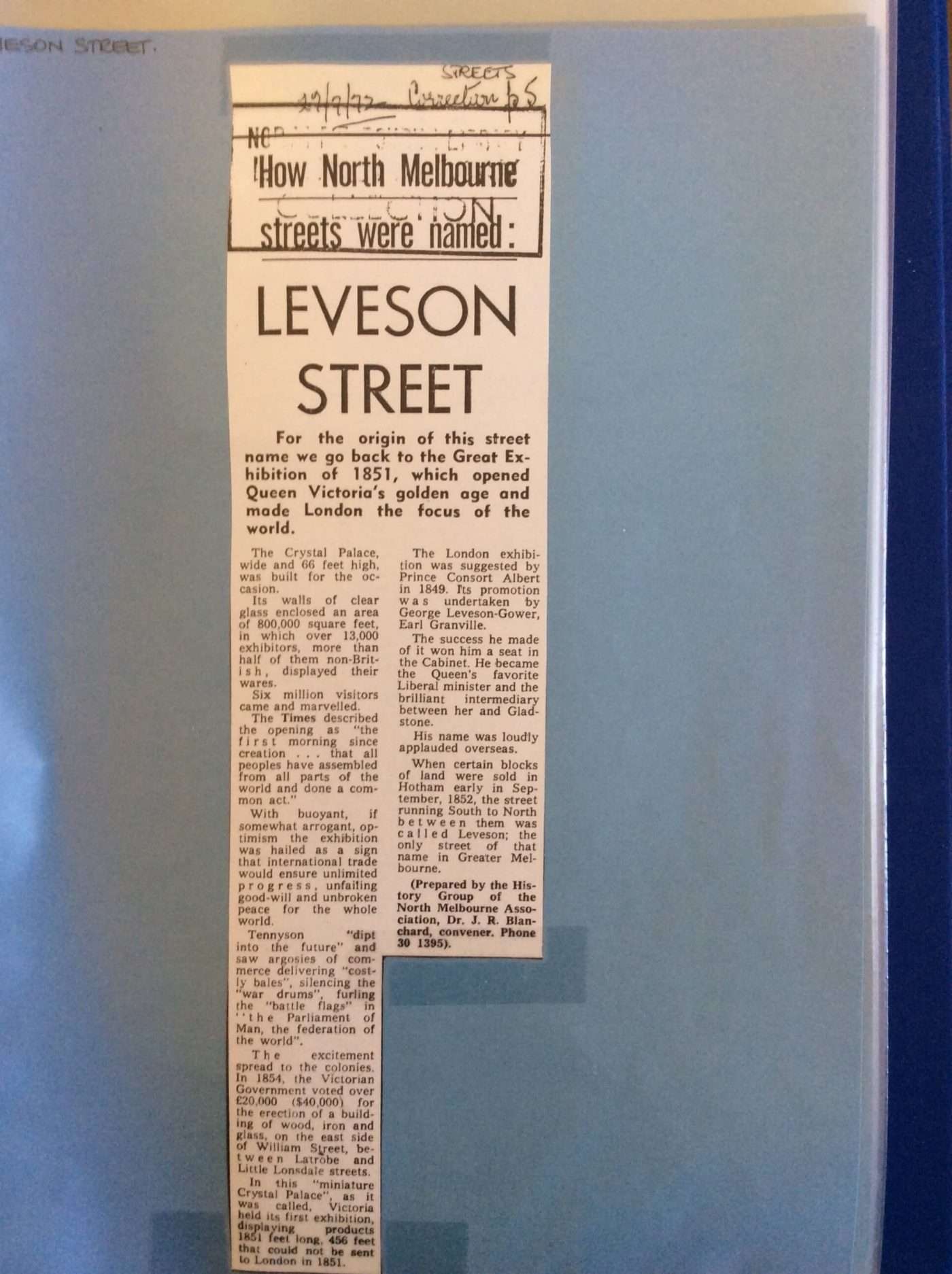
For the origin of this street name we go back to the Great Exhibition of 1851, which opened Queen Victoria’s golden age and made London the focus of the world. The Crystal Palace, 454 feet wide 1851 feet long and 66 feet high, was built for the occasion. Its walls of clear glass enclosed an area of 800,000 square feet, in which over 13,000 exhibitors, more than half of them non-British displayed their wares. Six million visitors came and marvelled. The Times described the opening as “the first morning since creation . . . that all peoples have assembled from all parts of the world and done a common act.” With buoyant, if somewhat arrogant, optimism the exhibition was hailed as a sign that international trade would ensure unlimited progress, unfailing good-will and unbroken peace for the whole world. Tennyson “dipt into the future” and saw argosies of commerce delivering “costly bales”, silencing the “war drums”, furling the “battle flags” in ‘the Parliament of Man, the federation of the world”. The excitement spread to the colonies. In 1854, the Victorian Government voted over £20,000 ($40,000) for the erection of a buildnig of wood, iron and glass, on the east side …
Laurens Street
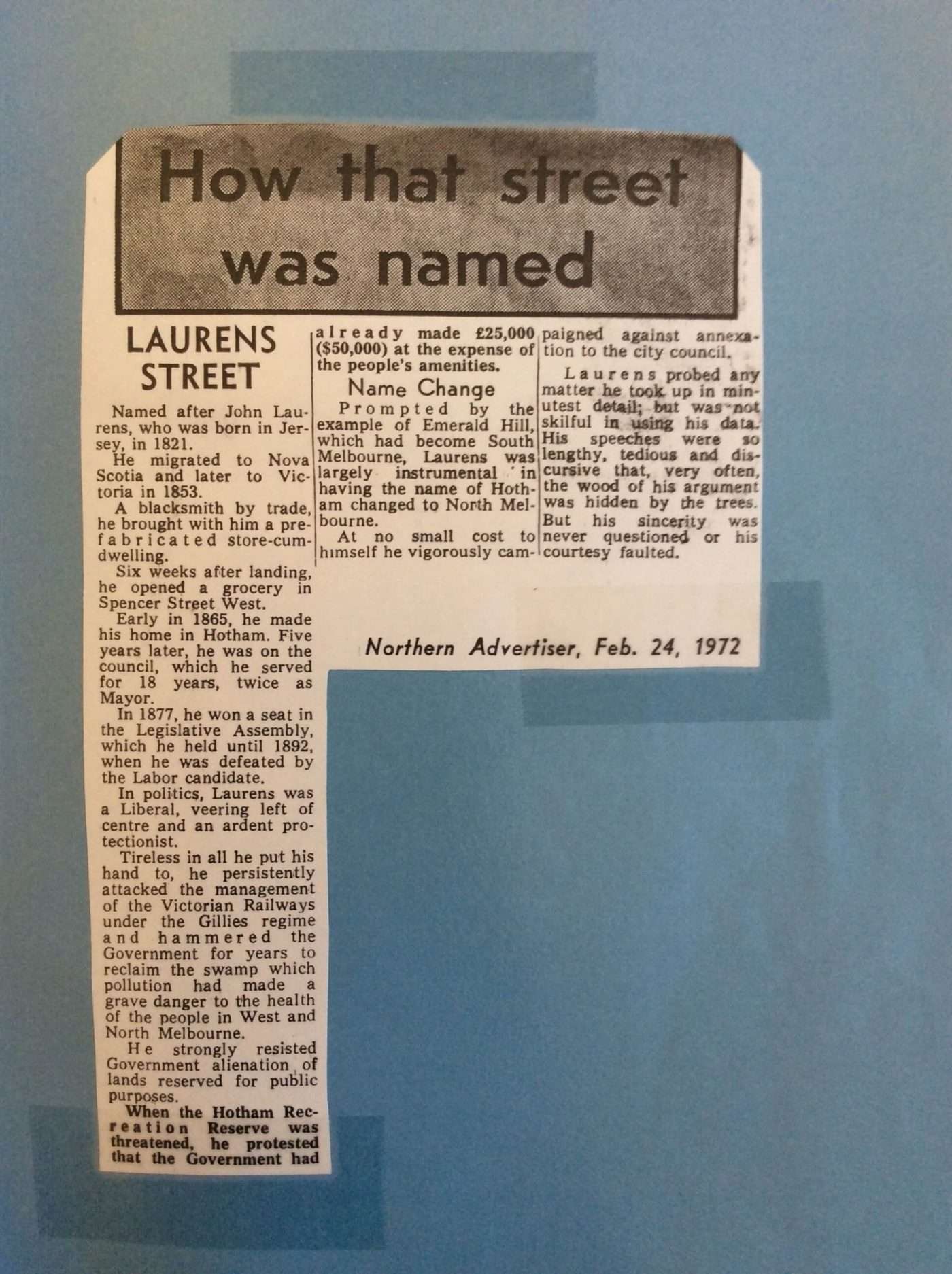
Named after John Laurens, who was born in Jersey, in 1821.(1) Source. (1) Northern Advertiser, Feb. 24, 1972. Blanchard collection, “What’s in a Name” at North Melbourne Library.
Howard Street
Named after Charles Howard who was the assistant commissary general of the new colony of Port Phillip. His job was to superintend the supply of rations. The street in North Melbourne so important to Church and commerce in his day, was fittingly named Howard Street.(1) Source. Northern Advertiser, 6/7/1972. Blanchard collection, “What’s in a Name” at North Melbourne Library.
Hotham Place
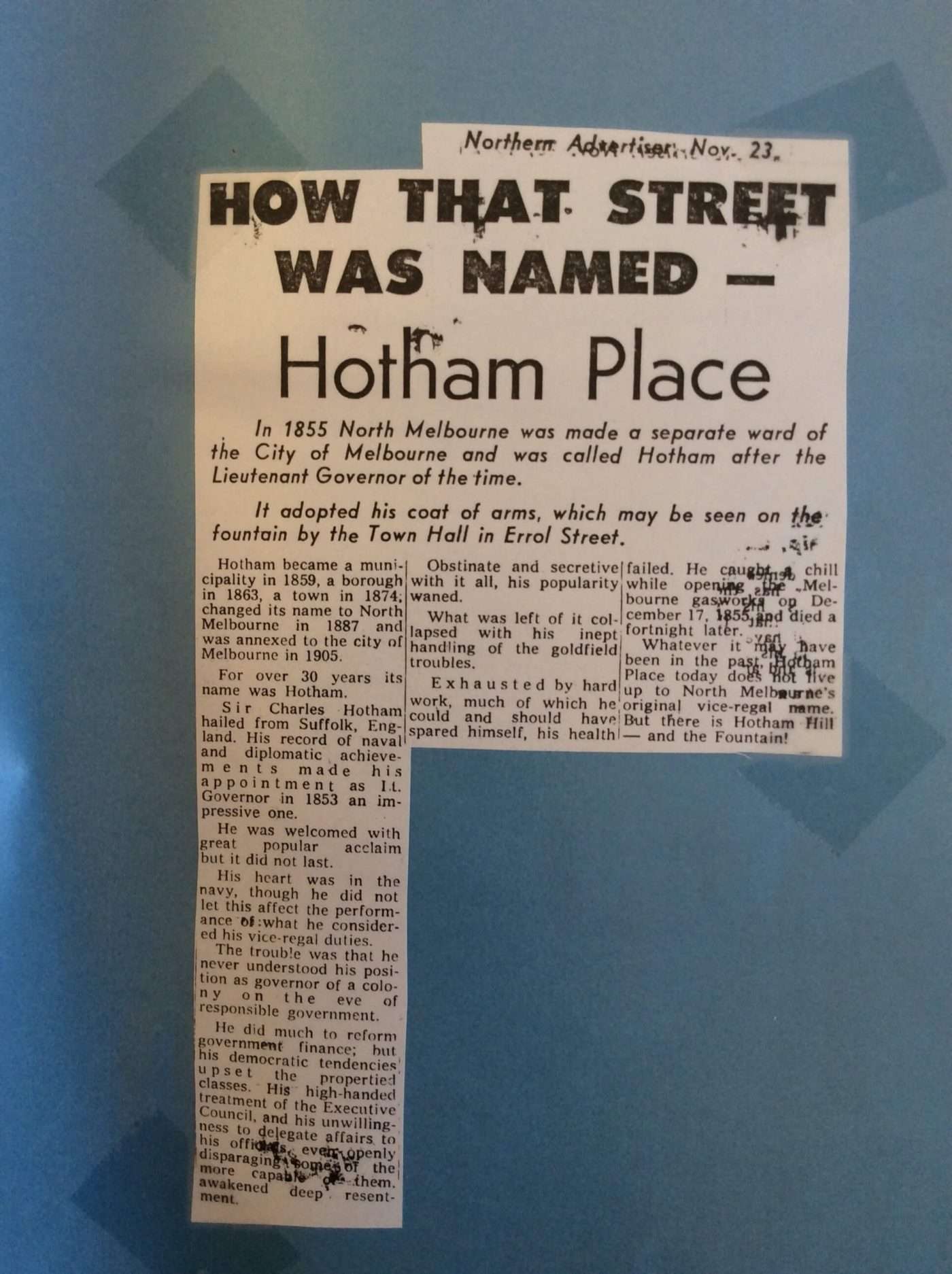
In 1855 North Melbourne was made a separate ward of the City of Melbourne and was called Hotham after the Lieutenant Governor of the time. It adopted his coat of arms, which may be seen on the fountain by Town Hall in Errol Street. Hotham became a municipality in 1859, a borough in 1863, a town in 1874, changed its name to North Melbourne in 1887 and was annexed to the city of Melbourne in 1905. For over 30 years its name was Hotham. Sir Charles Hotham hailed from Suffolk, England. His record of naval and diplomatic achievements made his appointment as Lt. Governor in 1853 an impressive one. He was welcomed with great popular acclaim but it did not last. Whatever it may have been in the past, Hotham Place today does not have to live up to North Melbourne’s original vice-regal name. But there is Hotham Hill — and the Fountain.(1) Source. Northern Advertiser, 23/11/1972. Blanchard collection, “What’s in a Name” at North Melbourne Library.
Harker Street
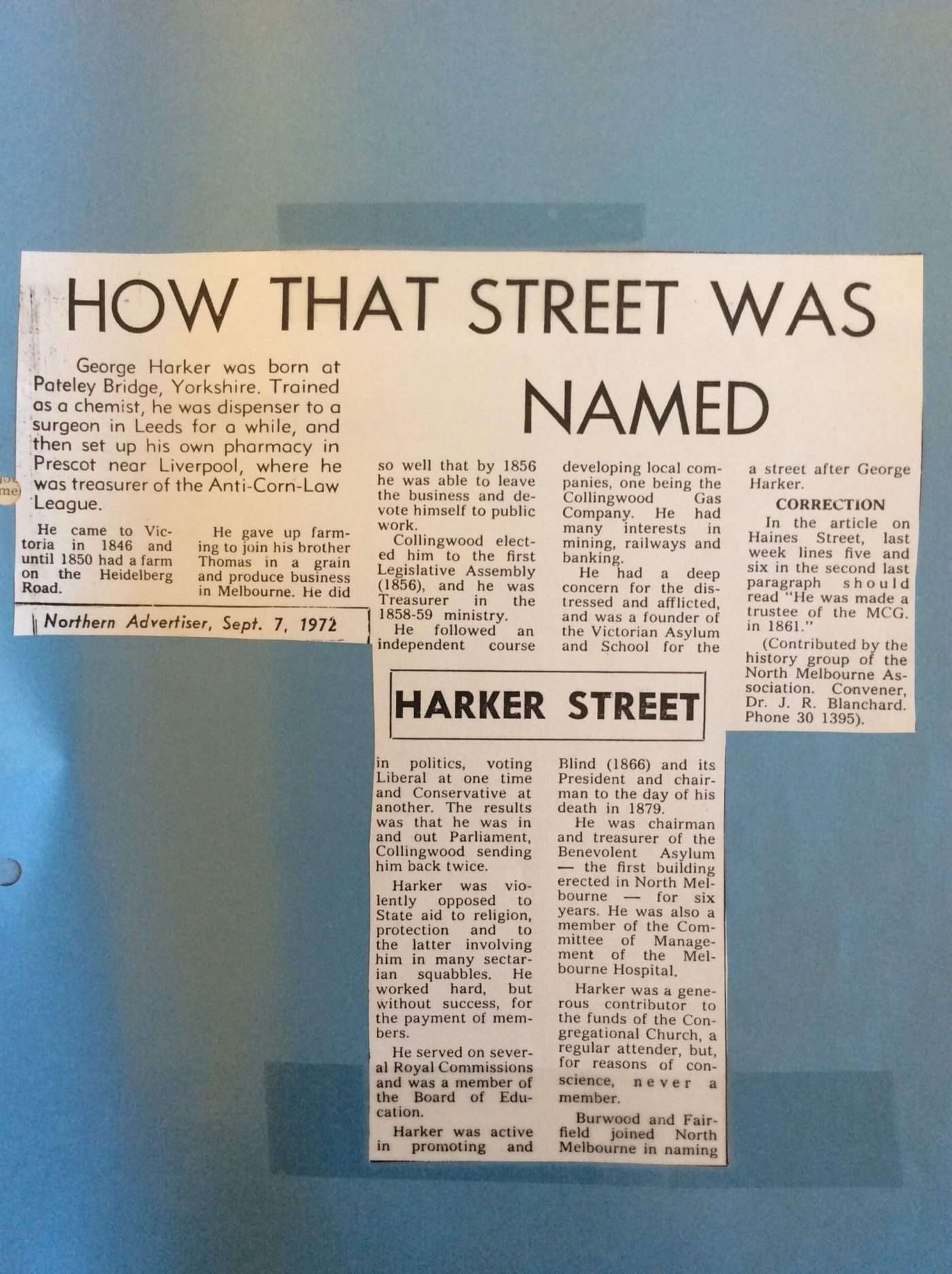
Named after George Harker who was born at Pateley Bridge, Yorkshire. He was chairman and treasurer of the Benevolent Asylum — the first building erected in North Melbourne — for six years. He was also a member of the Committee of Management of the Melbourne Hospital. Burwood and Fairfield joined North Melbourne in naming a street after George Harker.(1) Source. (1) Northern Advertiser, Sept. 7, 1972. Blanchard collection, “What’s in a Name” at North Melbourne Library.
Haines Street
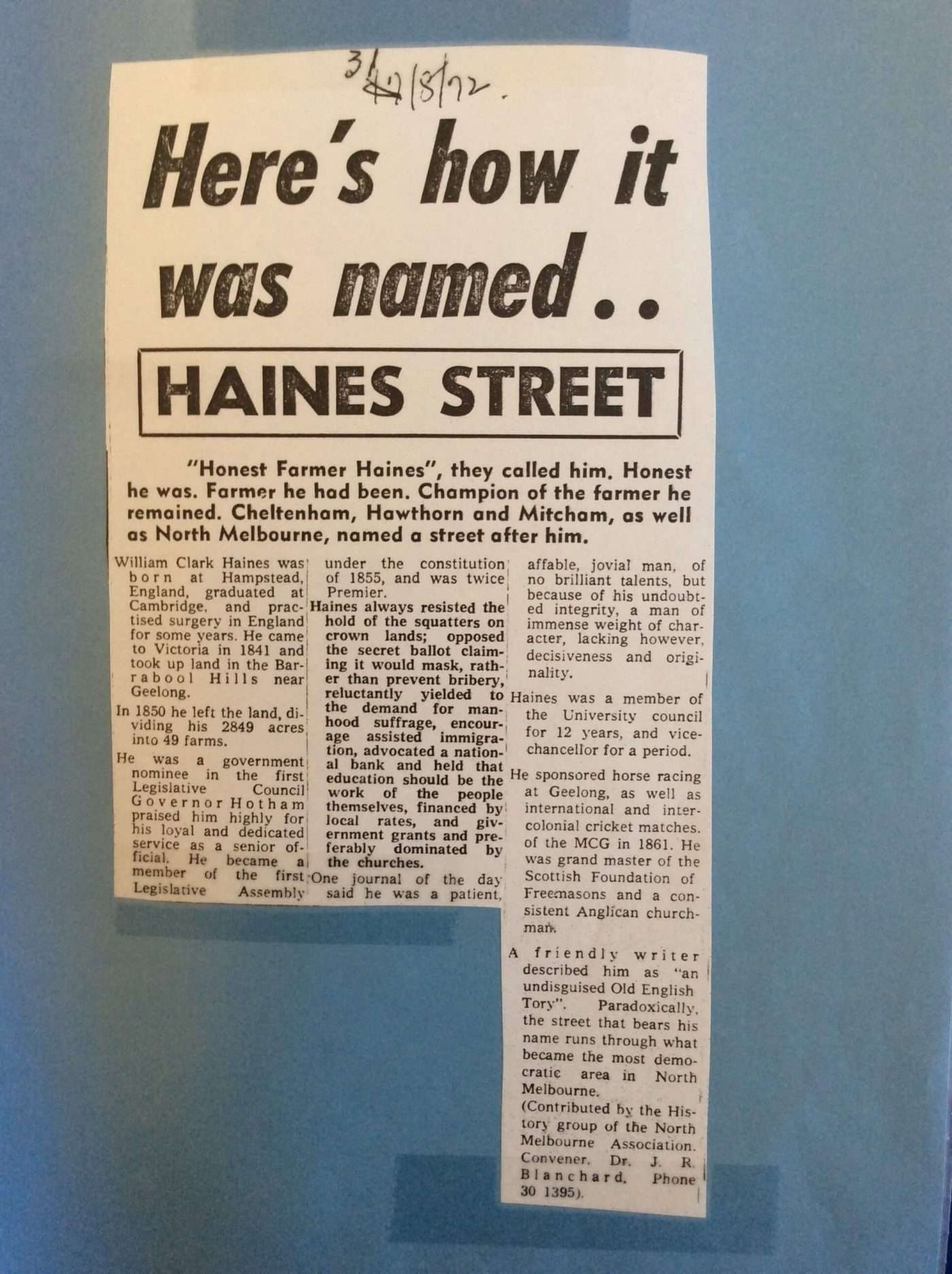
Named after “Honest Farmer Haines”, they called him. Honest he was. Farmer he had been. Champion of the farmer he remained. Cheltenham, Hawthorn and Mitcham, as well as North Melbourne, named a street after him. William Clark Haines was born at Hampstead, England, graduated at Cambridge, and practiced surgery in England for some years. He came to Victoria in 1841 and took up land in the Barrabool Hills near Geelong. A friendly writer described him as “an undisguised Old English Tory”. Paradoxically, the street that bears his name runs through what became the most democratic area in North Melbourne.(1) William Clark Haines was the first Chief secretary (Premier) of Victoria. (2) Source. (1) Northern Advertiser, 31/8/1972. Blanchard collection, “What’s in a Name” at North Melbourne Library. (2) “Parliament of Victoria 150 Years in the making 1856-2006” info@parliament.vic.gov.au
Gracie Street
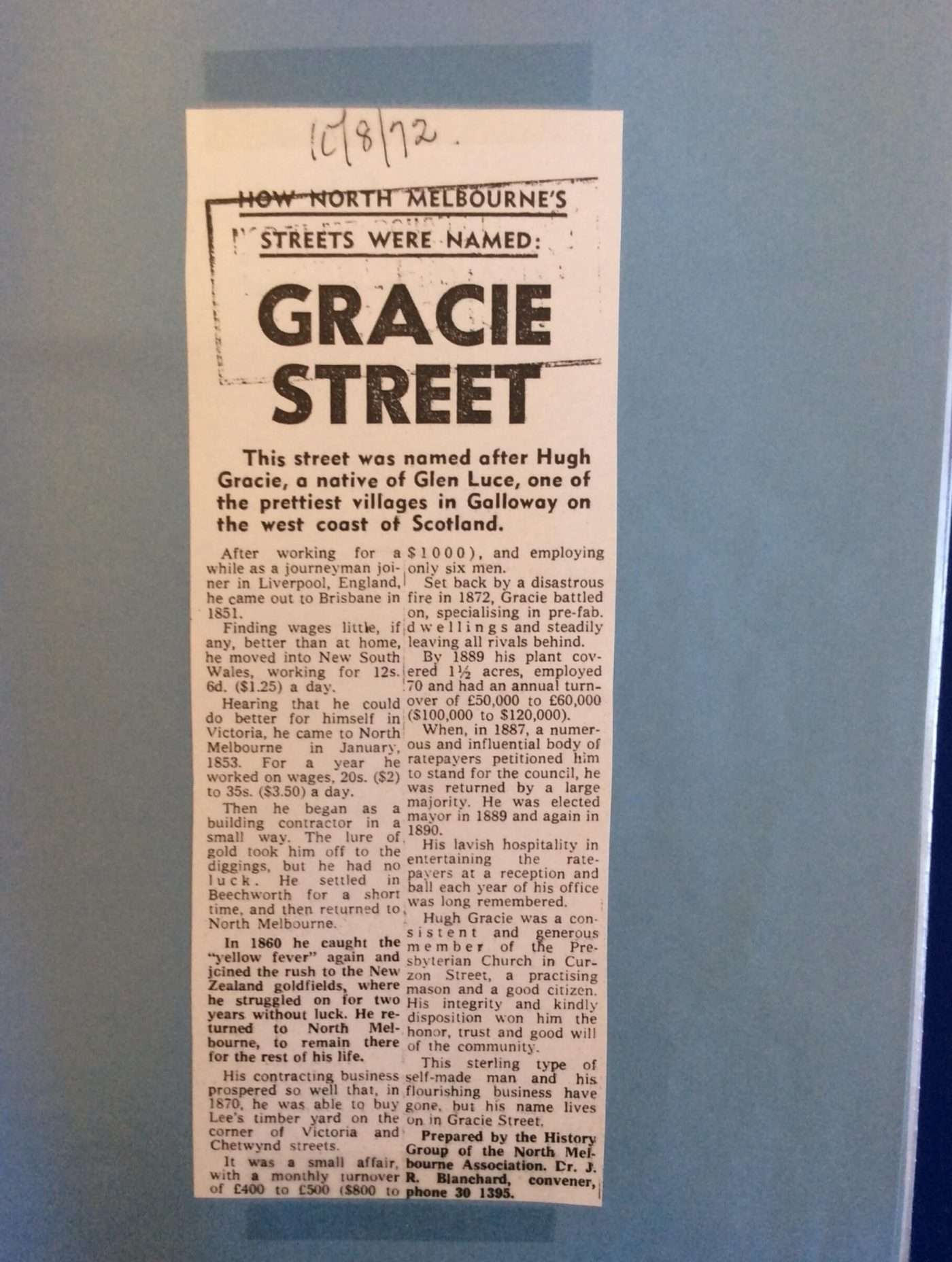
This street was named after Hugh Gracie, a native of Glen Luce, one of the prettiest villages in Galloway on the west coast of Scotland. In 1887, a numerous and influential body of ratepayers petitioned him to stand for the council, he was returned by a large majority. He was elected Lord Mayor for North Melbourne in 1889 and again in 1890. His lavish hospitality in entertaining the rate-payers at a reception and ball each year of his office was long remembered. Hugh Gracie was a consistent and generous member of the Presbyterian Church in Curzon Street North Melbourne, a practicing mason and a good citizen. His integrity and kindly disposition won him the honor, trust and good will of the community. This sterling type of self-made man and his flourishing business have gone, but his name lives on in Gracie Street.(1) Source. (1) Northern Advertiser 10/8/1972. Blanchard collection, “What’s in a Name” at North Melbourne Library.
Glass Street
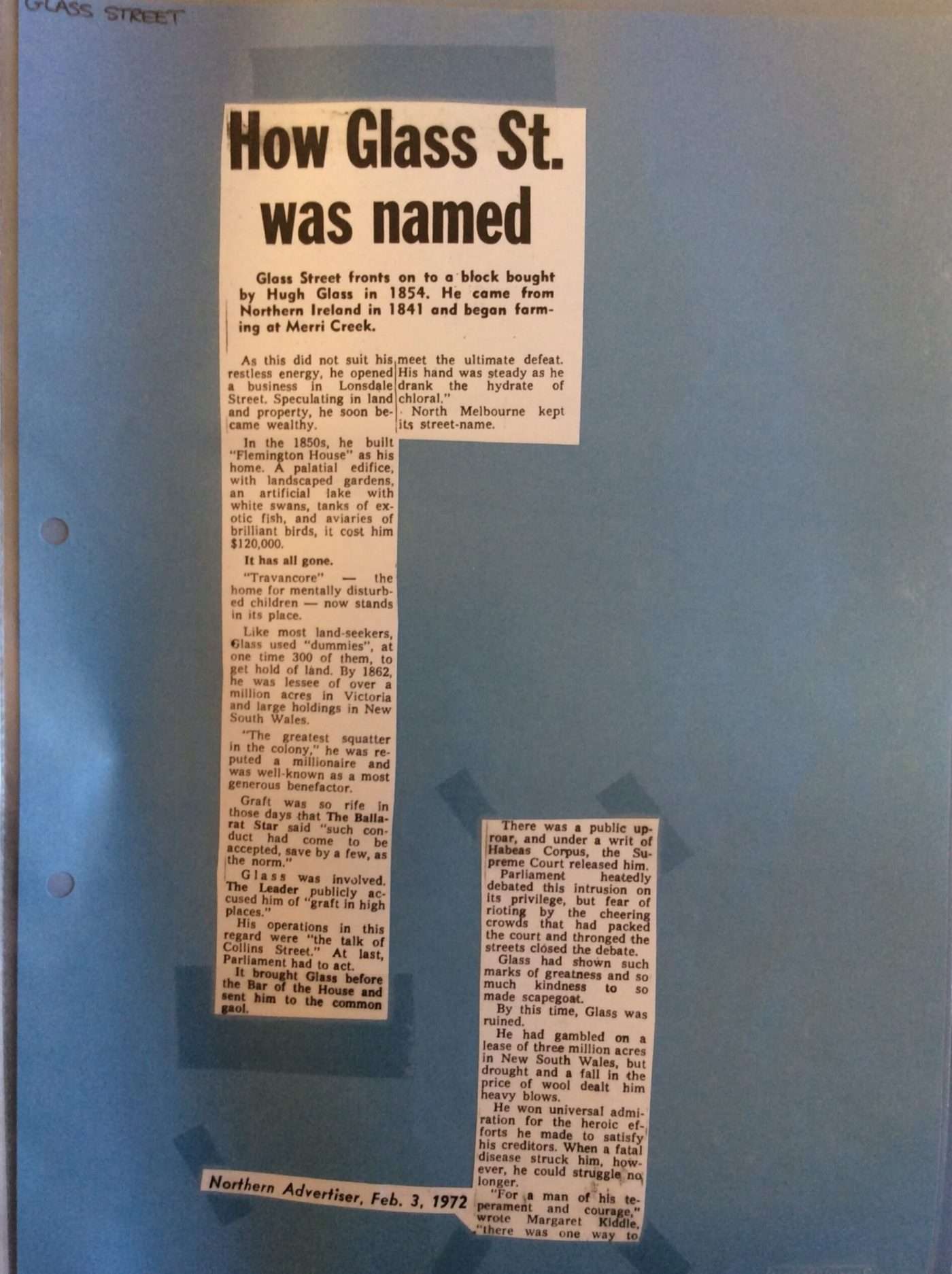
Glass Street North Melbourne fronts on to a block bought by Hugh Glass in 1854. He came from Northern Ireland in 1841 and began farming at Merri Creek.(1) Source. (1) Northern Advertiser Feb. 3, 1972. Blanchard collection, “What’s in a Name” at North Melbourne Library.