Flemington Road

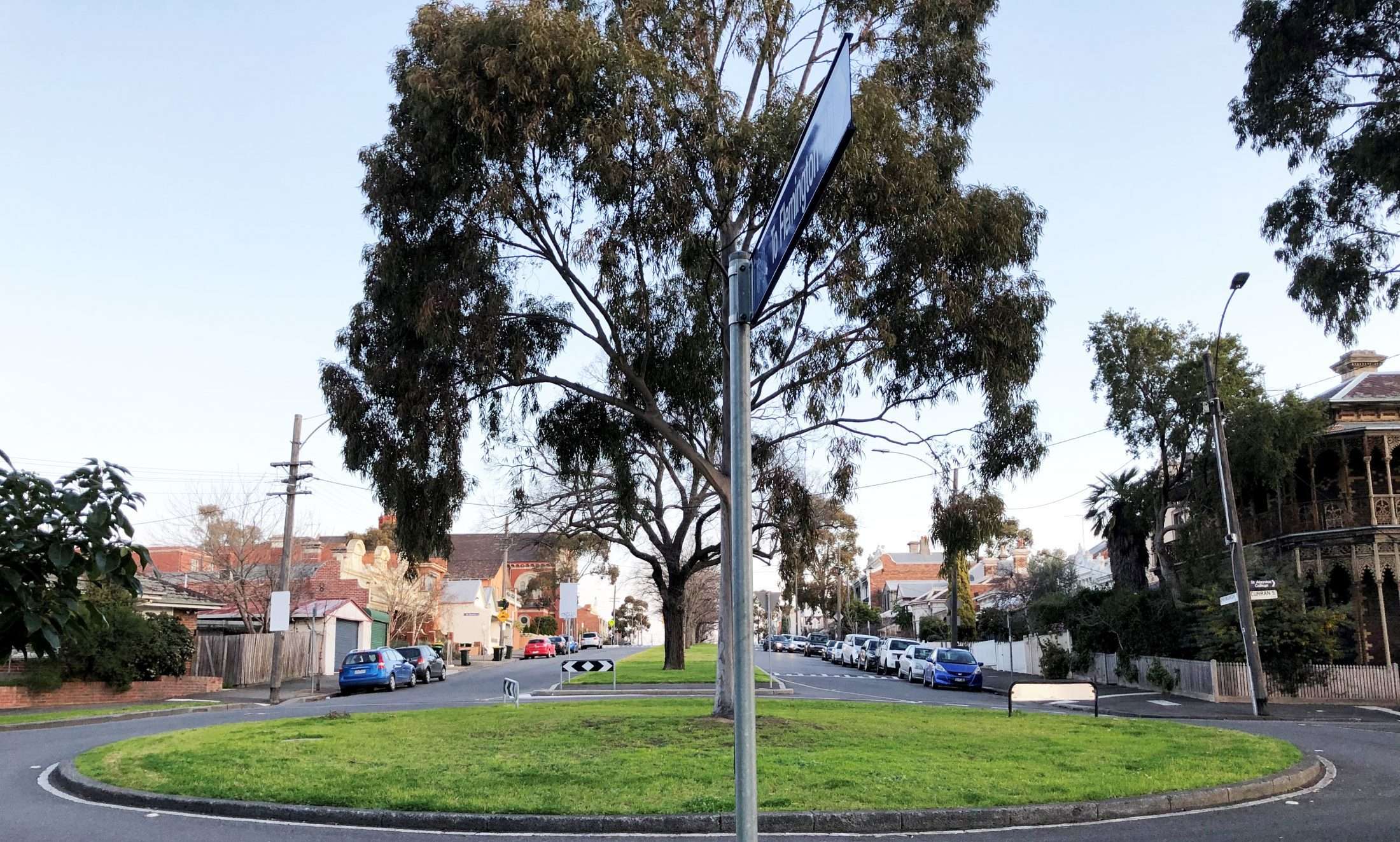
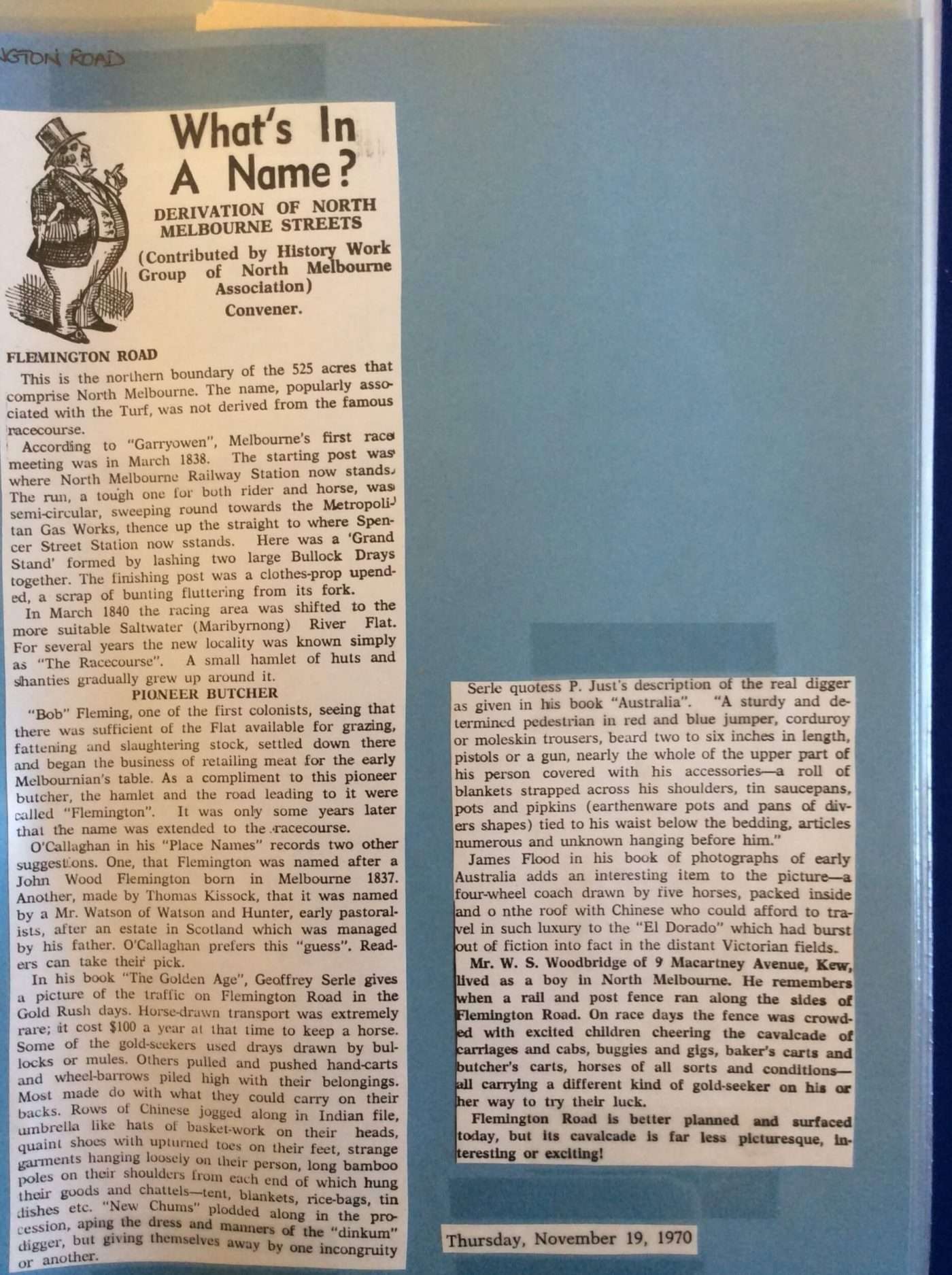
This is the northern boundary of the 525 acres that comprise North Melbourne. The name, popularly associated with the Turf, was not derived from the famous racecourse. According to “Garryowen”, Melbourne’s first race meeting was in March 1838. The starting post was where North Melbourne Railway Station now stands. The run, a tough one for both rider and horse, was semi-circular, sweeping round towards the Metropolitan Gas Works, thence up the straight to where Spencer Street Station now stands. Here was a ‘Grand Stand’ formed by lashing two large Bullock Drays together. The finishing post was a clothes-prop upend-ed, a scrap of bunting fluttering from its fork. In March 1840 the racing area was shifted to the more suitable Saltwater (Maribyrnong) River Flat. For several years the new locality was known simply as “The Racecourse”. A small hamlet of huts and shanties gradually grew up around it. PIONEER BUTCHER  “Bob” Fleming, one of the first colonists, seeing that there was sufficient of the Flat available for grazing, fattening and slaughtering stock, settled down there and began the business of retailing meat for the early Melbournian’s table. As a compliment to this pioneer butcher, the hamlet and the road leading to …
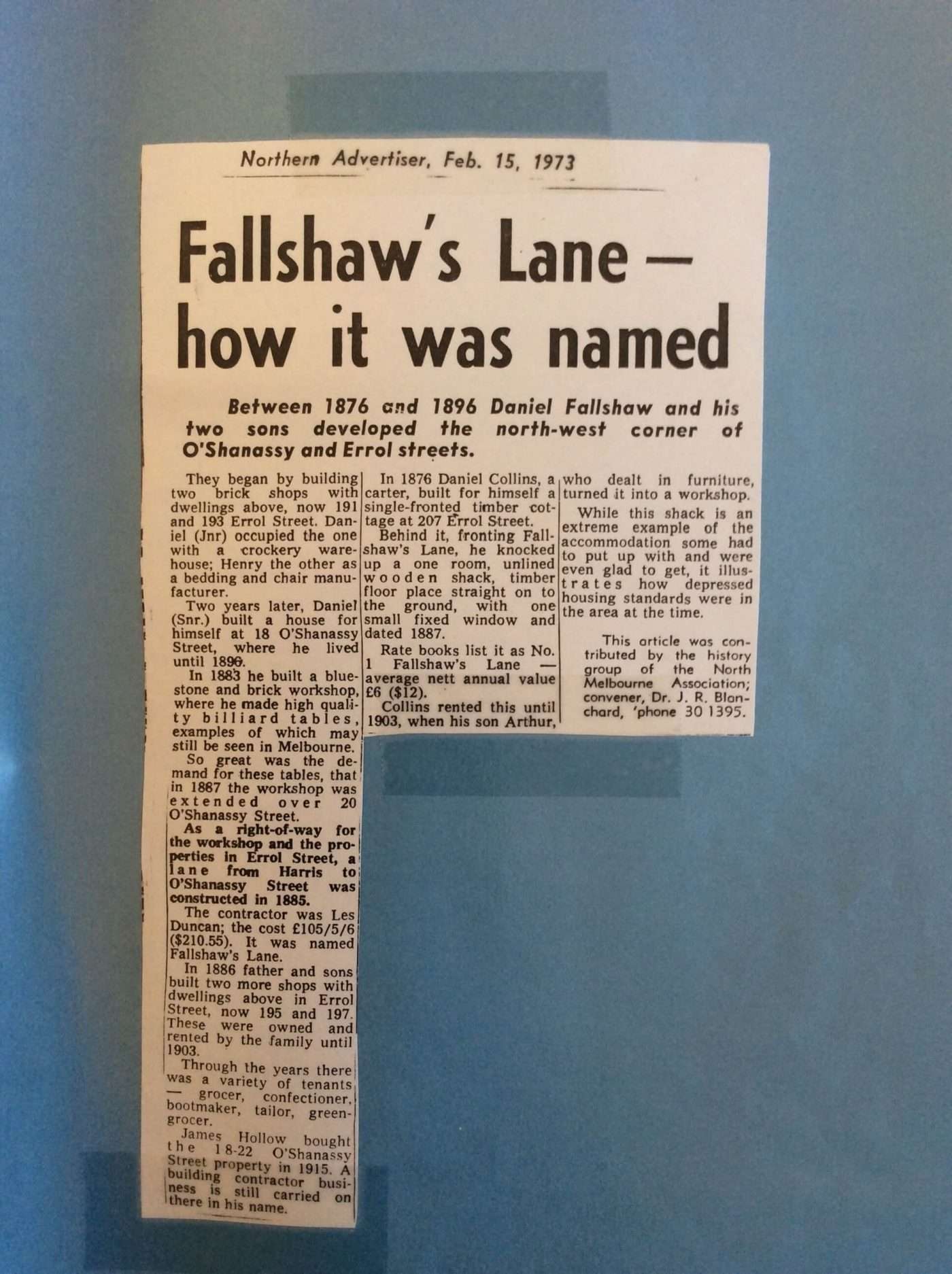
Fallshaws Lane

Named after Daniel Fallshaw. He and his two sons developed the north-west corner of O’Shanassy and Errol streets in North Melbourne. Source (1) Northern Advertiser, Feb. 15, 1973. Blanchard collection, “What’s in a Name” at North Melbourne Library.

Erskine Street

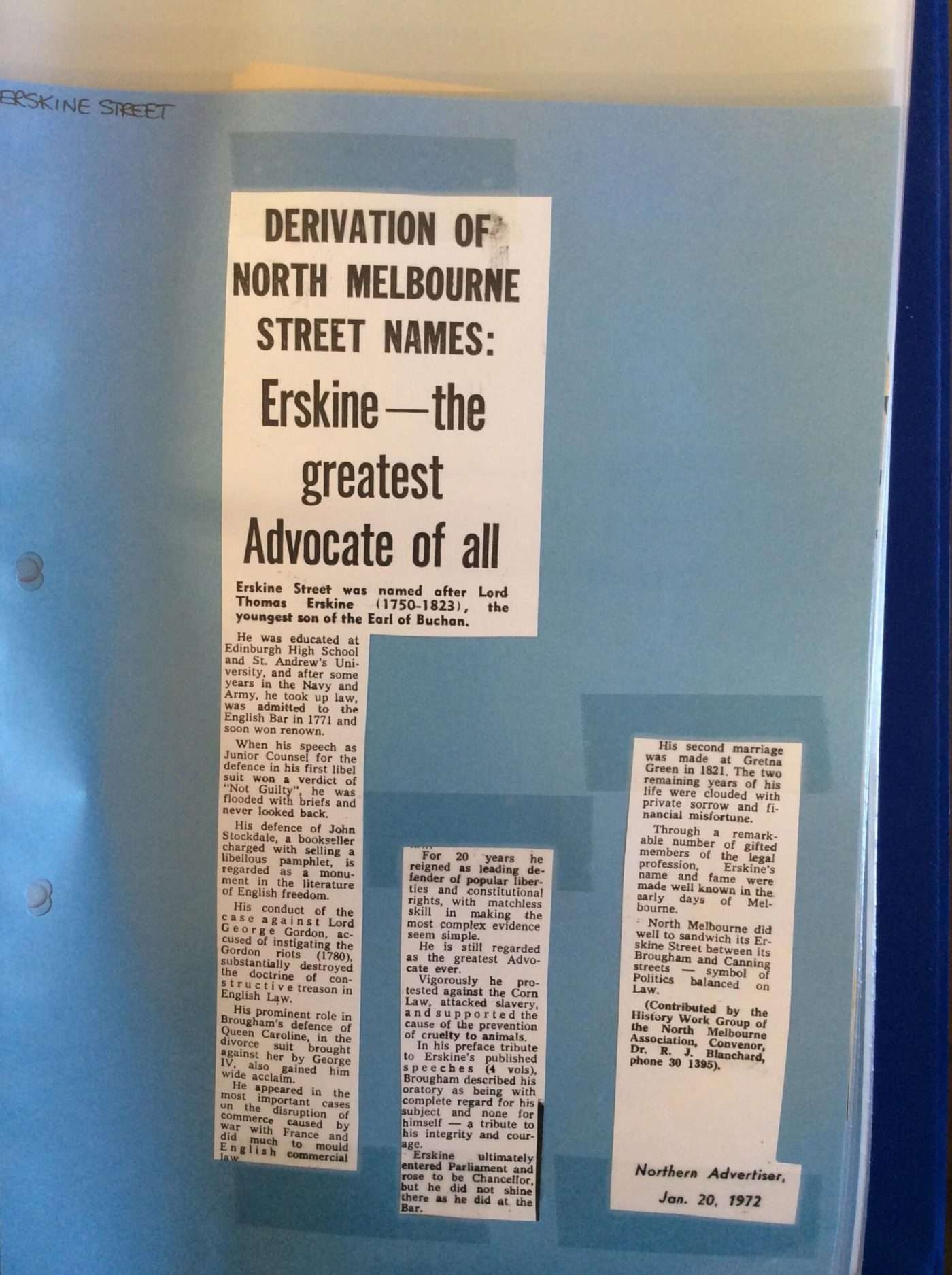
Erskine – the greatest Advocate of all. Erskine Street was named after Thomas Erskine (1750-1823), youngest son of the Earl of Buchan. Vigorously he protested against the Corn Law, attacked slavery, and supported the cause of the prevention of cruelty to animals. Through a remarkable number of gifted members of the legal profession, Erskine’s name and fame were made well known in the early days of Melbourne. North Melbourne did well to sandwich its Erskine Street between its Brougham and Canning streets — symbol of Politics balanced on Law.(1) Source. (1) Northern Advertiser, Jan. 20, 1972. Blanchard collection, “What’s in a Name” at North Melbourne Library.

Elm Street

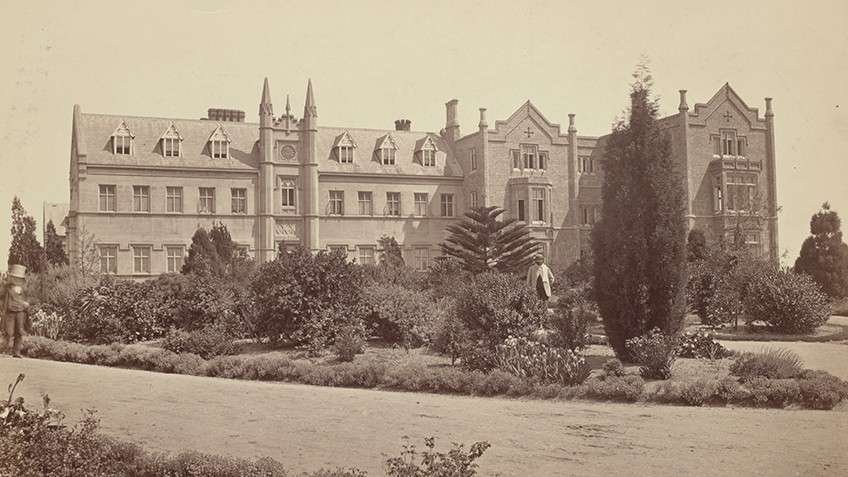
Many Melbourne suburbs have streets named after trees. To mention a few — Doveton has at least 14, Heidelberg and Blackburn 10, Bayswater, Thomastown and Caulfield 9. North Melbourne has one only. In the early days, visitors from Britain often remarked on how features of the “home” landscape were being introduced into the Australian scene. English trees, particularly oaks and elms, were planted in parks, the grounds of institutions and private gardens. The North Melbourne Benevolent Asylum, whose 10 acres straddled Victoria Street at its “T” junction with Curzon Street, was a good example of this. In July, 1849, the Argus complained that cases of destitution were committed to the city watch-house because there was no-where else for them to go. Three months later, the Victorian Benevolent Society reported that too many hospital beds were being occupied by cases more suitable for a different kind of institution, because of the “incurable nature of their diseases and the completely shattered state of their constitution”. To meet the obvious need, the Government granted the land and £1000 ($2000) for such an institution. So the Benevolent Asylum was opened on November 27, 1851, with 32 inmates. At its jubilee in 1900 there were …

Dryburgh Street

    “Burgh” is a shortened form of “borough”; obsolete in ordinary English usage since the 17th century, but retained in Scotland for a town possessing a charter. It is pronounced “borough’ not “berg”. This street is a sign of Scottish nostalgia. It was named after Dryburgh Abbey, which stands in a setting of sheer beauty on a horse shoe of land encircled by the river Tweed. It looks out on the triple peaks of the Eildon Hills (1300 feet), where sacrifices were once made to the sun-god, and, later, the Romans built a great military camp. It took 12 years to build. Meantime, the builders—English and Scottish monks— lived in wooden huts on the river-bank, feeding well on the excellent salmon the river provided. The Abbey was completed on 13th December, 1152. Years of, suffering awaited it. In 1322 the retreating army of Edward II set the place ablaze. Helped by liberal gifts from Robert the Bruce, the monks restored it. In 1385, Richard II’s men made a bonfire of it again. Once more the monks restored it. At last in 1545, the English army under Hertford left it a smoking ruin. Centuries of neglect completed the destruction. Nov …

De Feu Street

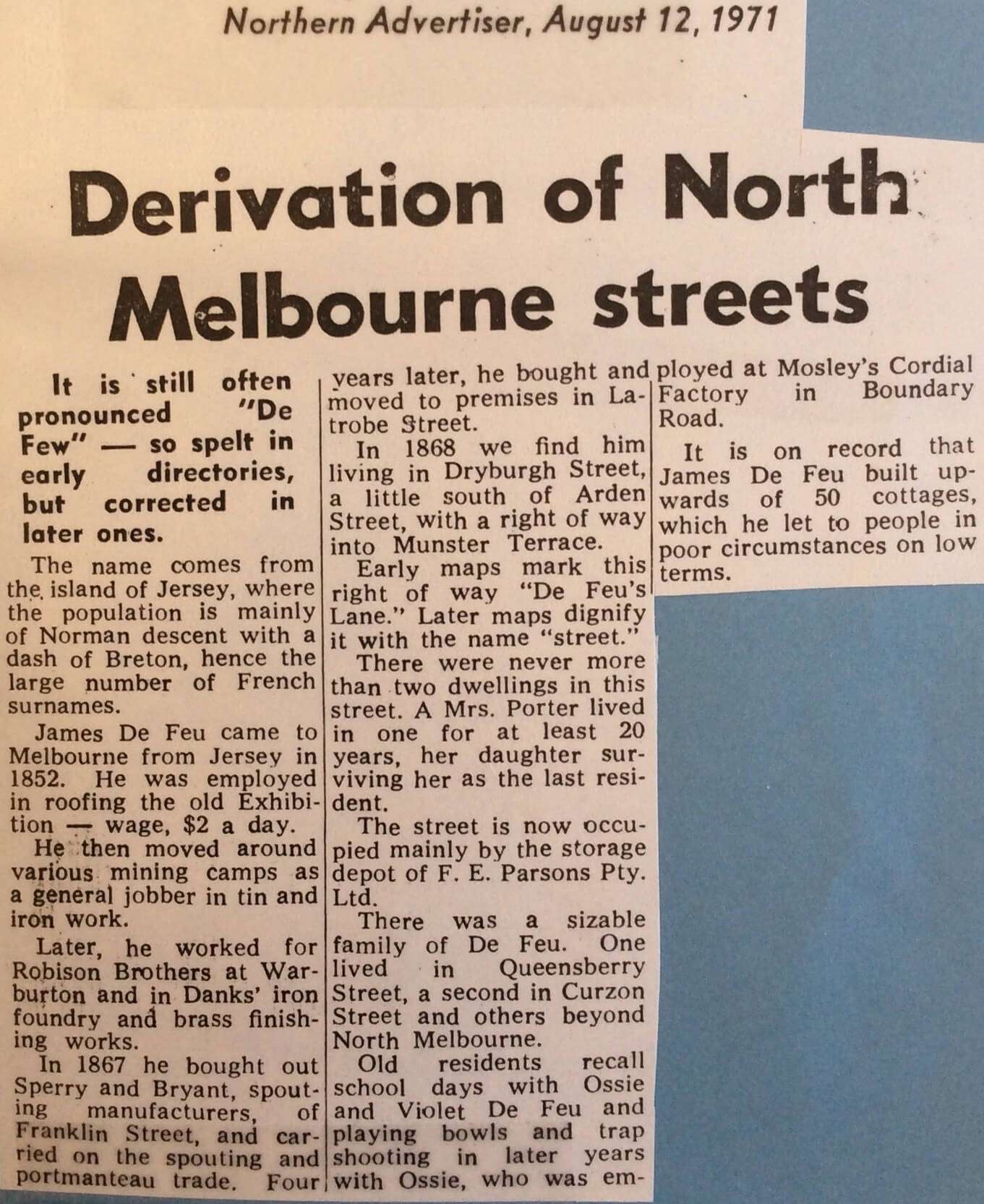
It is still often pronounced “De Few” so spelt in early directories, but corrected in later ones. The name comes from the, island of Jersey, where the population is mainly of Norman descent with a dash of Breton, hence the large number of French surnames. James De Feu came to Melbourne from Jersey in 1852. He was employed in roofing the old Exhibition, wage, $2 a day. He then moved around various mining camps as a general jobber in tin and iron work. Later, he worked for Robison Brothers at Warburton and in Danks’ iron foundry and brass finishing works. In 1867 he bought out Sperry and Bryant, spouting manufacturers, of Franklin Street, and carried on the spouting and portmanteau trade. Four years later, he bought and moved to premises in Latrobe Street. In 1868 we find him living in Dryburgh Street, a little south of Arden Street, with a right of way into Munster Terrace. Early maps mark this right of way “De Feu’s Lane.” Later maps dignify it with the name “street.” There were never more than two dwellings in this street. A Mrs. Porter lived in one for at least 20 years, her daughter surviving her as the last resident. The …

Courtney Street

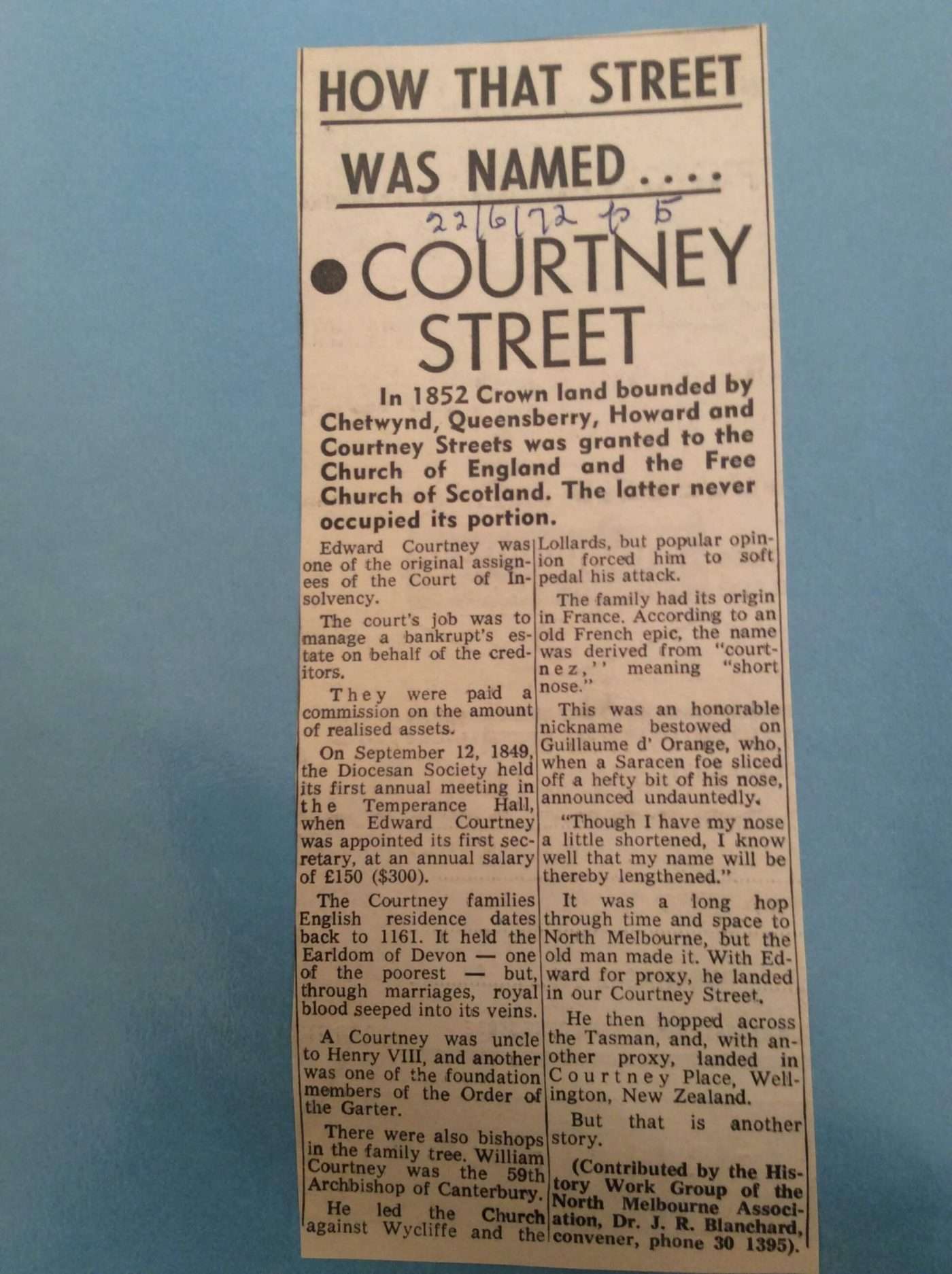
In 1852 Crown land bounded by Chetwynd, Queensberry, Howard and Courtney Streets was granted to the Church of England and the Free Church of Scotland. The latter never occupied its portion. Edward Courtney was one of the original assignees of the Court of Insolvency. The court’s job was to manage a bankrupt’s estate on behalf of the creditors. They were paid a commission on the amount of realised assets. On September 12, 1849, the Diocesan Society held its first annual meeting in the Temperance Hall, when Edward Courtney was appointed its first secretary, at an annual salary of £150 ($300). The Courtney families English residence dates back to 1161. It held the Earldom of Devon –one of the poorest — but, through marriages, royal blood seeped into its veins. A Courtney was uncle to Henry VIII, and another was one of the foundation members of the Order of the Garter. There were also bishops in the family tree. William Courtney was the 59th Archbishop of Canterbury. He led the Church against Wycliffe and the Lollards, but popular opinion forced him to soft pedal his attack. The family had its origin in France. According to an old French epic, the name …

Costello Lane

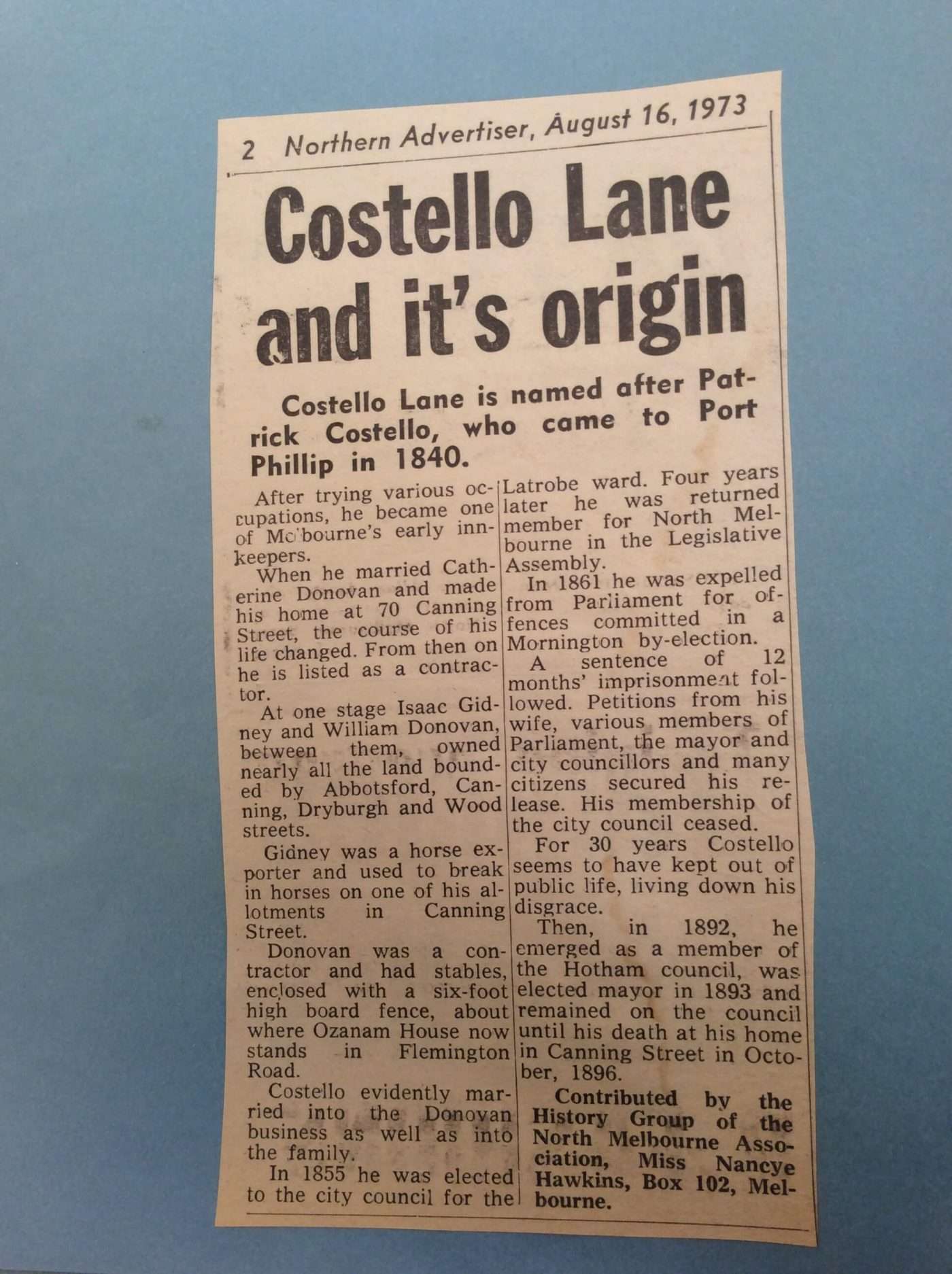
Costello Lane in North Melbourne is named after Patrick Costello, who came to Port Phillip in 1840. In 1855 he was elected to the city council for the Latrobe ward. Four years later he was returned member for North Melbourne in the Legislative Assembly. 1892, he emerged as a member of the Hotham council, was elected mayor in 1893 and remained on the council until his death at his home in Canning Street in October, 1896.(1) Source (1) Northern Advertiser, August 16,1973. by Nancye Hawkins from the Blanchard collection, “What’s in a Name” at North Melbourne Library. Recent research indicates there was no connection between Catherine Donovan, wife of Patrick Costello of Canning Street, and William Donovan of Wood Street, North Melbourne.

Chetwynd Street

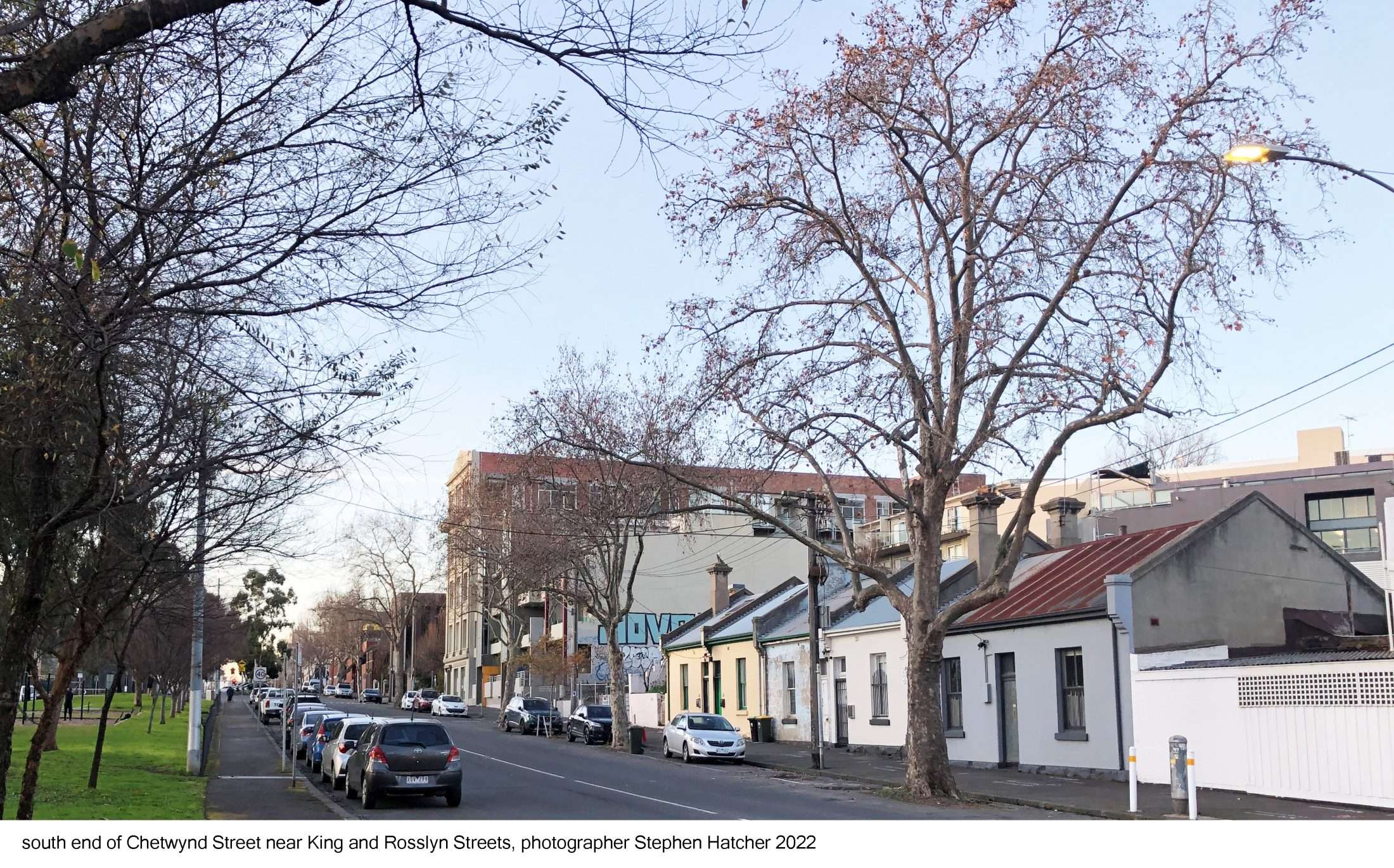
  Named after Granville William Chetwynd Stapylton. Stapylton came to Australia in 1828 as assistant surveyor in New South Wales. While engaged in surveying the coast south of Brisbane, aborigines attacked his camp, and he was killed on the 31st May 1840. His body was brought to Brisbane. Stapylton has left behind him the name of his Paternal grandfather in our Chetwrnd Street, North Melbourne.(1) Source. (1) Northern Advertiser, 18/3/1971. Blanchard collection, “What’s in a Name” at North Melbourne Library.

Chapman Street

Named after Henry Samuel Chapman (1803-1881). (1) Source. (1) Northern Advertiser 13/8/1970. Blanchard collection, “What’s in a Name” at North Melbourne Library and from the “Australian Dictionary” of Biography.