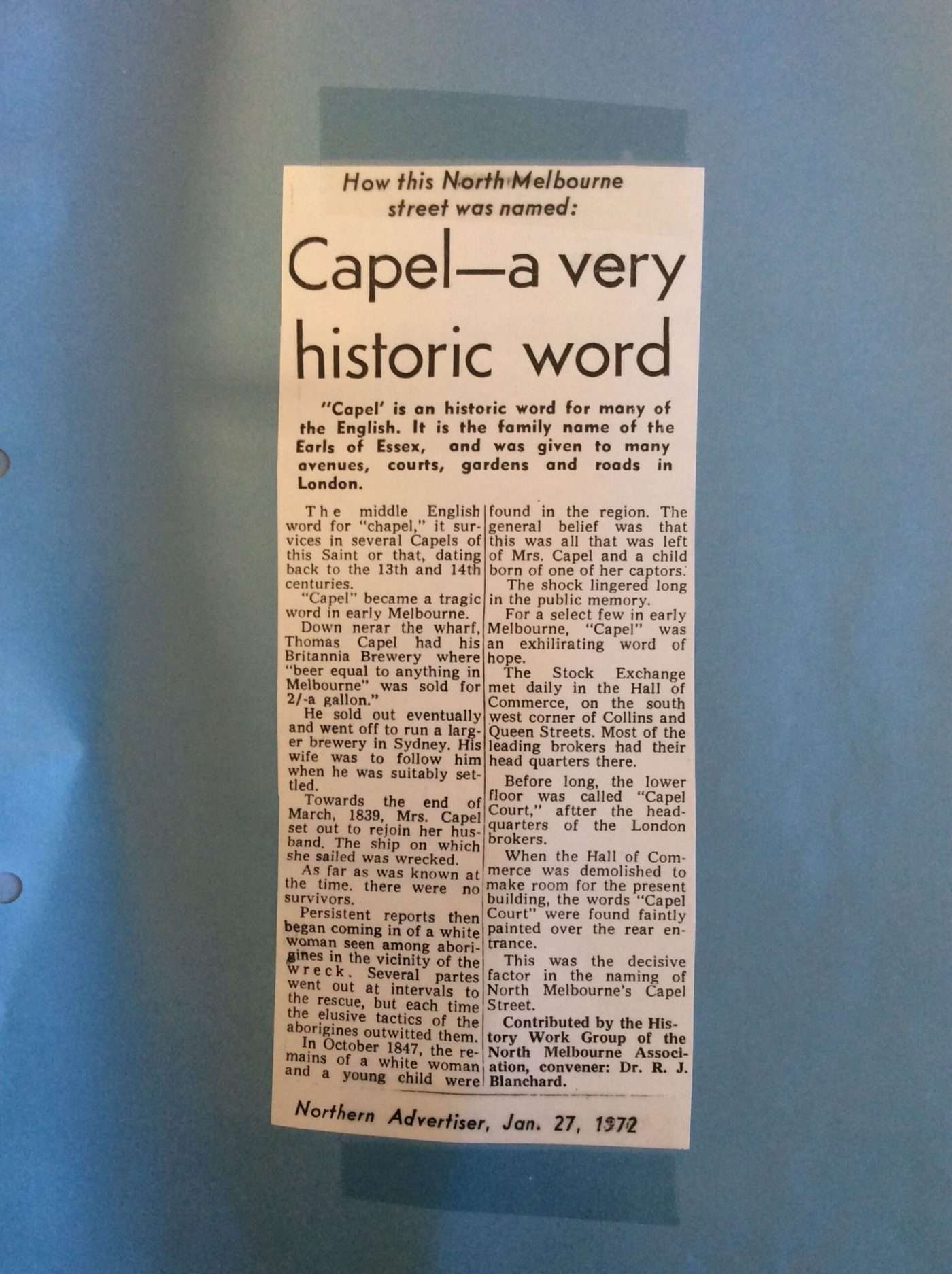
Capel Street begins in West Melbourne where it intersects with William Street before it heads north and ends when it runs into Bedford Street, North Melbourne. It is thought the street was named after Thomas Bladen Capel, a Londoner born in 1776, the son of William Capel and Harriet Bladen. He had a distinguished naval career, fighting for his king in the 1805 Battle of Trafalgar against the French and Spanish during the Napoleonic Wars. Capel Street’s earliest residents began settling in around 1854, six years before the street was officially documented in the government gazette. The area’s first significant landmark, known then as the cattle yard, had begun even earlier, in 1842, on the corner of Elizabeth and Victoria Streets. The street was first mentioned in the Argus in August, 1854, in an advertisement placed by local resident George Holt Miller, a master wheelwright and farrier. He announced his interest in selling two superior Scottish-built Whitechapel two-wheeled spring-carts, then all the rage in London. Miller has his own intriguing story. After arriving in Port Phillip in 1833 as a six-year-old, later in adulthood, he married Sarah Lambert in 1851. After she died during child birth, George married Helen McPherson …
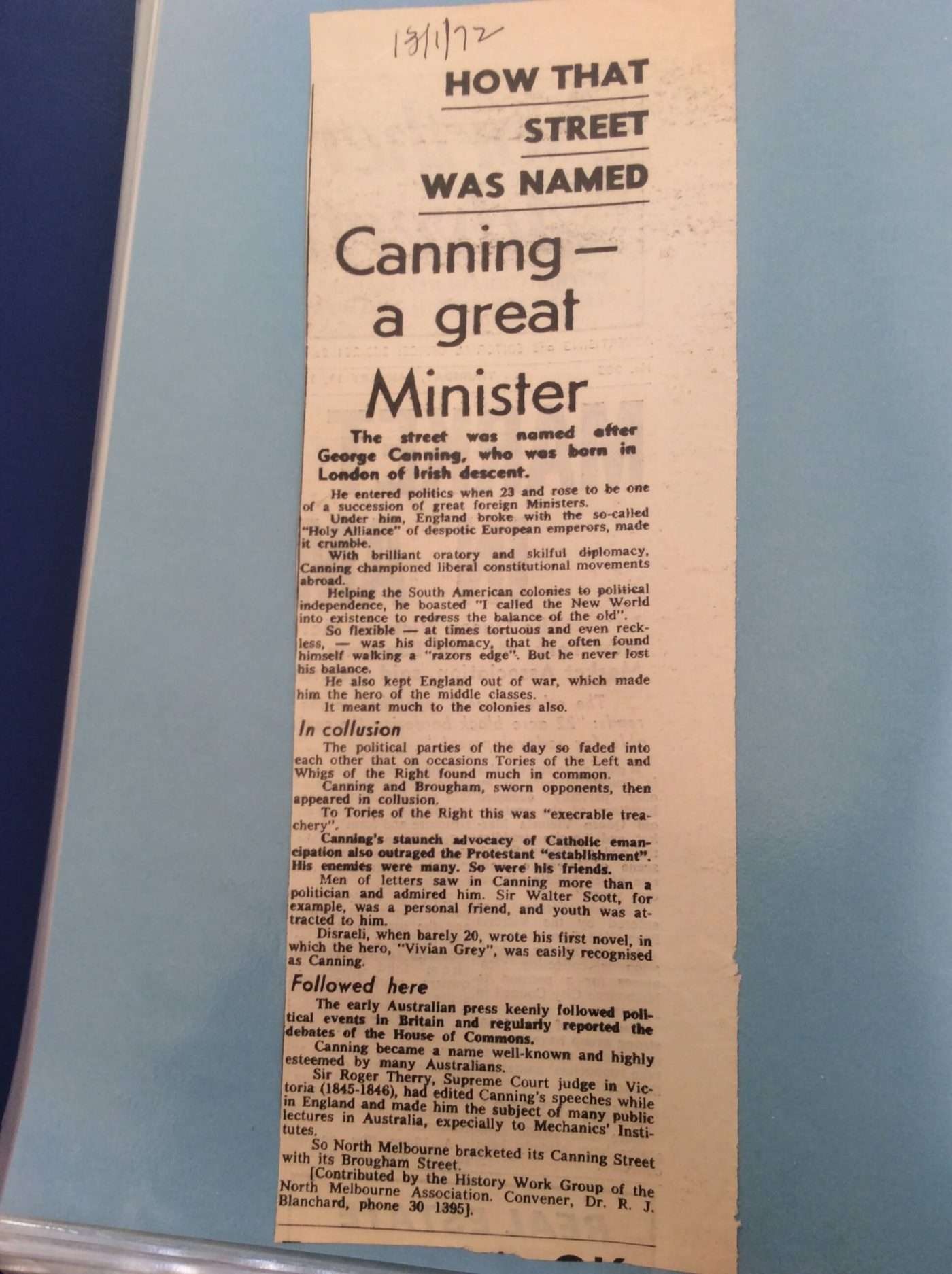
Canning Street
The street was named after George Canning, who was born in London of Irish descent. Followed here The early Australian press keenly followed political events in Britain at the time and regularly reported the debates of the House of Commons. Canning became a name well-known and highly esteemed by many Australians. Sir Roger Therry’ Supreme Court judge in Victoria (1845-1846), had edited Canning’s speeches while in England and made him the subject of many public lectures in Australia, especially to Mechanics’ Institutes. So North Melbourne bracketed its Canning Street with its Brougham Street.(1) Source. Northern Advertiser 13/1/1972. Blanchard collection, “What’s in a Name” at North Melbourne Library.
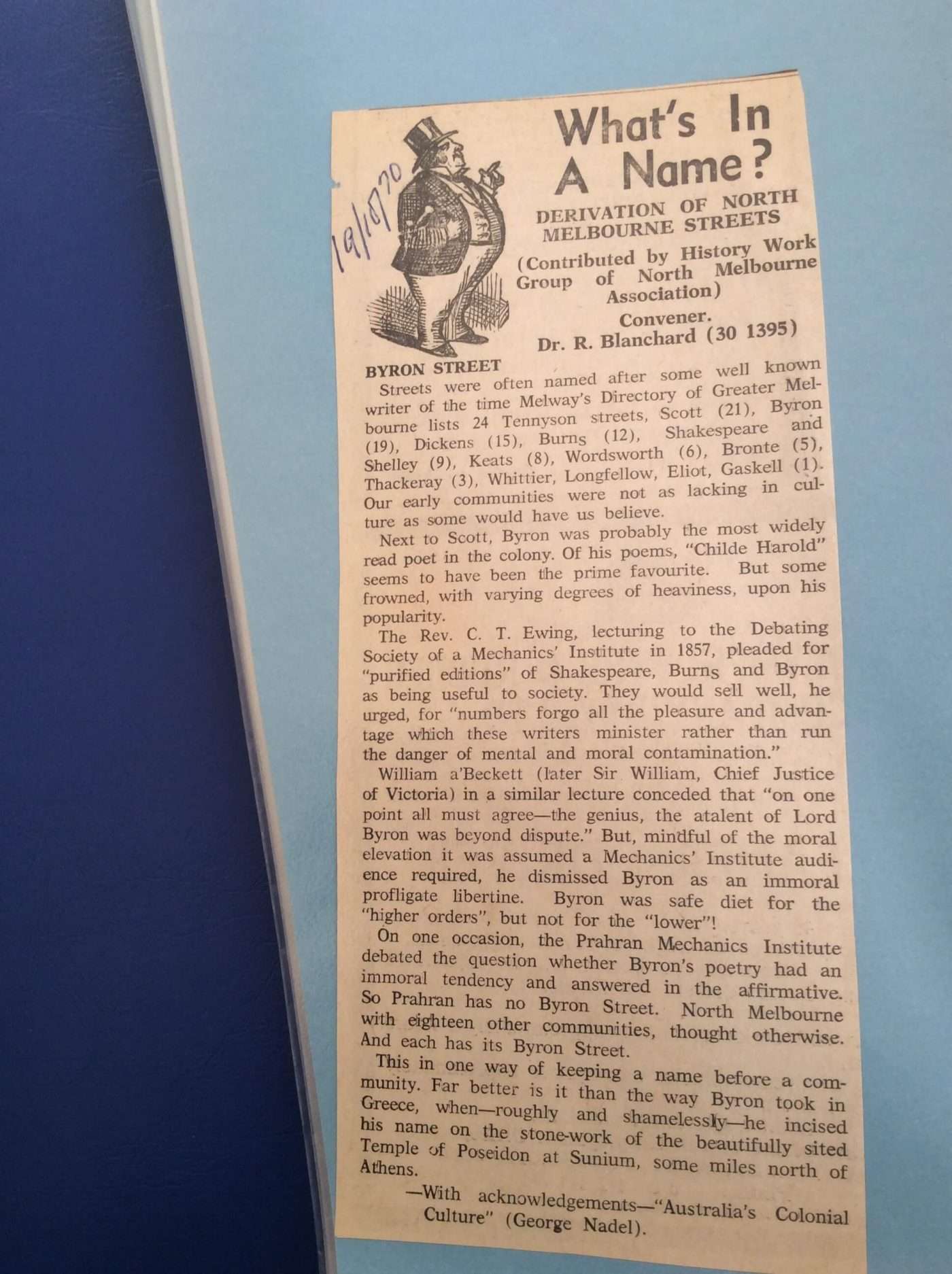
Byron Street
Streets were often named after some well known writer of the time Melway’s Directory of Greater Melbourne lists 24 Tennyson streets, Scott (21), Byron (19), Dickens (15), Burns (12), Shakespeare and Shelley (9), Keats (8), Wordsworth (6), Bronte (5), Thackeray (3), Whittier, Longfellow, Eliot, Gaskell (1). Our early communities were lacking in culture as some would have us believe. Next to Scott, Byron was probably the most widely read poet in the colony. Of his poems, “Childe Harold” seems to have been the prime favorite. But some frowned, with varying degrees of heaviness, upon his popularity. The Rev. C. T. Ewing, lecturing to the Debating Society of a Mechanics’ Institute in 1857, pleaded for “purified editions” of Shakespeare, Burns and Byron as being useful to society. They would sell well, he urged, for “numbers forgo all the pleasure and advantage which these writers minister rather than run the danger of mental and moral contamination.” William a’Beckett (later Sir William, Chief Justice of Victoria) in a similar lecture conceded that “on one point all must agree—the genius, the a talent of Lord Byron was beyond dispute.” But, mindful of the moral elevation it was assumed a Mechanics’ Institute audience required, he …
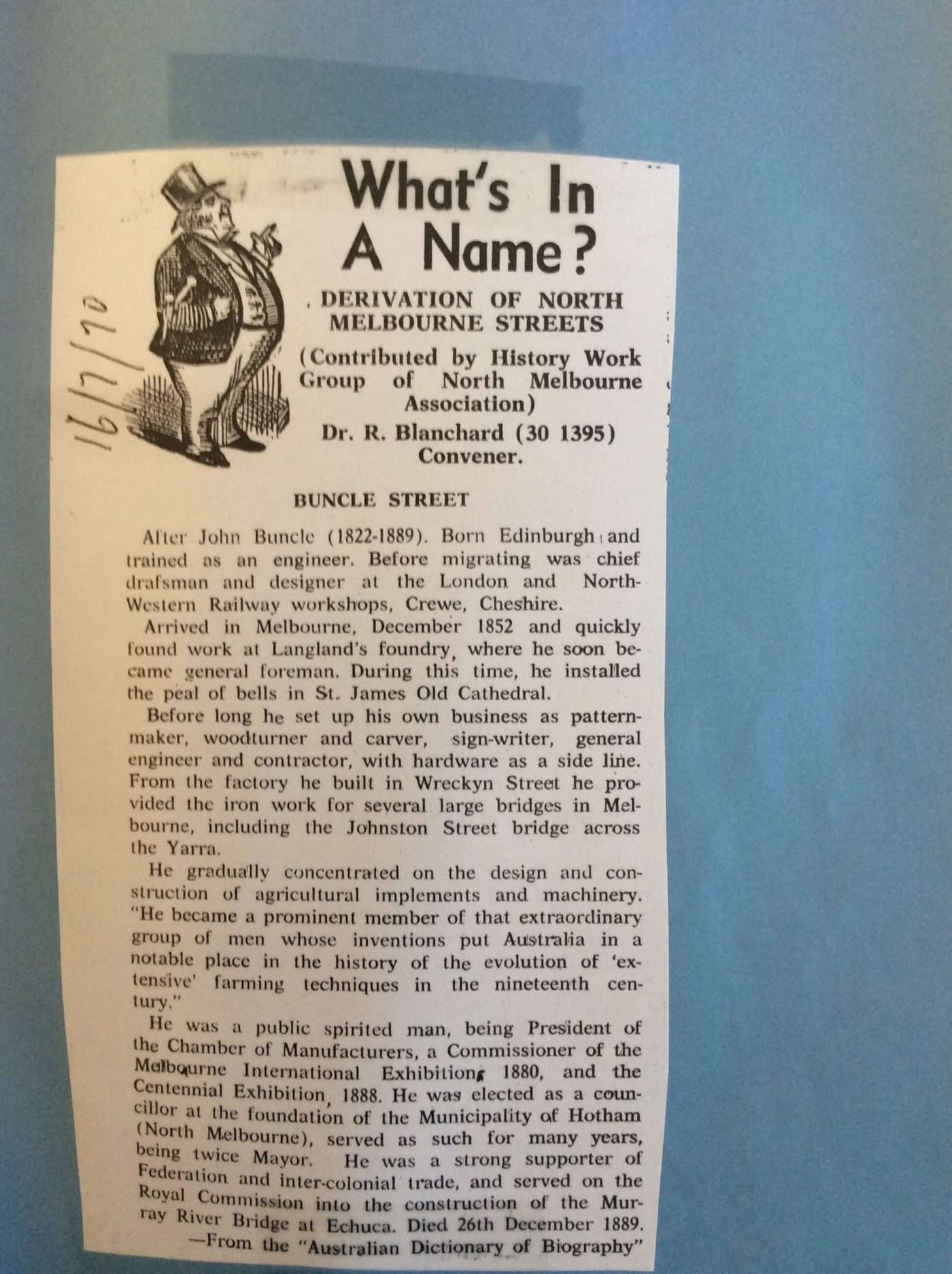
Buncle Street
Named after John Buncle (1822-1889). Born Edinburgh and trained as an engineer. Before migrating was chief draftsman and designer at the London and North-Western Railway workshops, Crewe, Cheshire.(1) Source. (1) Northern Advertise 16/7/1970. Blanchard collection, “What’s in a Name” at North Melbourne Library and from the Australian Dictionary, of Biography.
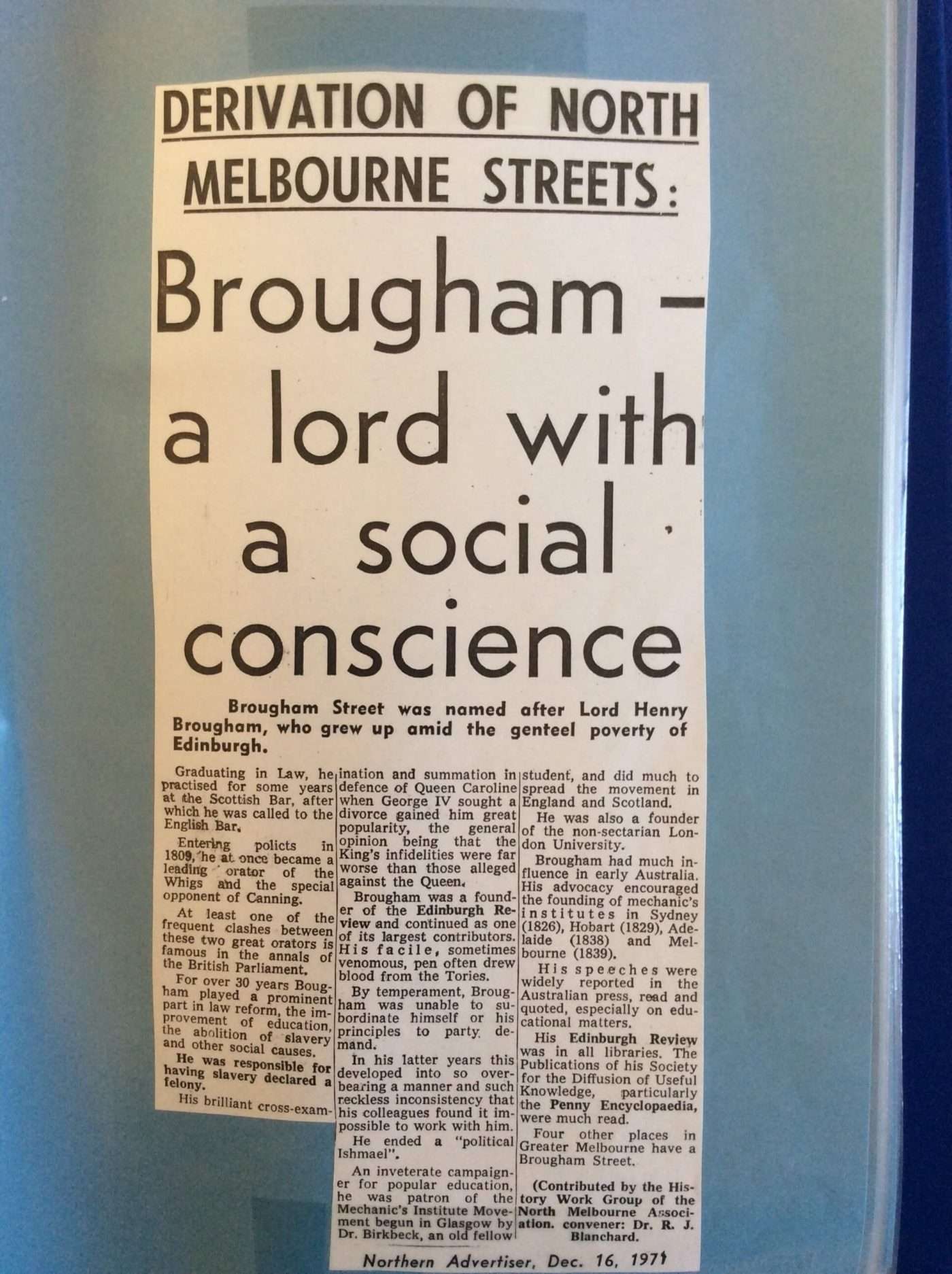
Brougham Street
Brougham Street was named after Lord Henry Brougham, who grew up amid the genteel poverty of Edinburgh. Brougham had much influence in early Australia. His advocacy encouraged the founding of mechanic’s institutes in Sydney (1826), Hobart (1829), Adelaide (1838) and Melbourne (1839). His speeches were widely reported in the Australian press, read and quoted, especially on educational matters. His Edinburgh Review was in all libraries. The Publications of his Society for the Diffusion of Useful Knowledge, particularly the Penny Encyclopaedia, were much read. Four other places in Greater Melbourne have a Brougham Street.(1) Source. (1) Northern Advertiser, Dec. 16, 1971. Blanchard collection, “What’s in a Name” at North Melbourne Library.
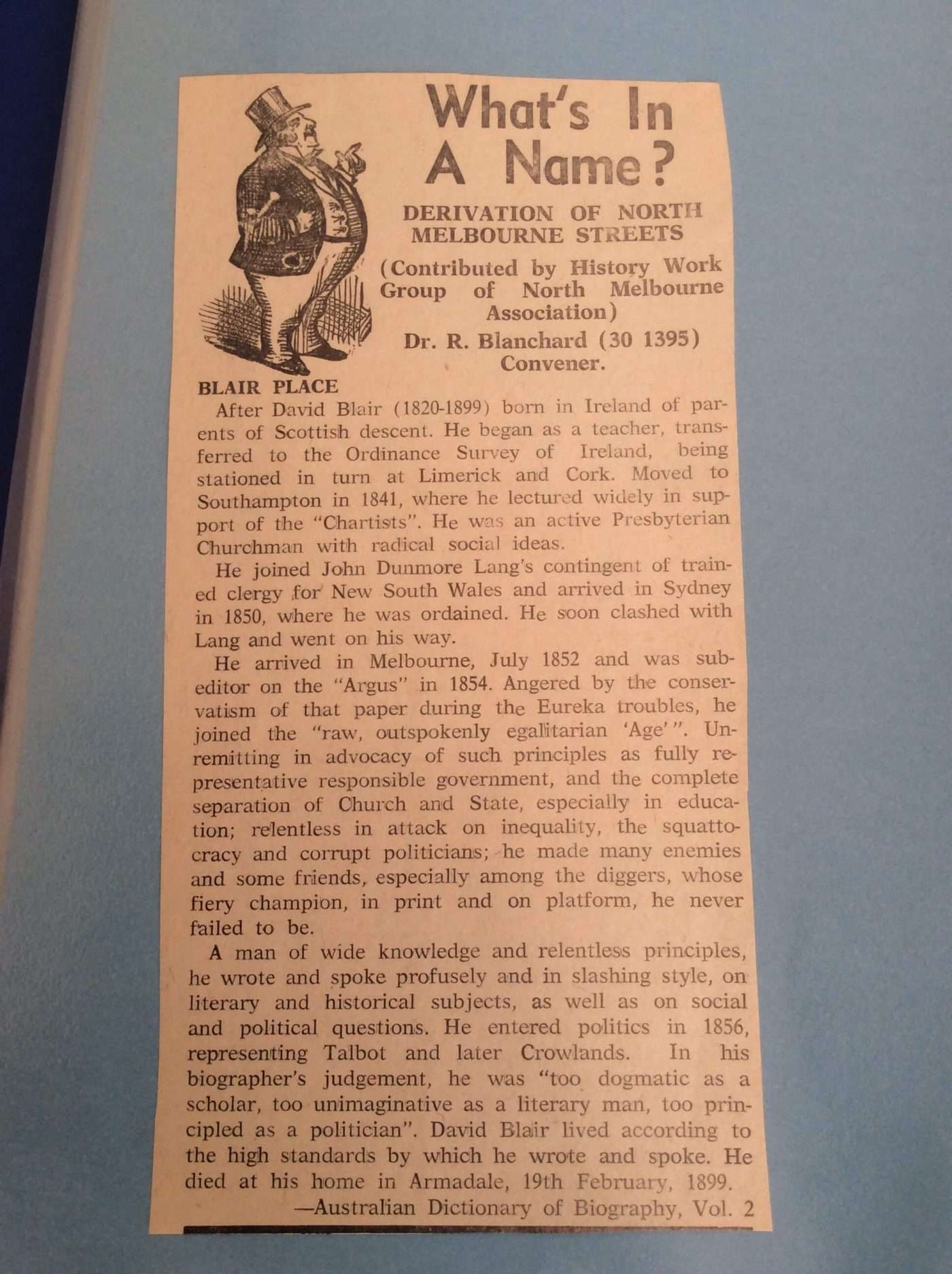
Blair Place
Named after David Blair (1820-1899) born in Ireland of parents of Scottish descent.(1) Source. (1) Northern Advertiser 1972. Blanchard collection, “What’s in a Name” at North Melbourne Library.Australian Dictionary of Biography, Vol. 2
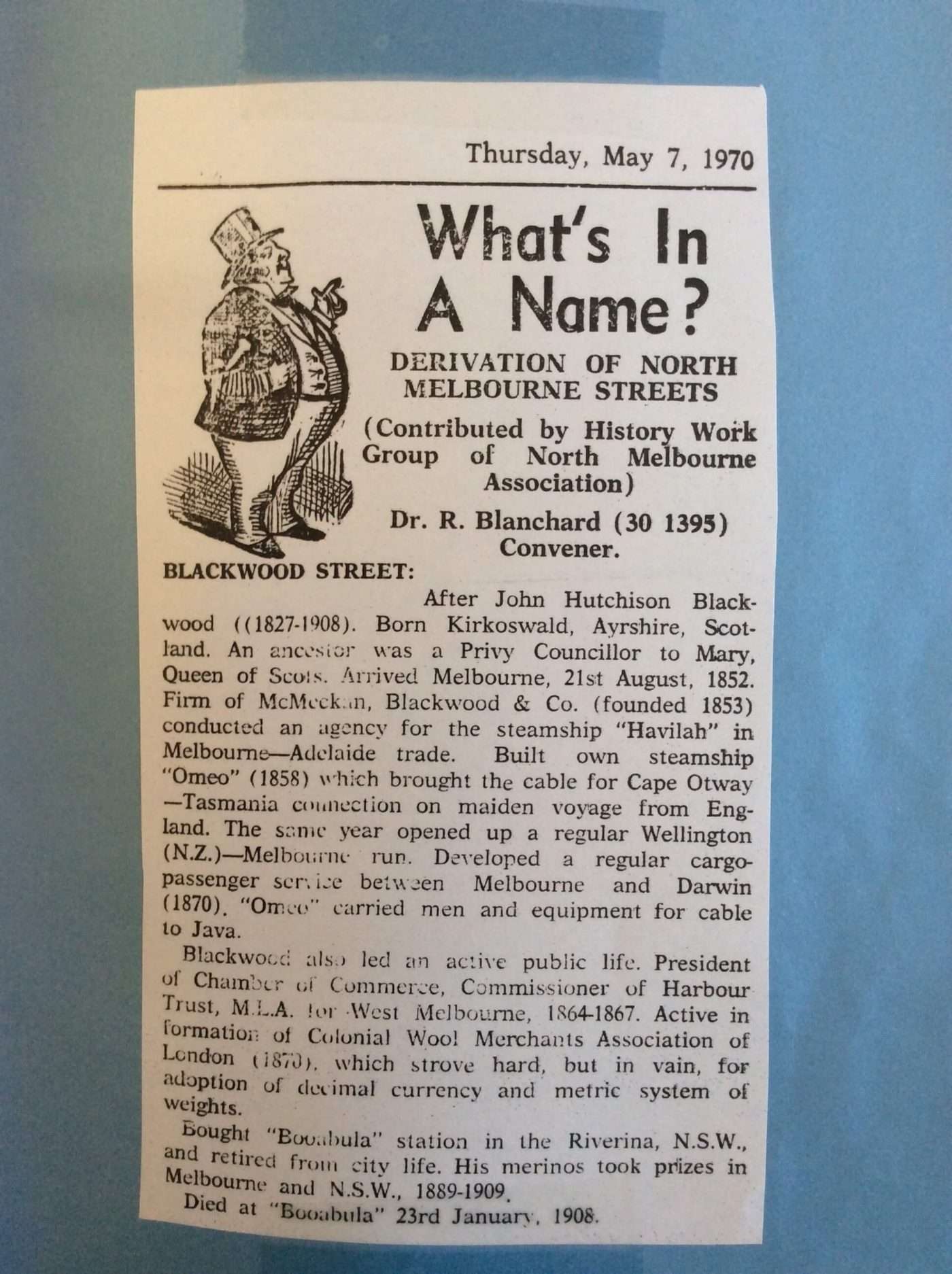
Blackwood Street
Named after John Hutchison Blackwood (1827-1908). Born Kirkoswald, Ayrshire, Scotland. An ancestor was a Privy Councillor to Mary, Queen of Scots. Arrived Melbourne, 21st August, 1852.(1) Source. Northern Advertiser Thursday, May 7, 1970. Blanchard collection, “What’s in a Name” at North Melbourne Library.
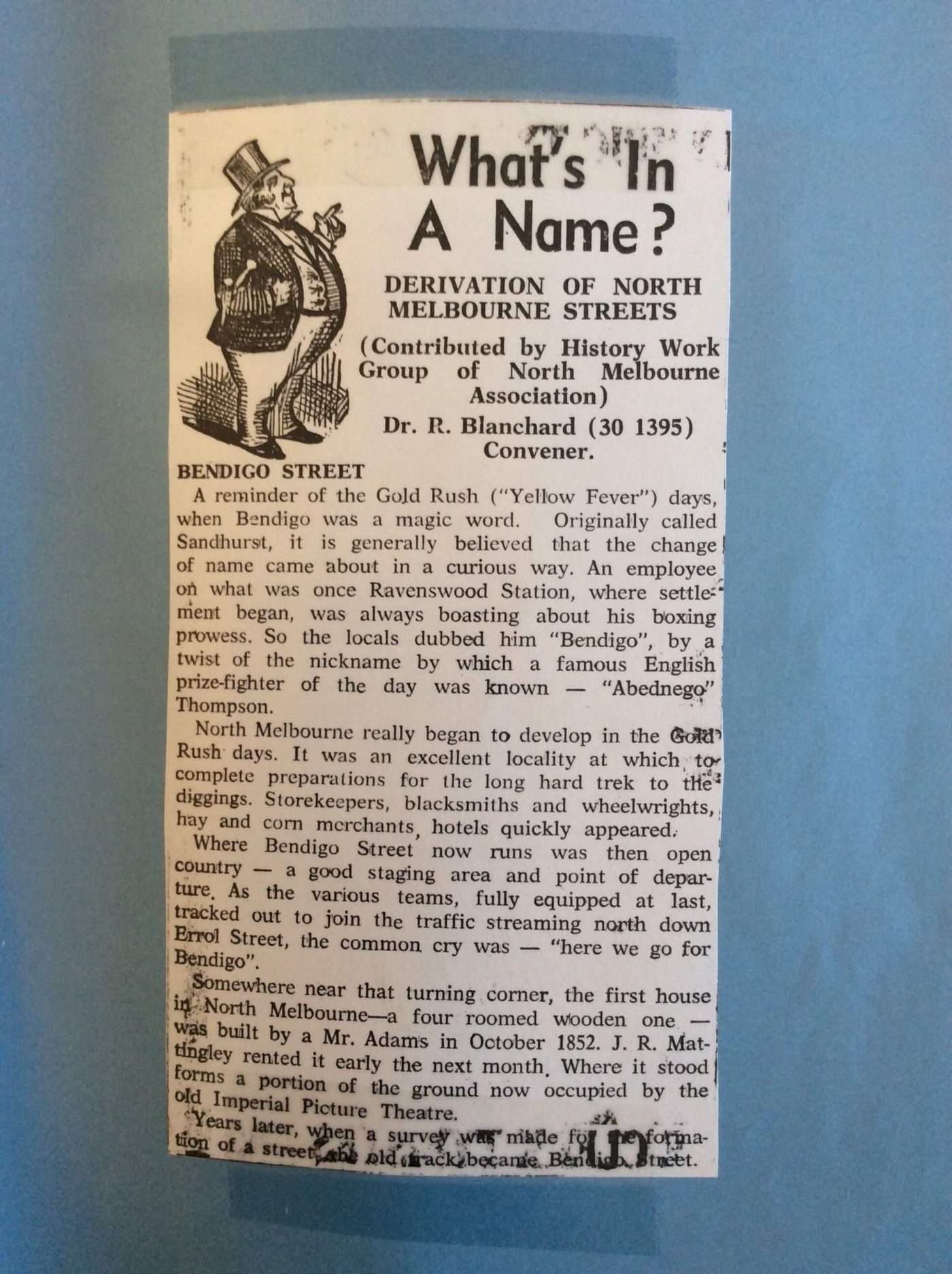
Bendigo Street
A reminder of the Gold Rush (“Yellow Fever”) days, when Bendigo was a magic word. Originally called Sandhurst, it is generally believed that the change of name came about in a curious way. An employee on what was once Ravenswood Station, where settlement began, was always boasting about his boxing prowess. So the locals dubbed him “Bendigo”, by twist of the nickname by which a famous English prize-fighter of the day was known “Abednegoe” Thompson. North Melbourne really began to develop in the Gold Rush days. It was an excellent locality at which, to complete preparations for the long hard trek to diggings. Storekeepers, blacksmiths and wheelwrights, hay and corn merchants, hotels quickly appeared. Where Bendigo Street now runs was then open country — a good staging area and point of departure. As the various teams, fully equipped at last, tracked out to join the traffic streaming north down Errol Street, the common, cry was “here we go for Bendigo”. Somewhere near that turning corner, the first house in North Melbourne-a four roomed wooden one I was, built by a Mr. Adams in October 1852. J. R. Mattingley rented it early the next month. Where it stood forms a portion …
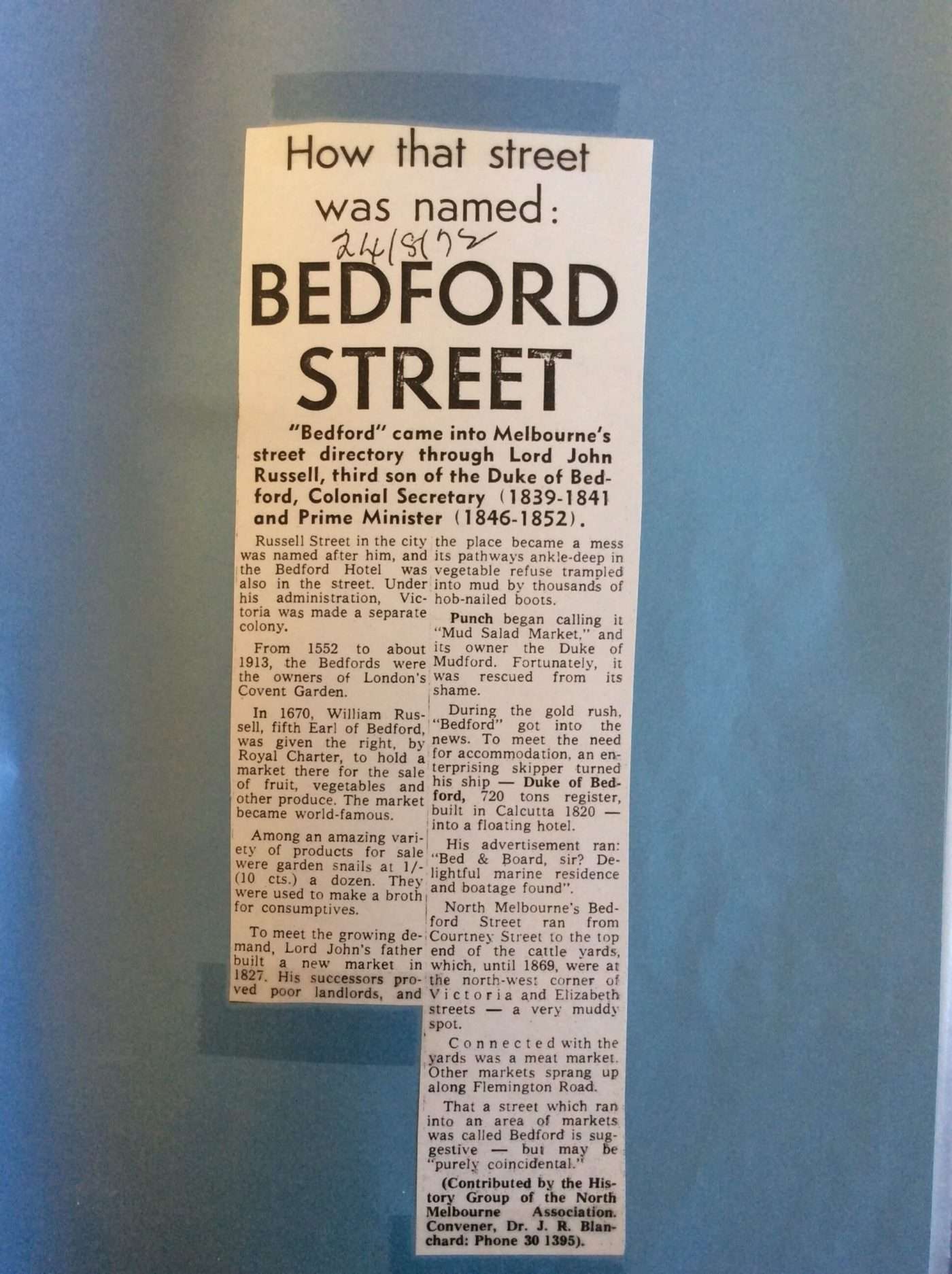
Bedford Street
It came into Melbourne’s street directory through Lord John Russell, third son of the Duke of Bedford, Colonial Secretary (1839-1841 and Prime Minister (1846-1852). Russell Street in the city was named after him, and the Bedford Hotel was also in the street. Under his administration, Victoria was made a separate colony. From 1552 to about 1913, the Bedfords were the owners of London’s Covent Garden. In 1670, William Russell, fifth Earl of Bedford, was given the right, by Royal Charter, to hold a market there for the sale of fruit, vegetables and other produce. The market became world-famous. Among an amazing variety of products for sale were garden snails at 1/- (10 cts.) a dozen. They were used to make a broth, for consumptives. To meet the growing demand, Lord John’s father built a new market in 1827. His successors proved poor landlords, and the place became a mess its pathways ankle-deep in vegetable refuse trampled into mud by thousands of hob-nailed boots. Punch began calling it “Mud Salad Market.” and its owner the Duke of Mudford. Fortunately, it was rescued from its shame. During the gold rush, “Bedford” got into the news. To meet the need for accommodation. an …
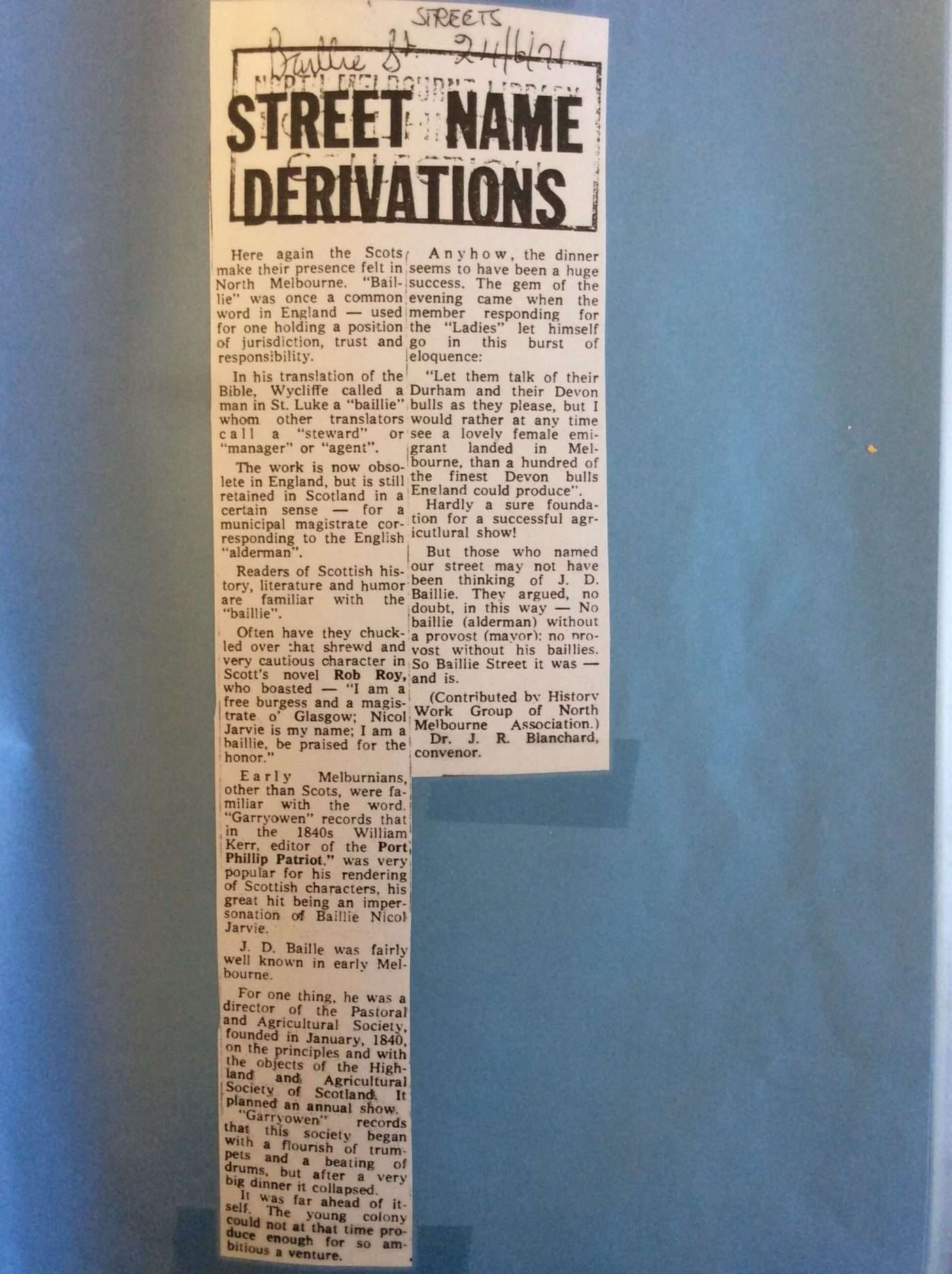
Baillie Street
Here again the Scots make their presence felt in North Melbourne. “Baillie” was once a common in England — used for one holding a position of jurisdiction, trust and responsibility. In his translation of the Bible, Wycliffe called a man in St. Luke a “baillie” whom other translators call a “steward” or “manager” or “agent”. The work is now obsolete in England, but is still retained in Scotland in a certain sense — for a municipal magistrate corresponding to the English “alderman”. Readers of Scottish history, literature and humor are familiar with the Baillie. Often have they chuckled over that shrewd and very cautious character in Scott’s novel Rob Roy, who boasted — “I am a free burgess and a magistrate o’ Glasgow; Nicol Jarvie is my name; I am a be praised for the honor.” Early Melburnians, other than Scots, were familiar with the word. “Garryowen” records that in the 1840s William Kerr, editor of the Port Phillip Patriot.” was very, popular for his rendering: of Scottish characters, his great hit being an impersonation of Baillie Nicol Jarvie. J. D. Baillie was fairly well known in early Melbourne. For one thing, he was a director of the Pastoral’ and …