Jeffcott Street

Named after Sir William Jeffcott (1800 – 1855) he was an Irish barrister, a judge of the Supreme Court of New South Wales for the District of Port Phillip from 1843 to 1845.(1) Source. (1) Jeffcott, Sir William (1800–1855)”. Australian Dictionary of Biography. Canberra: Australian National University. TOWN ALLOTMENTS. A considerable number of new allotments have been surveyed and marked out for sale, between the Flag Staff and the Swamp, abutting upon La Trobe and Spencer-streets, and a new street called after Judge Jeffcott. They will not, however, be put up to sale except upon special application, and under any circumstances we should recommend their being withheld, till the removal of the boiling-down establishments has rendered the neighbourhood a little less obtrusive upon the ollactories. We have before noticed the abandonment of the lane system, which has been productive of so much mischief. The streets are all marked out of equal width, but we doubt whether a narrowing of the blocks would not prove a still further advantage, in decreasing the tendency to the creation of rookeries, narrow rights of way, and other nuisances. In future, town allotments are only to consist of a quarter acre each, the frontage remaining …
Cobden Street

Named after Richard Cobden, apostle of Free Trade, and relentless crusader for the repeal of the Corn Law – a protectionist device which, he said, “took from the poorest of the poor to add to the richest of the rich”.(1) Source. (1) Northern Advertiser, 1972. Blanchard collection, What’s in a Name” at North Melbourne Library. (2) Melbourne Council Street Card Number #520, street gazetted in 1867.

Wood Street

Wood Street is quite short, running in an east west direction between Abbotsford and Dryburgh Streets on the side of Hotham Hill. When settlers arrived in 1835 the area was the lightly treed grassland of a clan of the Kulin Nation. To the north the land rose up to what became Royal Park. One block north of Wood Street is the current Pleasance Gardens which had a rocky outcrop, said to have caves, and this spot was likely a gathering place for the local clan. In the 1850s rock was quarried where Carroll Street now meets the Gardens. To the south the land sloped down to a creek and a vista containing a blue saltwater lagoon. Initially the settlers used the land to graze their cows. As Melbourne expanded in a north-west direction the Hotham Hill locality was divided into “town allotments”. There were seven allotments on the north side and seven on the south side of Wood Street (as yet unnamed), see detail from Public Lands Office map 14 October 1858. These allotments were auctioned at government land auctions on the 28 December 1865 (north side) and 8 January 1866 (south side). The persons buying there allotments were likely …

Vale Street

Named after William Mountford Kinsey Vale who came to Victorian from London in March, 1853. (1) Source. (1) Northern Advertiser, March 1, 1973. Blanchard collection, “What’s in a Name” at North Melbourne Library. (2) Melbourne Council Street Card Number #1147, street gazetted in 1867.

Union Street

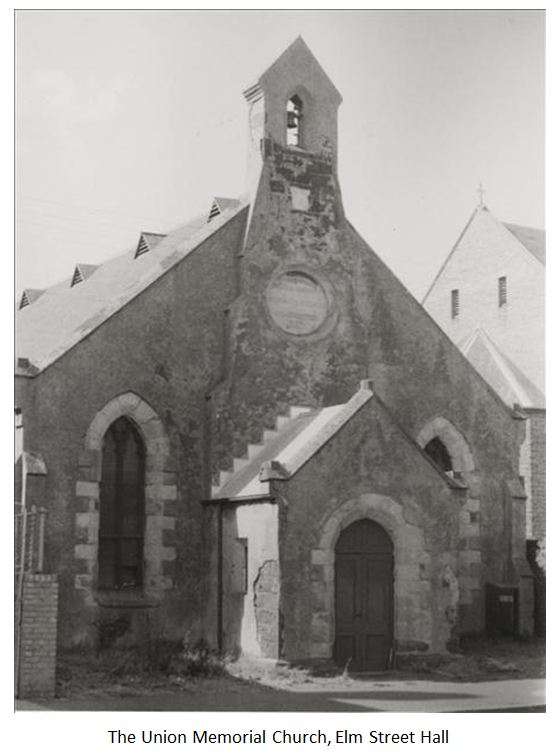
In December 1854 two acres of land facing Curzon Street of the block bounded by Queensberry, Abbotsford & Elm Streets, North Melbourne were given to the Church of Scotland (Presbyterian). The street dividing this area from the rest of the block was initially named Church Street. Scottish Presbyterians brought their church divisions to Australia. These were; — the Established Church of Scotland — the United Presbyterian Church, a union of early secessions from the Mother Church — and the Free Church of Scotland — formed by the “disruption” of the Church of Scotland in 1843. The divisions sprang from differences on questions of theology, Church and State, and the relation of church authority to the individual conscience. Members of the three Presbyterian churches living in North Melbourne all agreed to worship together, a minister of each church coming from another parish to officiate in turn. In September, 1855, after worshiping for a time in a smithy in Villiers Street and then in a stable loft in Errol Street, services began in an iron, building “The Scots Presbyterian Church” on the Curzon Street site. During the week the building was used as a school and its pupils dubbed It “the tin …

Sutton Street

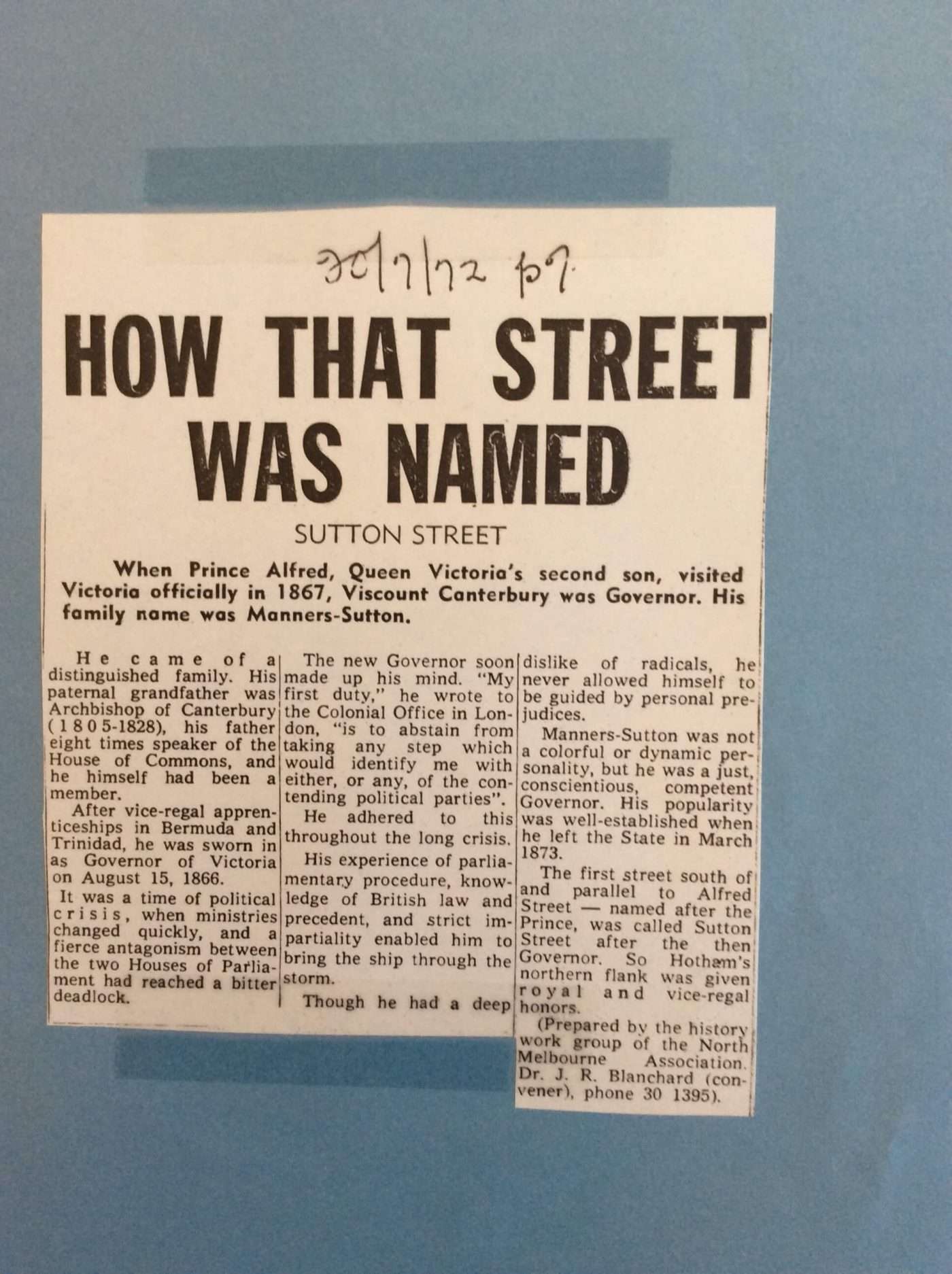
Named after the Governor of Victoria John Manners-Sutton, 3rd Viscount Canterbury England. Source. (1) Northern Advertiser, 20/7/1972. Blanchard collection, “What’s in a Name” at North Melbourne Library. (2) Melbourne Council Street Card Number #1111.

Straker Street

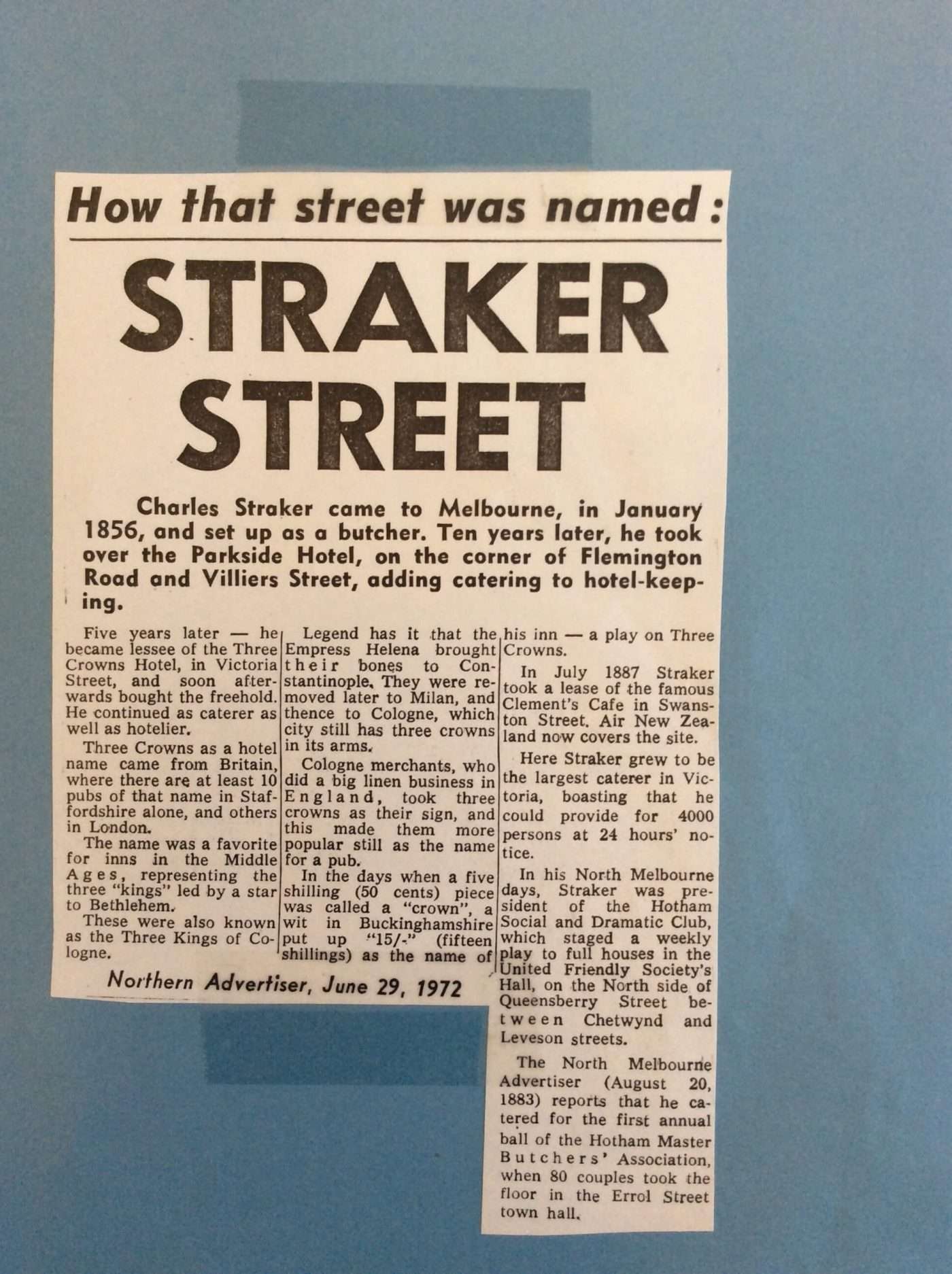
Named after Charles Doyl Straker who came to Melbourne, in January 1856, and set up as a butcher.(1) Source. (1) Northern Advertiser, June 29, 1972. Blanchard collection, “What’s in a Name” at North Melbourne Library.

Shiel Street

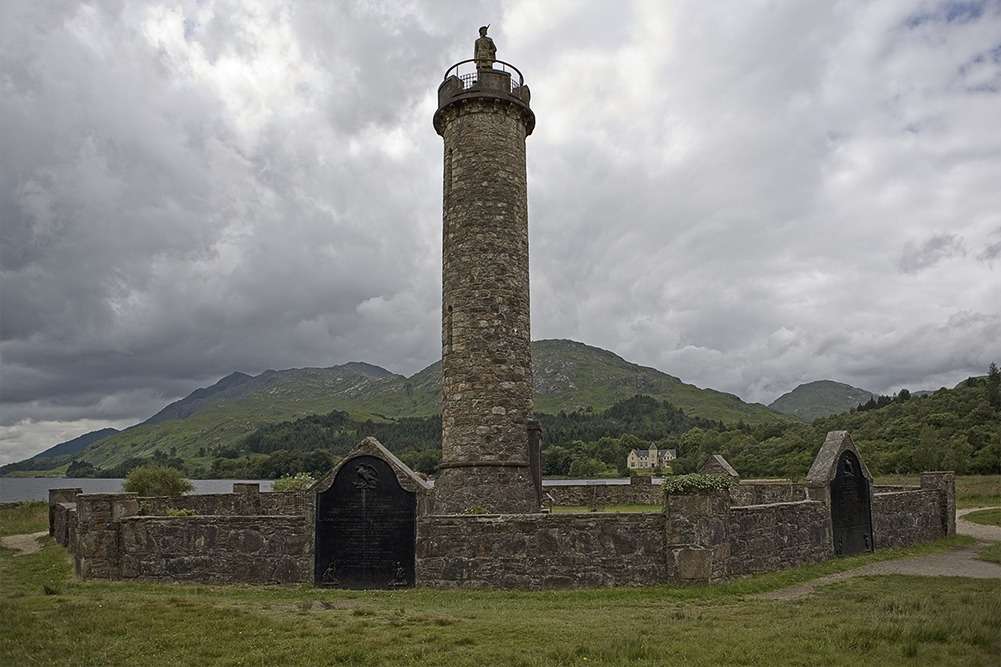
Although more than 100 years had come and gone, the numerous Scots of Hotham (North Melbourne) could still be sentimental over their Bonnie Prince Charlie. From 1869 to 1902 they had a hotel bearing his name on the corner of Abbotsford and Arden Streets North Melbourne. When a street was made to link the Scottish Dryburgh and Melrose Streets, they called it Shiel. This was after a loch of exceptional beauty in the Western Highlands of Scotland, on the boundary of the district of Argyll and Inverness. On August 19, 1745, Prince Charles Edward Stuart landed at Glen Finnan at the head of Loch Shiel, to make a last attempt to regain the throne of the United Kingdom for his family. He had expected to find, the nucleus of an army awaiting him, but there was none. Disappointed and chagrined, he waited in suspense. Then to the skirl of the pipes and swagger of the kilt, Lochiel Cameron marched down the glen at the head of 700 to 800 men. Other clans began to arrive. The Prince had a small, but formidable Highland army of 13,400. He raised his standard at the head of the loch and gave orders to …

Scotia Street

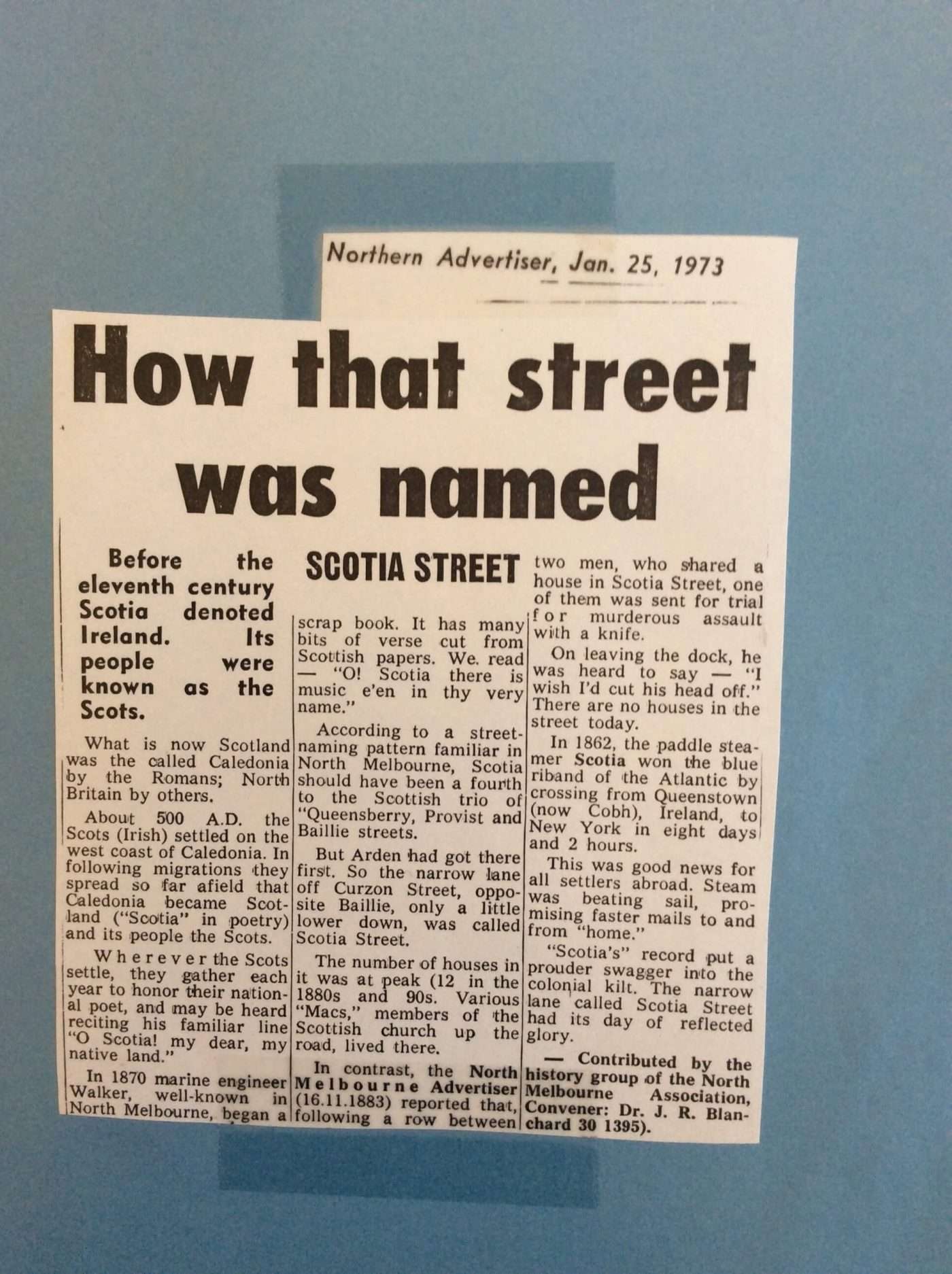
Before the eleventh century Scotia denoted Ireland. Its people were known as the Scots. What is now Scotland was the called Caledonia by the Romans; North Britain by others. About 500 A.D. the Scots (Irish) settled on the west coast of Caledonia. In following migrations they spread so far afield that Caledonia became Scotland (“Scotia” in poetry) and its people the Scots. Wherever the Scots settle, they gather each year to honor their national poet, and may be heard reciting his familiar line “O Scotia! my dear, my native land.” In 1870 marine engineer Walker, well-known in North Melbourne, began a scrap book. It has many bits of verse cut from Scottish papers. We read — “O! Scotia there is music e’en in thy very name.” According to a street-naming pattern familiar in North Melbourne, Scotia should have been a fourth to the Scottish trio of “Queensberry, Provist and Baillie streets. But Arden had got there first. So the narrow lane off Curzon Street, opposite Baillie, only a little lower down, was called Scotia Street. The number of houses located there at it’s peak was 12 in the 1880s and 90s. Various “Macs,” members of the Scottish church up the …

Reynolds Street

Named after William Reynolds, one of many ex-mayors after whom a street has been named in North Melbourne.(1) Source. (1) Northern Advertiser, 5/10/1972. Blanchard collection, “What’s in a Name” at North Melbourne Library.