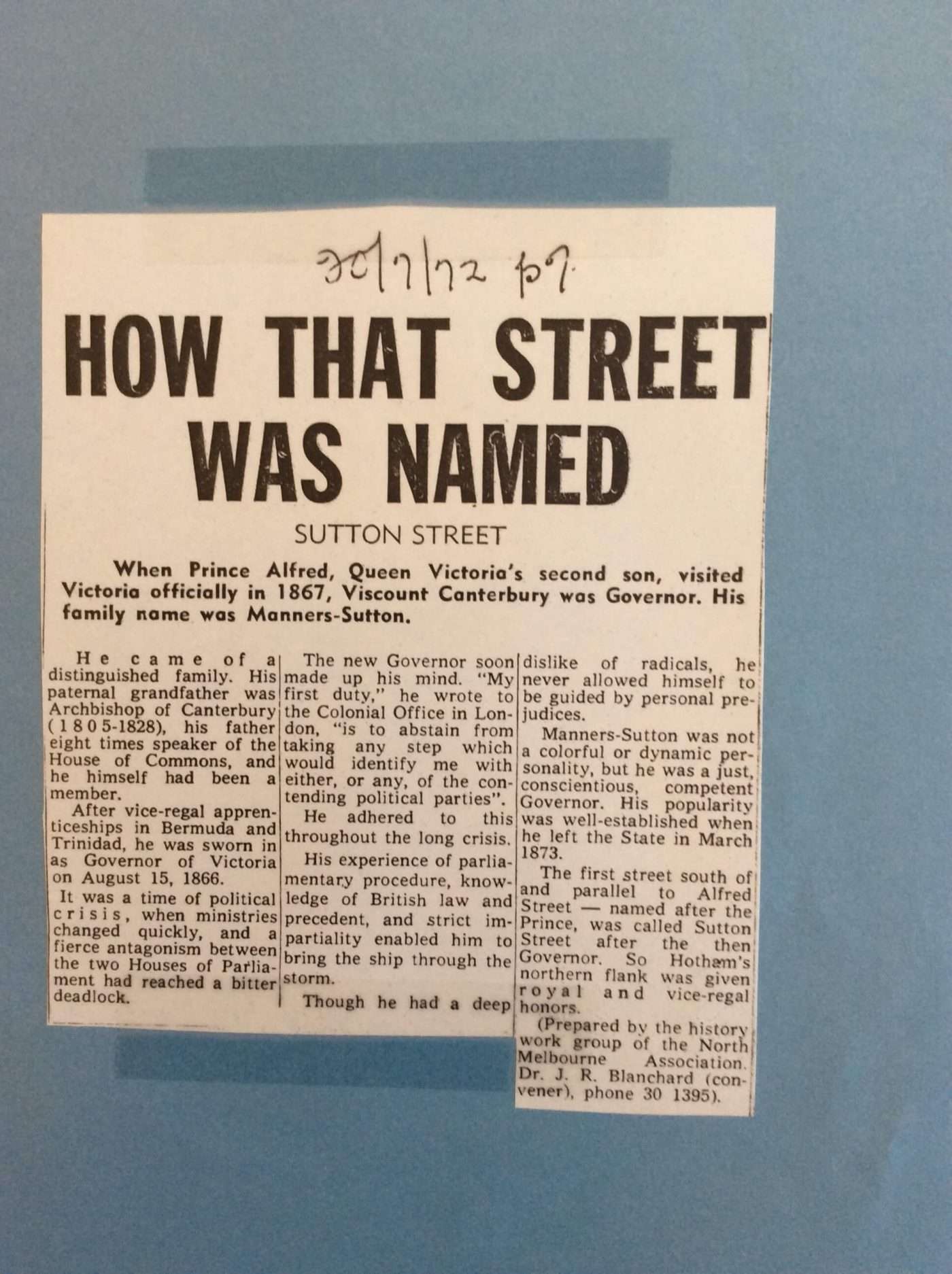
Sutton Street

Named after the Governor of Victoria John Manners-Sutton, 3rd Viscount Canterbury England. Source. (1) Northern Advertiser, 20/7/1972. Blanchard collection, “What’s in a Name” at North Melbourne Library. (2) Melbourne Council Street Card Number #1111.

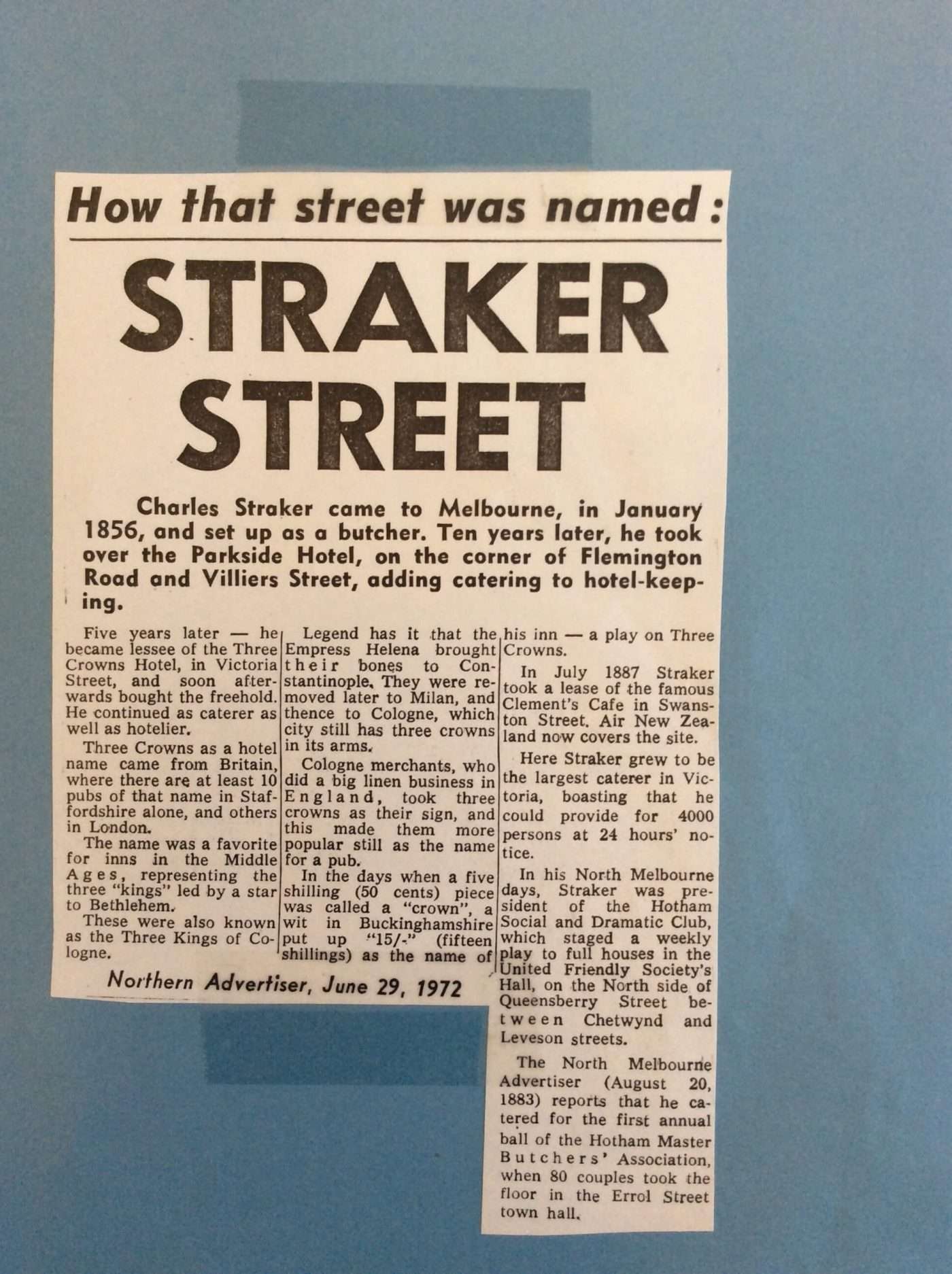
Straker Street

Named after Charles Doyl Straker who came to Melbourne, in January 1856, and set up as a butcher.(1) Source. (1) Northern Advertiser, June 29, 1972. Blanchard collection, “What’s in a Name” at North Melbourne Library.

Shiel Street

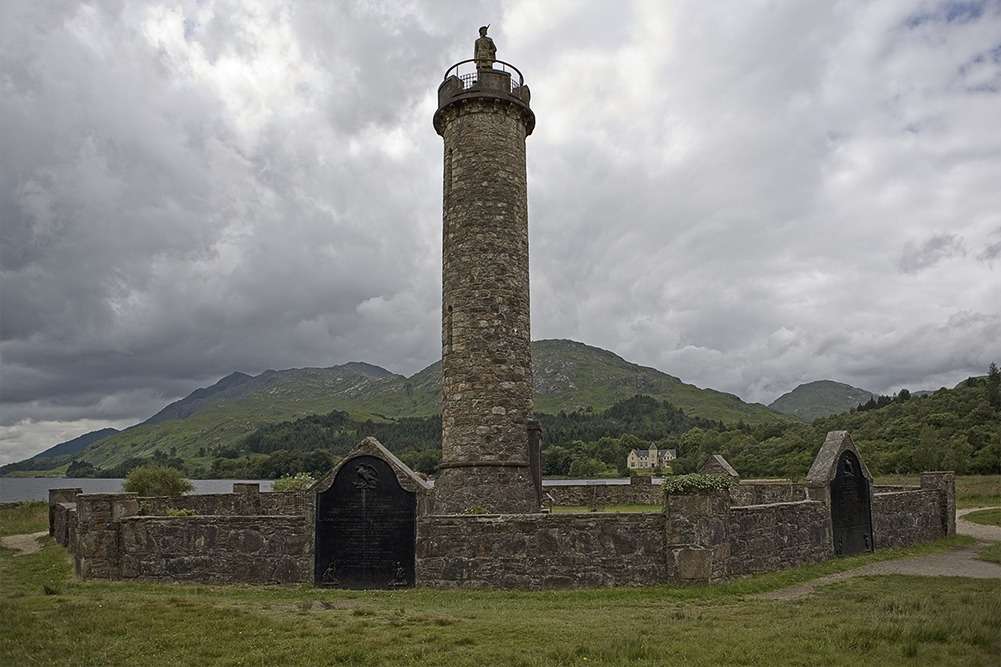
Although more than 100 years had come and gone, the numerous Scots of Hotham (North Melbourne) could still be sentimental over their Bonnie Prince Charlie. From 1869 to 1902 they had a hotel bearing his name on the corner of Abbotsford and Arden Streets North Melbourne. When a street was made to link the Scottish Dryburgh and Melrose Streets, they called it Shiel. This was after a loch of exceptional beauty in the Western Highlands of Scotland, on the boundary of the district of Argyll and Inverness. On August 19, 1745, Prince Charles Edward Stuart landed at Glen Finnan at the head of Loch Shiel, to make a last attempt to regain the throne of the United Kingdom for his family. He had expected to find, the nucleus of an army awaiting him, but there was none. Disappointed and chagrined, he waited in suspense. Then to the skirl of the pipes and swagger of the kilt, Lochiel Cameron marched down the glen at the head of 700 to 800 men. Other clans began to arrive. The Prince had a small, but formidable Highland army of 13,400. He raised his standard at the head of the loch and gave orders to …

Scotia Street

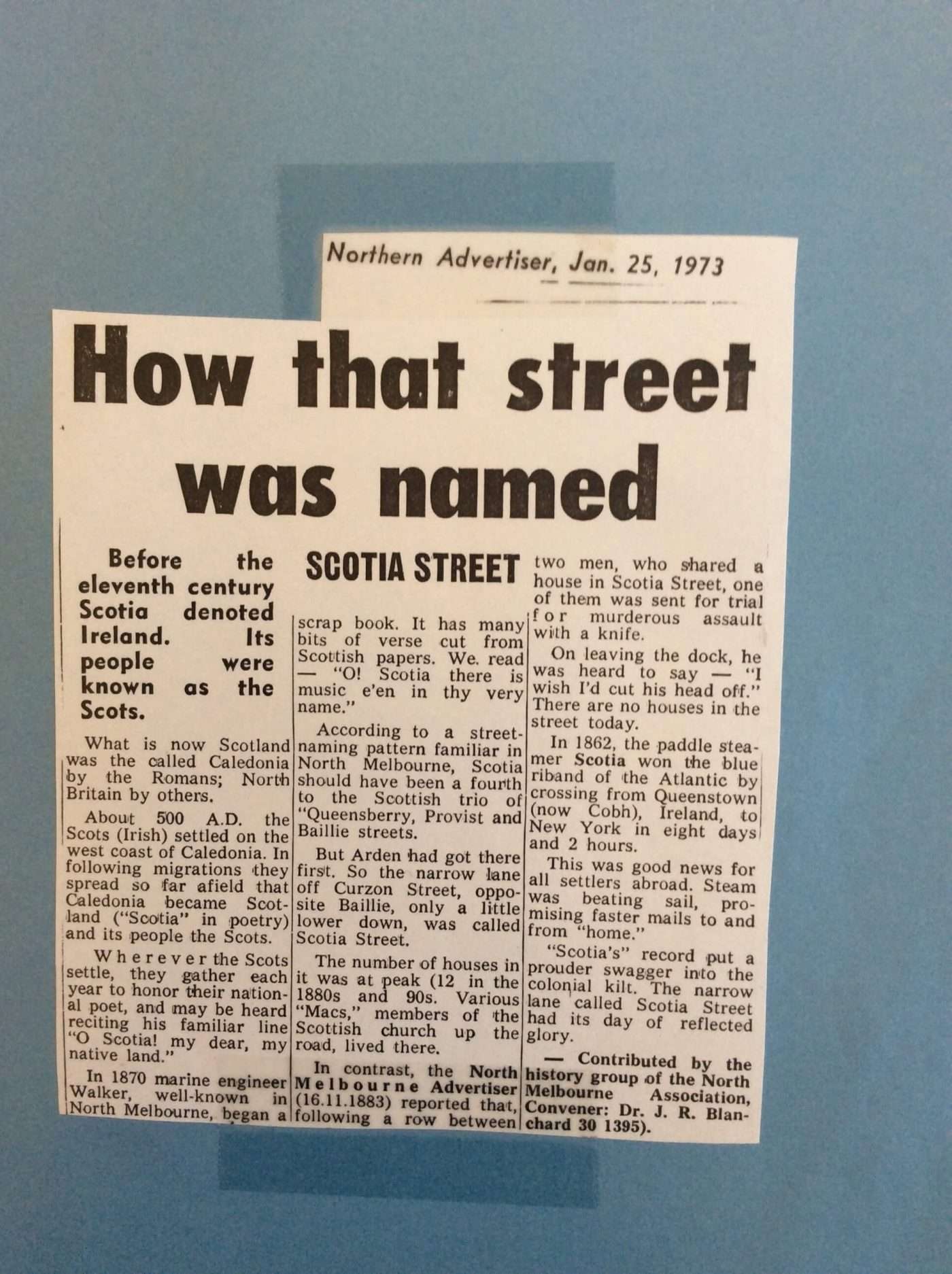
Before the eleventh century Scotia denoted Ireland. Its people were known as the Scots. What is now Scotland was the called Caledonia by the Romans; North Britain by others. About 500 A.D. the Scots (Irish) settled on the west coast of Caledonia. In following migrations they spread so far afield that Caledonia became Scotland (“Scotia” in poetry) and its people the Scots. Wherever the Scots settle, they gather each year to honor their national poet, and may be heard reciting his familiar line “O Scotia! my dear, my native land.” In 1870 marine engineer Walker, well-known in North Melbourne, began a scrap book. It has many bits of verse cut from Scottish papers. We read — “O! Scotia there is music e’en in thy very name.” According to a street-naming pattern familiar in North Melbourne, Scotia should have been a fourth to the Scottish trio of “Queensberry, Provist and Baillie streets. But Arden had got there first. So the narrow lane off Curzon Street, opposite Baillie, only a little lower down, was called Scotia Street. The number of houses located there at it’s peak was 12 in the 1880s and 90s. Various “Macs,” members of the Scottish church up the …

Reynolds Street

Named after William Reynolds, one of many ex-mayors after whom a street has been named in North Melbourne.(1) Source. (1) Northern Advertiser, 5/10/1972. Blanchard collection, “What’s in a Name” at North Melbourne Library.

Raglan Street

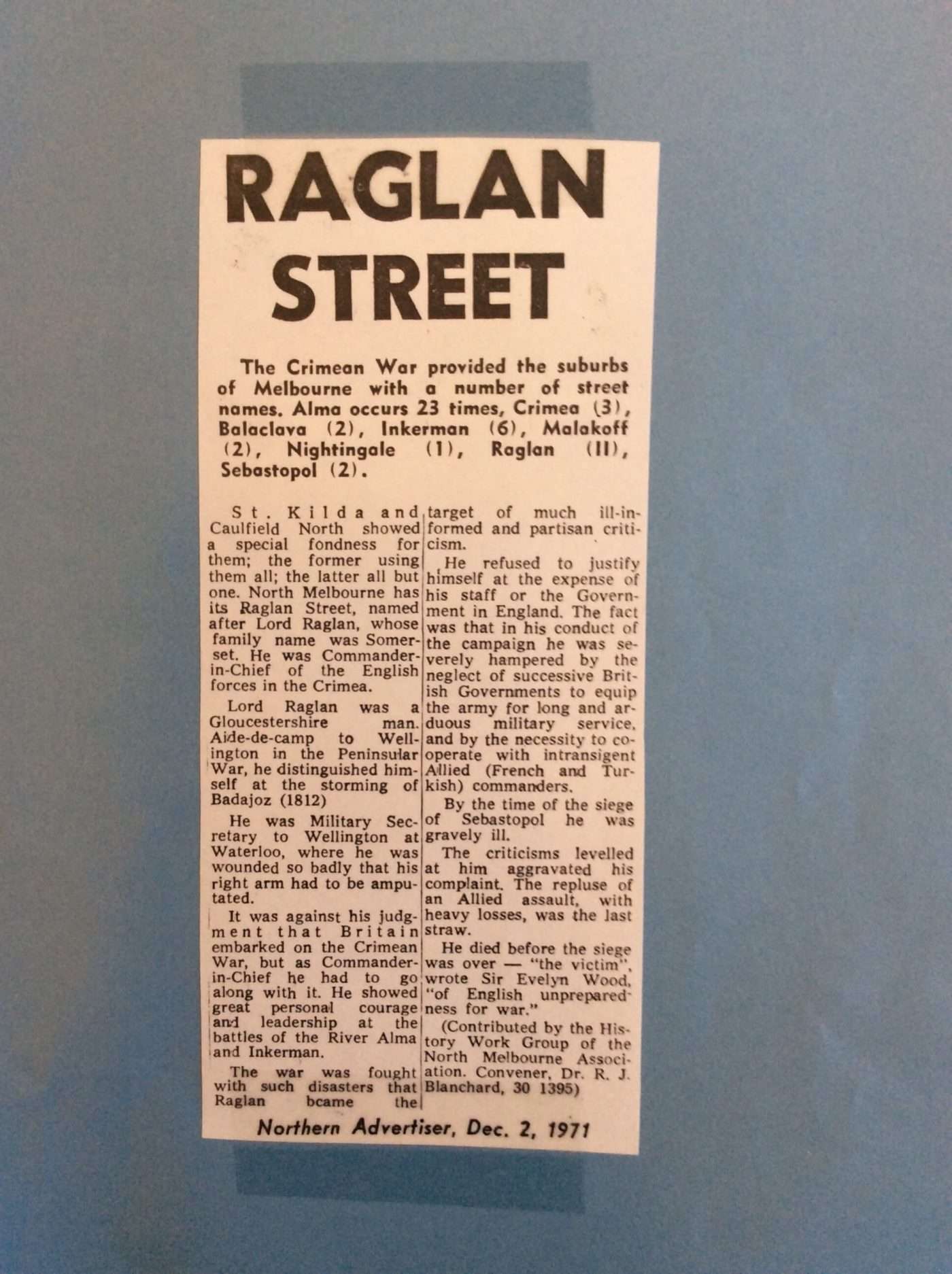
The Crimean War provided the suburbs of Melbourne with a number of street names. Alma occurs 23 times, Crimea (3), Balaclava (2), Inkerman (6), Malakoff ( 2) , Nightingale (1) Raglan (II) Sebastopol (2). St. Kilda and Caulfield North showed a special fondness for them; the former using them all; the latter all but one. North Melbourne has its Raglan Street, named after Lord Raglan, whose family name was Somerset. He was Commander in-Chief of the English forces in the Crimea. Lord Raglan was a Gloucestershire man. Aide-de-camp to Wellington in the Peninsular War, he distinguished him at the storming of Badajoz (1812) He was Military Secretary to Wellington at Waterloo, where he was wounded so badly that his right arm had to be amputated. It was against his judgment that Britain embarked on the Crimean War, but as Commander in-Chief he had to go along with it. He showed great personal courage and leadership at the battles of the River Alma and Inkerman. The war was fought with such disasters that Raglan became the target of much ill-informed and partisan critiicism. He refused to justify himself at the expense of his staff or the Government in England. The fact …

Queensberry Street

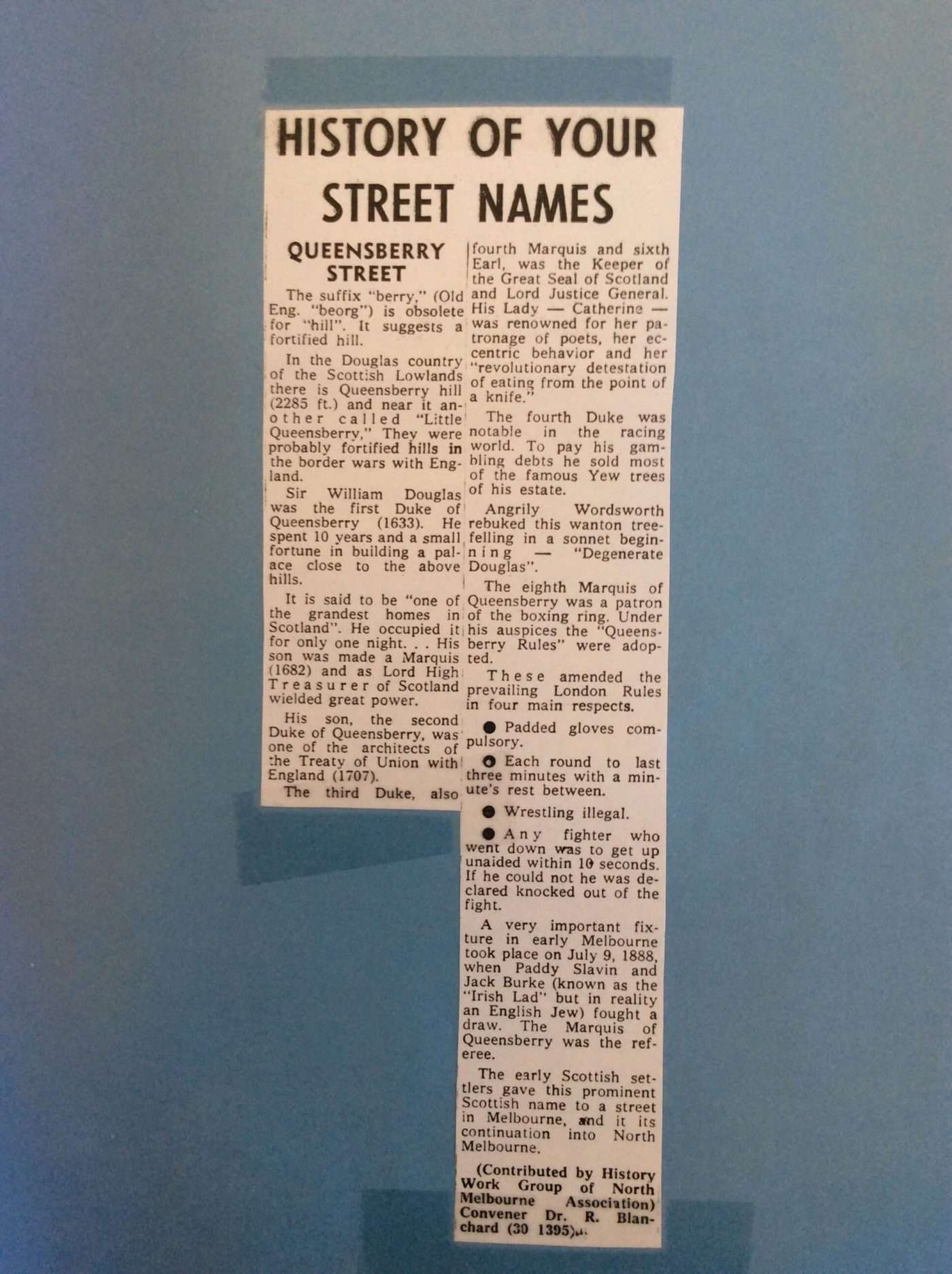
The suffix “berry,” (Old Eng. “beorg”) is obsolete for “hill”. It suggests a fortified hill. In the Douglas country of the Scottish Lowlands there is Queensberry hill of (2285 ft.) and near it another called “Little Queensberry,” They were probably fortified hills in the border wars with England. Sir William Douglas was the first Duke of Queensberry (1633). He spent 10 years and a small fortune in building a palace close to the above hills. It is said to be “one of the grandest homes in of Scotland”. He occupied it for only one night… His son was made a Marquis (1682) and as Lord High Treasurer of Scotland wielded great power. His son, the second Duke of Queensberry, was one of the architects of the Treaty of Union with England (1707). The third Duke, also fourth Marquis and sixth Earl, was the Keeper of the Great Seal of Scotland and Lord Justice General. His Lady — Catherine — was renowned for her patronage of poets, her eccentric behavior and her revolutionary detestation of eating from the point of a knife. The fourth Duke was notable in the racing world. To pay his gambling debts he sold most of the …

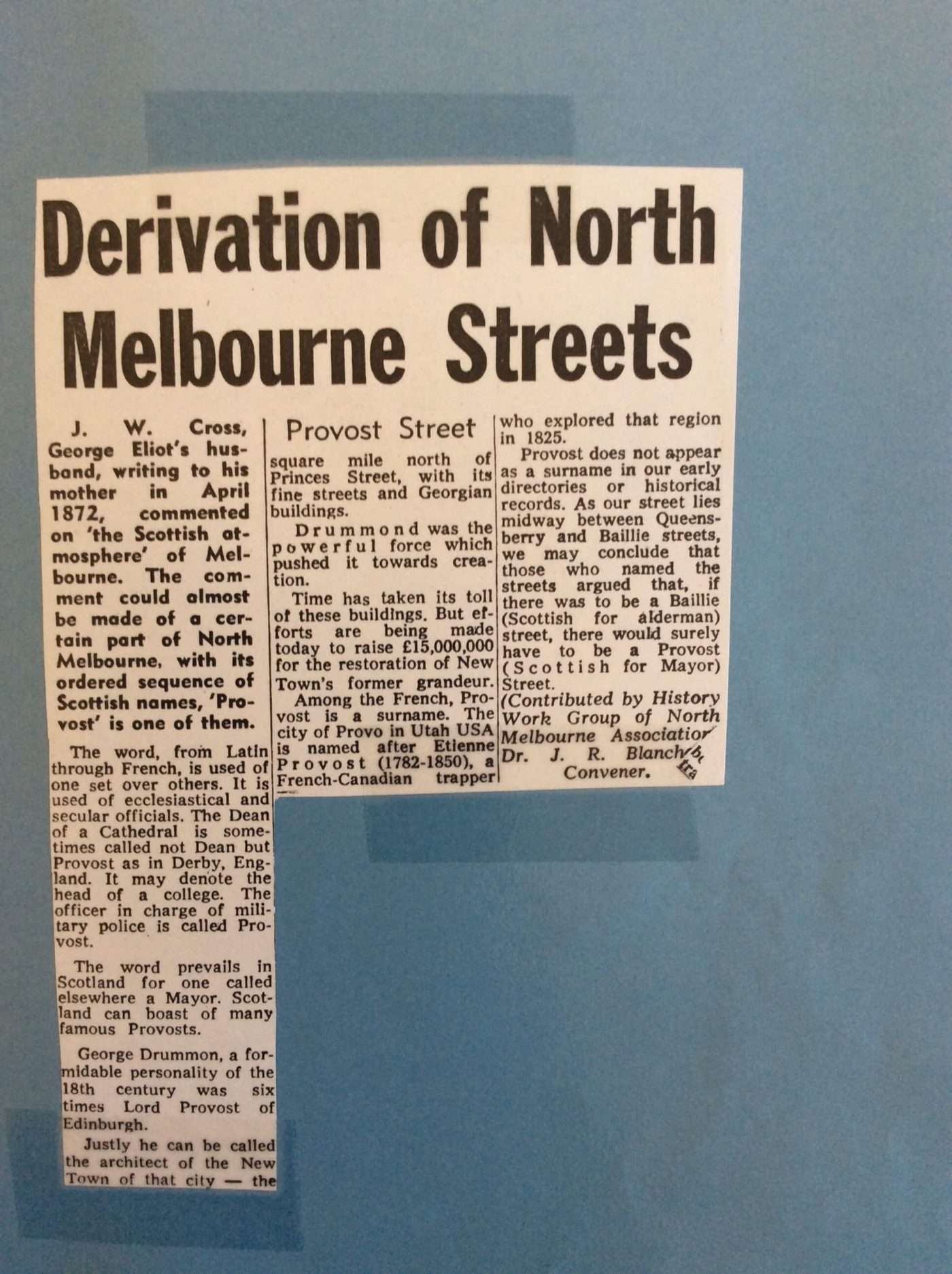
Provost Street

J. W. Cross, George Eliot’s husband, writing to his mother in April 1872, commented on ‘the Scottish atmosphere’ of Melbourne. The comment could almost be made of a certain part of North Melbourne, with its ordered sequence of Scottish street names, ‘Provost’ is one of them. The word, from Latin through French, is used of one set over others. It is used by ecclesiastical and secular officials. The Dean of a Cathedral is sometimes called, not Dean but, Provost as in Derby, England. It may denote the head of a college. The officer in charge of military police is also called Provost. The word prevails in Scotland for one called elsewhere, a Mayor. Scotland can boast of many famous Provosts in its romantically rich history. George Drummon, a formidable personality of the 18th century was six times Lord Provost of Edinburgh. Justly he can be called the architect of the New Town of that city – the square mile north of Princes Street, with its fine streets and Georgian buildings. Drummond was the powerful force which pushed it towards creation. Time has taken its toll on these buildings. But efforts are being made today to raise £15,000,000 for the restoration …
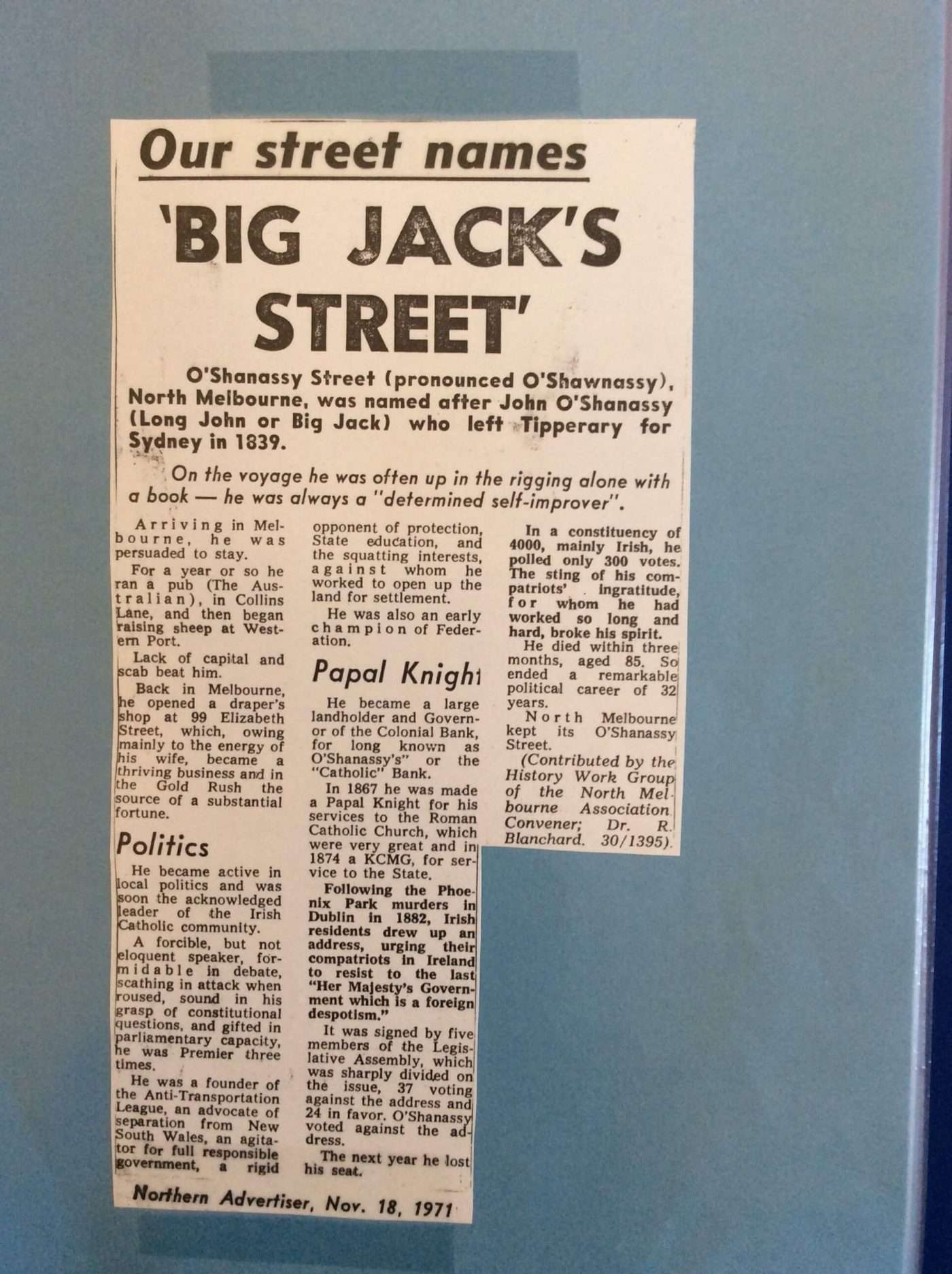
O’Shanassy Street

O’Shanassy Street (pronounced O’Shawnassy), North Melbourne, was named after John O’Shanassy (Long John or Big Jack) who left Tipperary for Sydney in 1839, and later made his way to Melbourne.(1) Source. (1) Northern Advertiser, Nov. 18, 1971. Blanchard collection, What’s in a Name” at North Melbourne Library.    

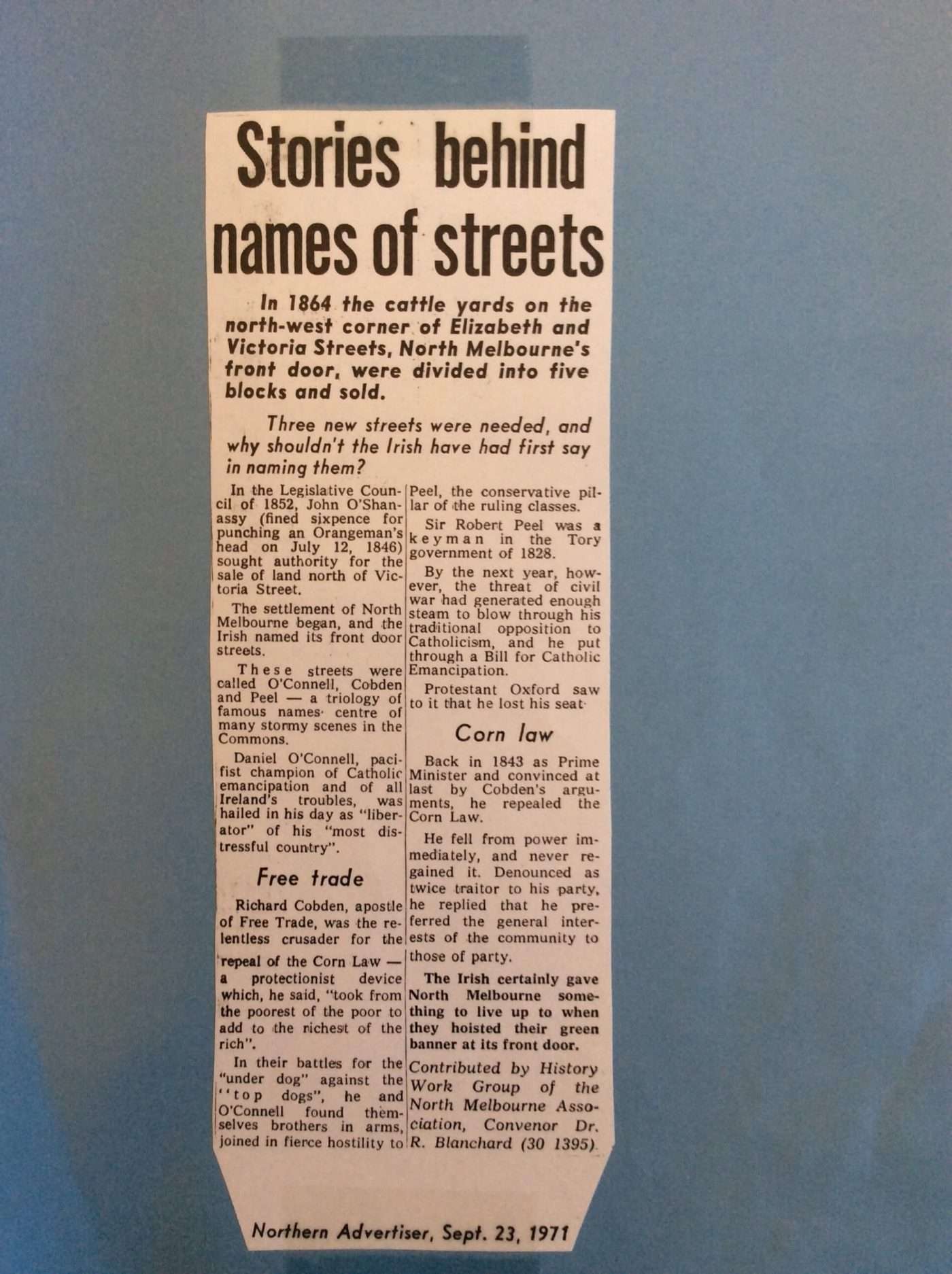
O’Connell Street

In 1864 the cattle yards on the north-west corner of Elizabeth and Victoria Streets, North Melbourne’s front door, were divided into five blocks and sold. Three new streets were needed, and why shouldn’t the Irish have had first say in naming them? In the Legislative Council of 1852, John O’Shanassy (fined sixpence for punching an Orangeman’s head on July 12, 1846) sought authority for the sale of land north of Victoria Street. The settlement of North Melbourne began, and the Irish named its front door streets. These streets were called O’Connell, Cobden and Peel — a triology of famous names center of many stormy scenes in the English Commons. Daniel O’Connell, pacifist champion of Catholic emancipation and of all Ireland’s troubles, was hailed in his day as “liberator” of his “most distressful country”. The Irish certainly gave North Melbourne something to live up to when they hoisted their green banner at its front door.(1) O’Connell Street North Melbourne was therefore named in honor of Daniel O’Connell. Source. (1) Northern Advertiser, 23/9/1971. Blanchard collection,”What’s in a Name” at North Melbourne Library.