Howard Street

Named after Charles Howard who was the assistant commissary general of the new colony of Port Phillip. His job was to superintend the supply of rations. The street in North Melbourne so important to Church and commerce in his day, was fittingly named Howard Street.(1) Source. Northern Advertiser, 6/7/1972. Blanchard collection, “What’s in a Name” at North Melbourne Library.

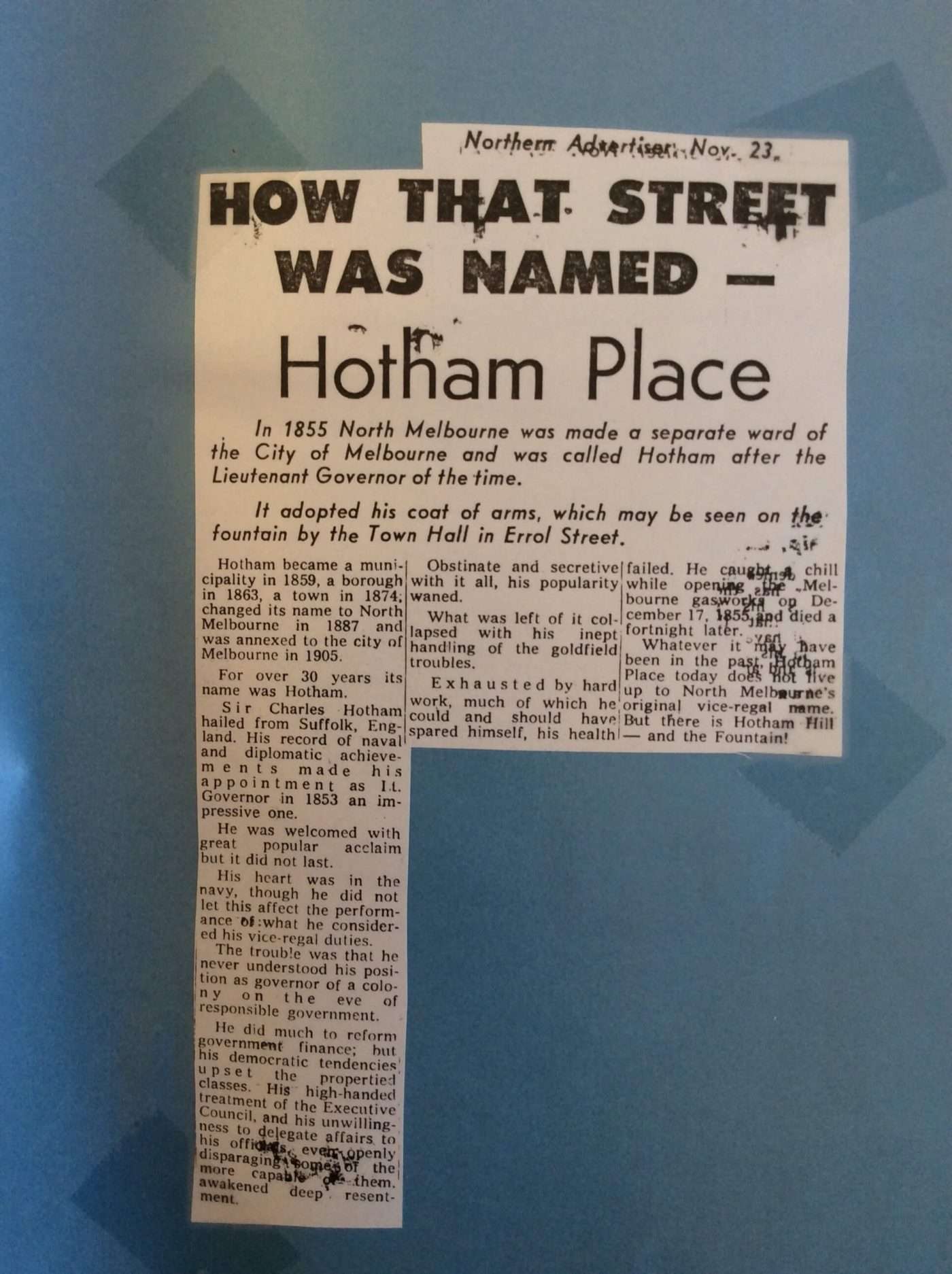
Hotham Place

In 1855 North Melbourne was made a separate ward of the City of Melbourne and was called Hotham after the Lieutenant Governor of the time. It adopted his coat of arms, which may be seen on the fountain by Town Hall in Errol Street. Hotham became a municipality in 1859, a borough in 1863, a town in 1874, changed its name to North Melbourne in 1887 and was annexed to the city of Melbourne in 1905. For over 30 years its name was Hotham. Sir Charles Hotham hailed from Suffolk, England. His record of naval and diplomatic achievements made his appointment as Lt. Governor in 1853 an impressive one. He was welcomed with great popular acclaim but it did not last. Whatever it may have been in the past, Hotham Place today does not have to live up to North Melbourne’s original vice-regal name. But there is Hotham Hill — and the Fountain.(1) Source. Northern Advertiser, 23/11/1972. Blanchard collection, “What’s in a Name” at North Melbourne Library.

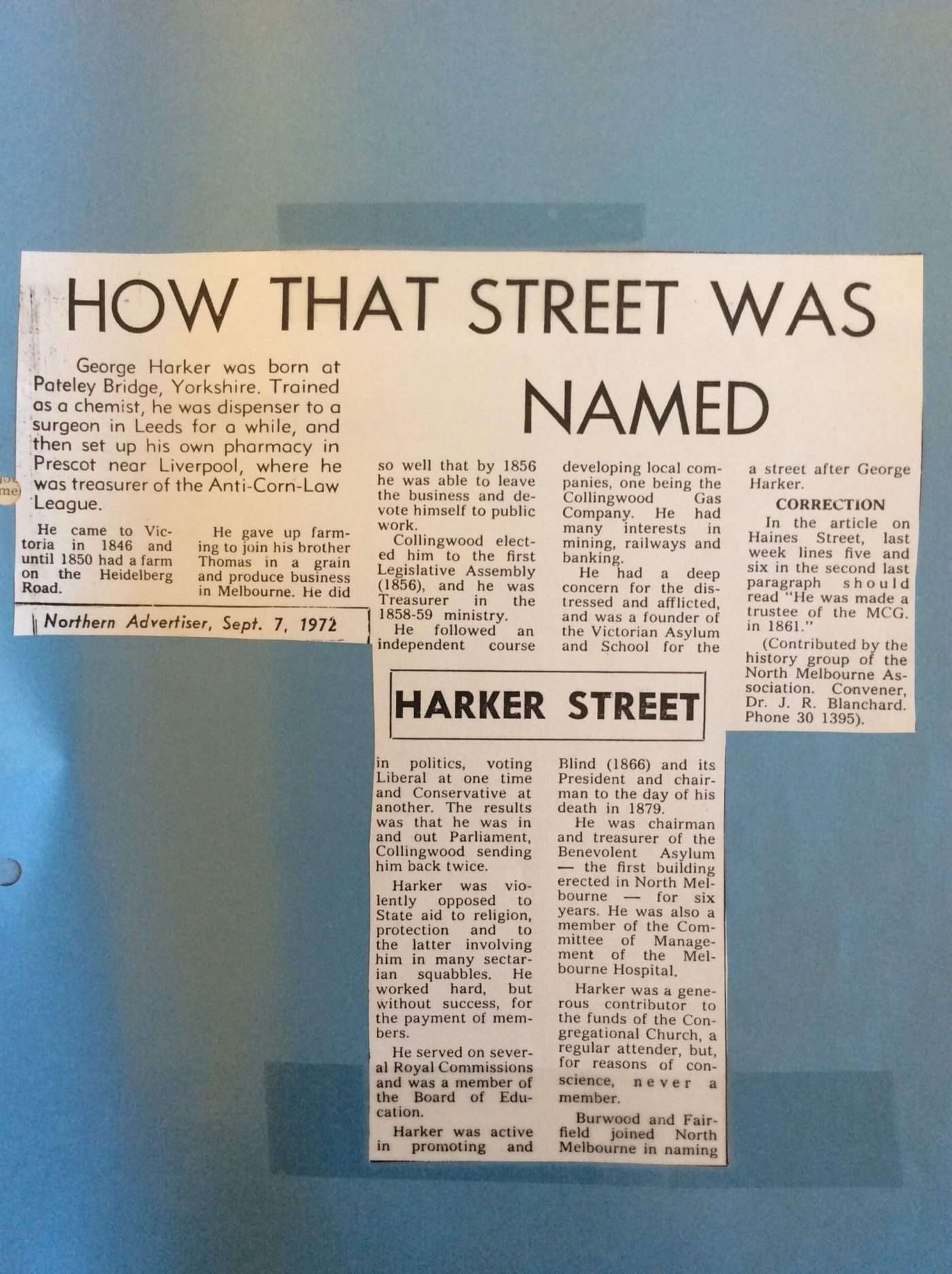
Harker Street

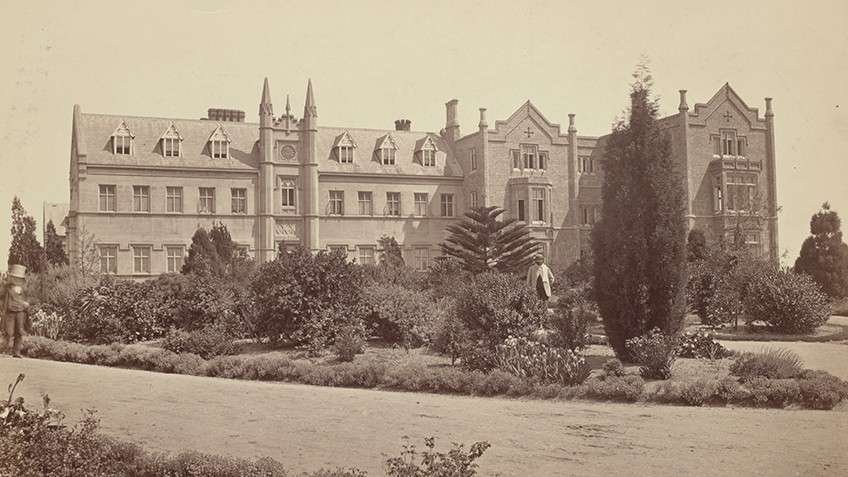
Named after George Harker who was born at Pateley Bridge, Yorkshire. He was chairman and treasurer of the Benevolent Asylum — the first building erected in North Melbourne — for six years. He was also a member of the Committee of Management of the Melbourne Hospital. Burwood and Fairfield joined North Melbourne in naming a street after George Harker.(1) Source. (1) Northern Advertiser, Sept. 7, 1972. Blanchard collection, “What’s in a Name” at North Melbourne Library.

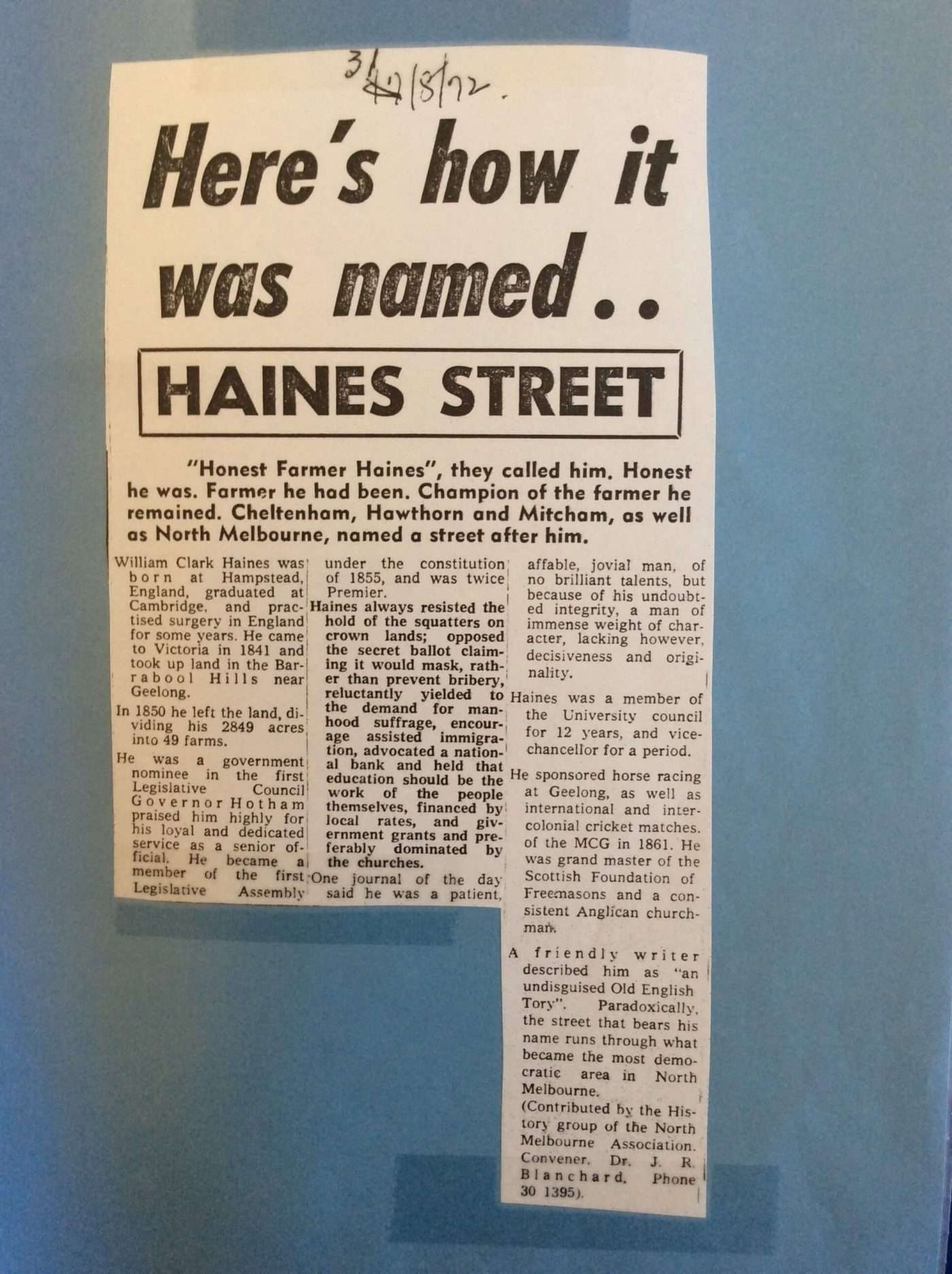
Haines Street

Named after “Honest Farmer Haines”, they called him. Honest he was. Farmer he had been. Champion of the farmer he remained. Cheltenham, Hawthorn and Mitcham, as well as North Melbourne, named a street after him. William Clark Haines was born at Hampstead, England, graduated at Cambridge, and practiced surgery in England for some years. He came to Victoria in 1841 and took up land in the Barrabool Hills near Geelong. A friendly writer described him as “an undisguised Old English Tory”. Paradoxically, the street that bears his name runs through what became the most democratic area in North Melbourne.(1) William Clark Haines was the first Chief secretary (Premier) of Victoria. (2) Source. (1) Northern Advertiser, 31/8/1972. Blanchard collection, “What’s in a Name” at North Melbourne Library. (2) “Parliament of Victoria 150 Years in the making 1856-2006” info@parliament.vic.gov.au

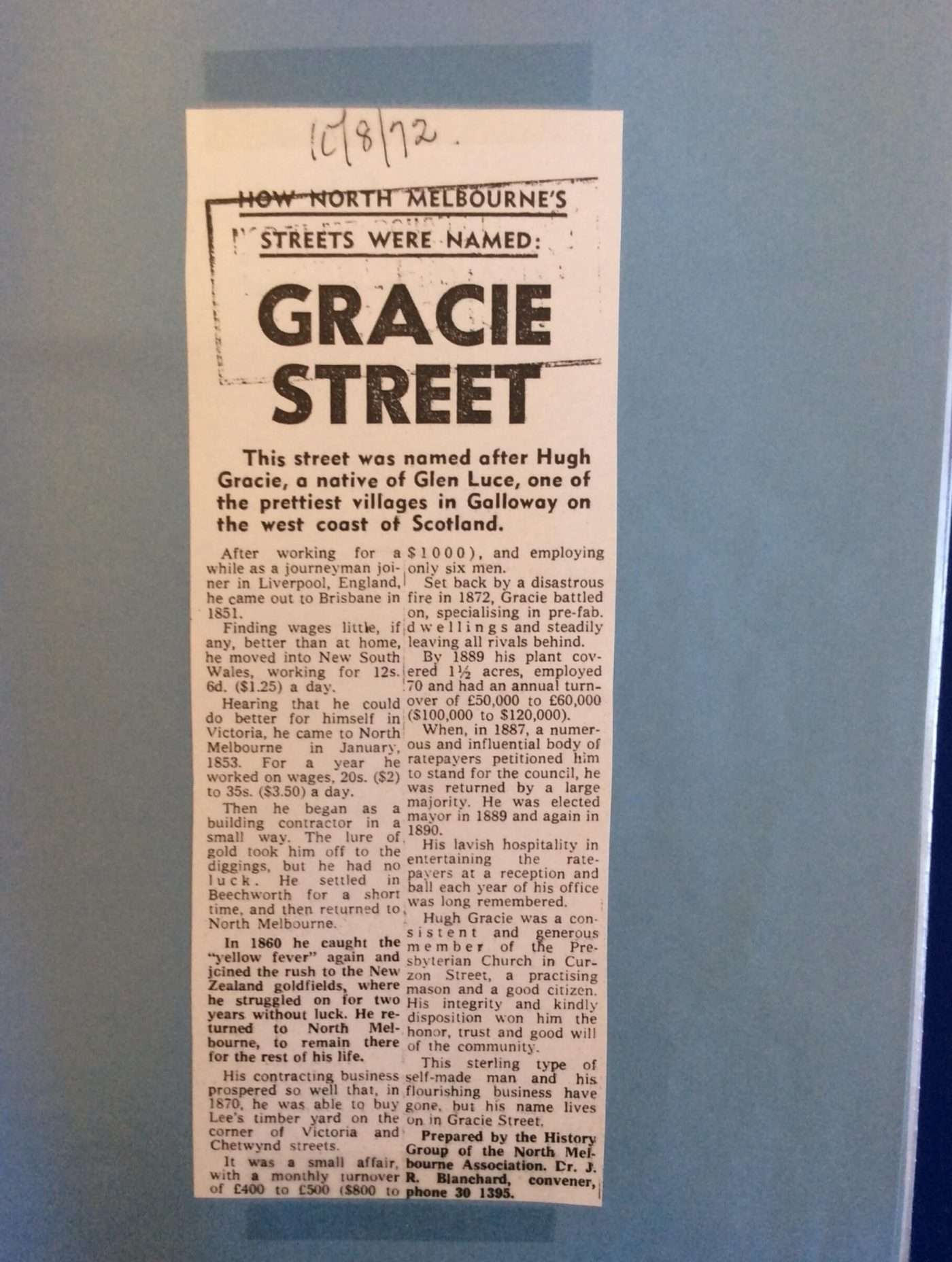
Gracie Street

This street was named after Hugh Gracie, a native of Glen Luce, one of the prettiest villages in Galloway on the west coast of Scotland. In 1887, a numerous and influential body of ratepayers petitioned him to stand for the council, he was returned by a large majority. He was elected Lord Mayor for North Melbourne in 1889 and again in 1890. His lavish hospitality in entertaining the rate-payers at a reception and ball each year of his office was long remembered. Hugh Gracie was a consistent and generous member of the Presbyterian Church in Curzon Street North Melbourne, a practicing mason and a good citizen. His integrity and kindly disposition won him the honor, trust and good will of the community. This sterling type of self-made man and his flourishing business have gone, but his name lives on in Gracie Street.(1) Source. (1) Northern Advertiser 10/8/1972. Blanchard collection, “What’s in a Name” at North Melbourne Library.

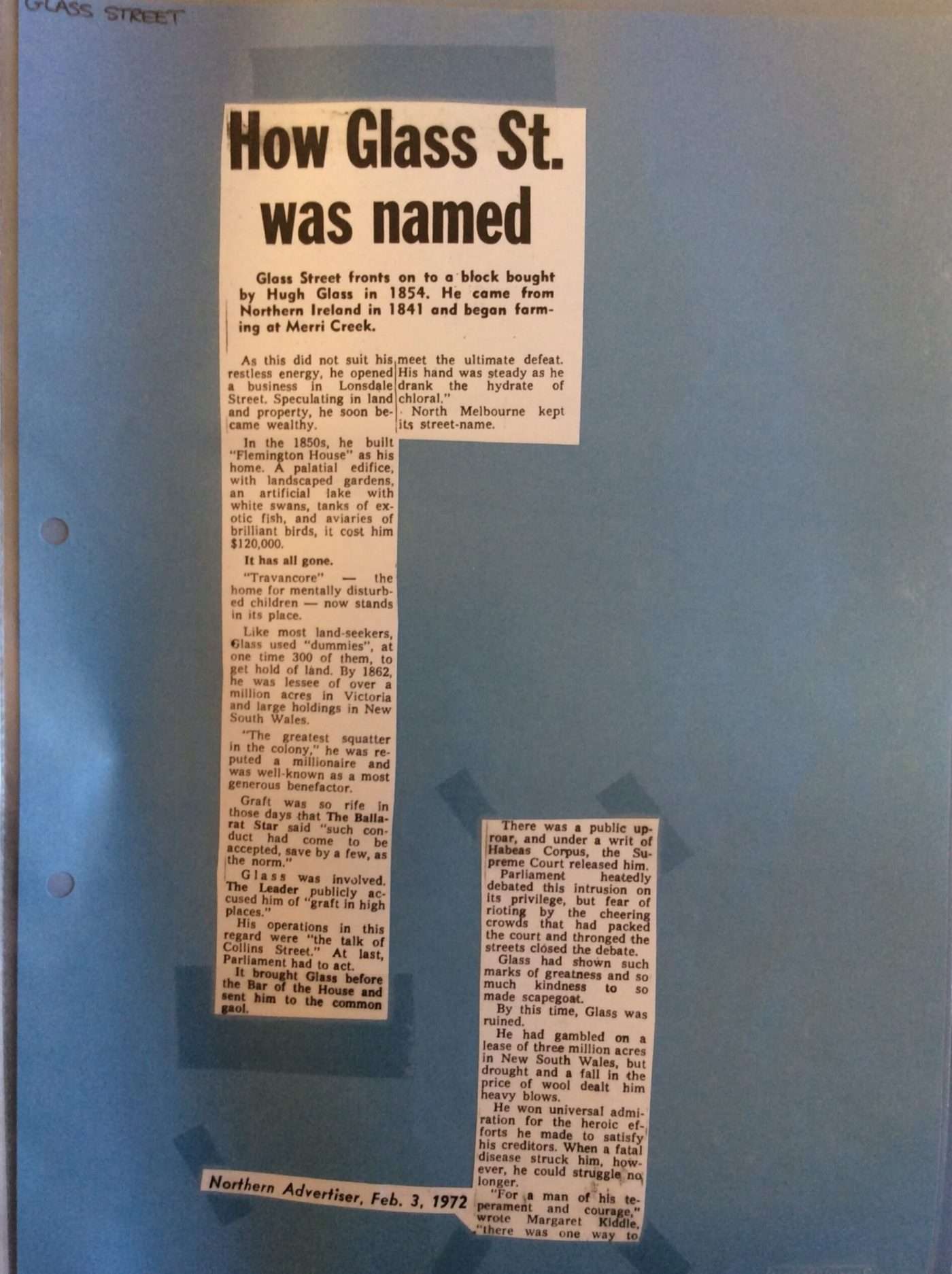
Glass Street

Glass Street North Melbourne fronts on to a block bought by Hugh Glass in 1854. He came from Northern Ireland in 1841 and began farming at Merri Creek.(1) Source. (1) Northern Advertiser Feb. 3, 1972. Blanchard collection, “What’s in a Name” at North Melbourne Library.

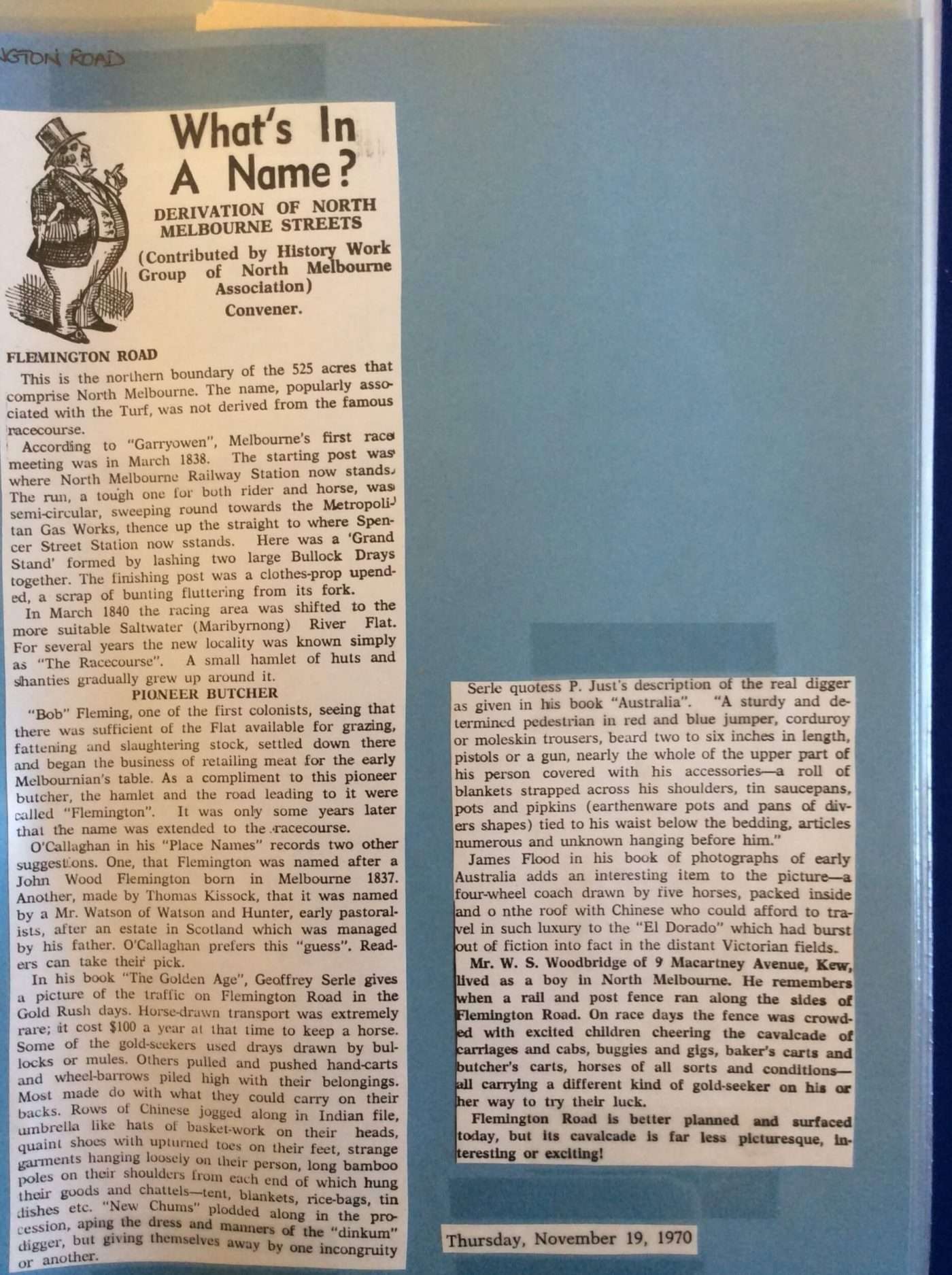
Flemington Road

This is the northern boundary of the 525 acres that comprise North Melbourne. The name, popularly associated with the Turf, was not derived from the famous racecourse. According to “Garryowen”, Melbourne’s first race meeting was in March 1838. The starting post was where North Melbourne Railway Station now stands. The run, a tough one for both rider and horse, was semi-circular, sweeping round towards the Metropolitan Gas Works, thence up the straight to where Spencer Street Station now stands. Here was a ‘Grand Stand’ formed by lashing two large Bullock Drays together. The finishing post was a clothes-prop upend-ed, a scrap of bunting fluttering from its fork. In March 1840 the racing area was shifted to the more suitable Saltwater (Maribyrnong) River Flat. For several years the new locality was known simply as “The Racecourse”. A small hamlet of huts and shanties gradually grew up around it. PIONEER BUTCHER  “Bob” Fleming, one of the first colonists, seeing that there was sufficient of the Flat available for grazing, fattening and slaughtering stock, settled down there and began the business of retailing meat for the early Melbournian’s table. As a compliment to this pioneer butcher, the hamlet and the road leading to …

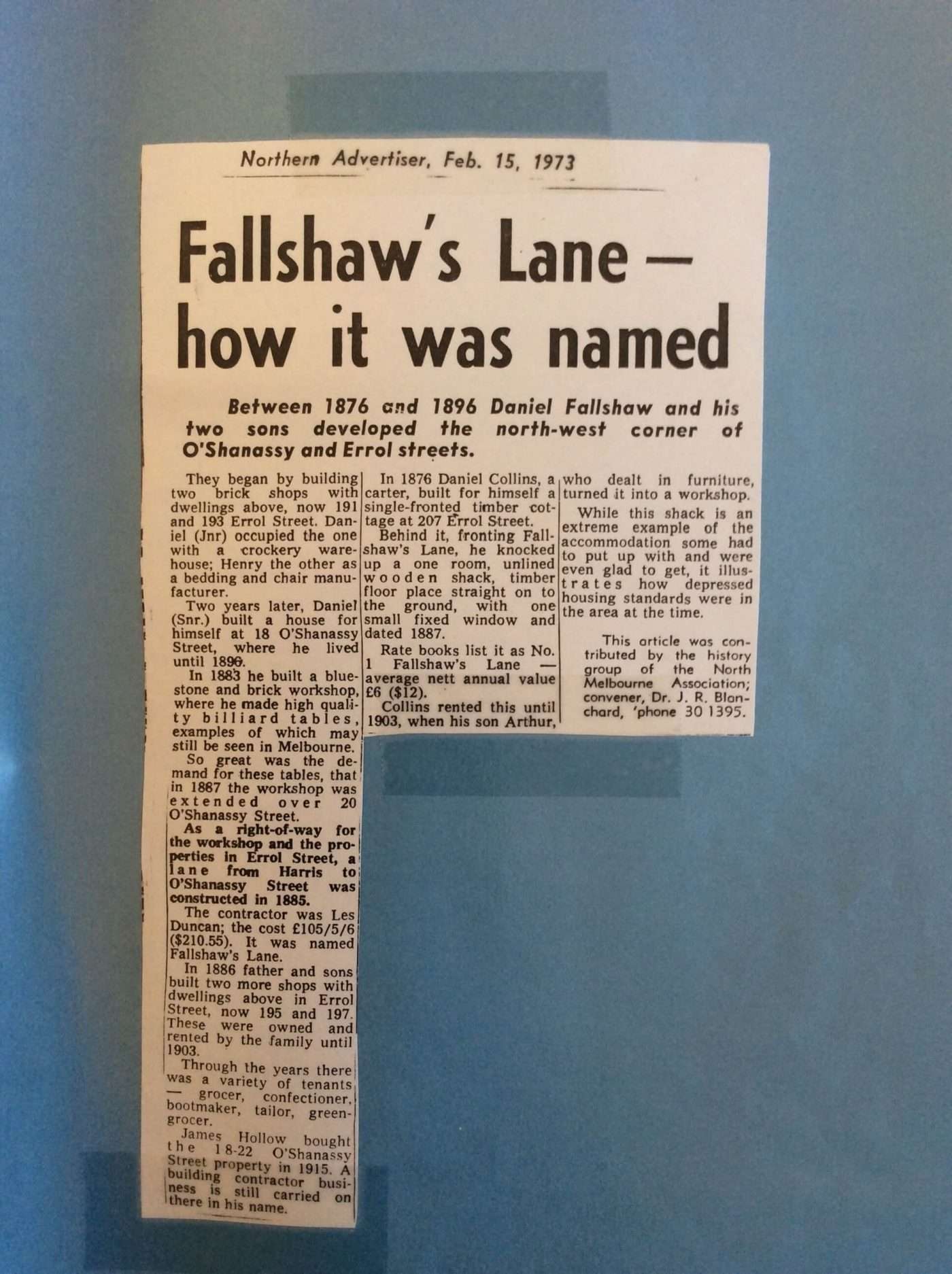
Fallshaws Lane

Named after Daniel Fallshaw. He and his two sons developed the north-west corner of O’Shanassy and Errol streets in North Melbourne. Source (1) Northern Advertiser, Feb. 15, 1973. Blanchard collection, “What’s in a Name” at North Melbourne Library.

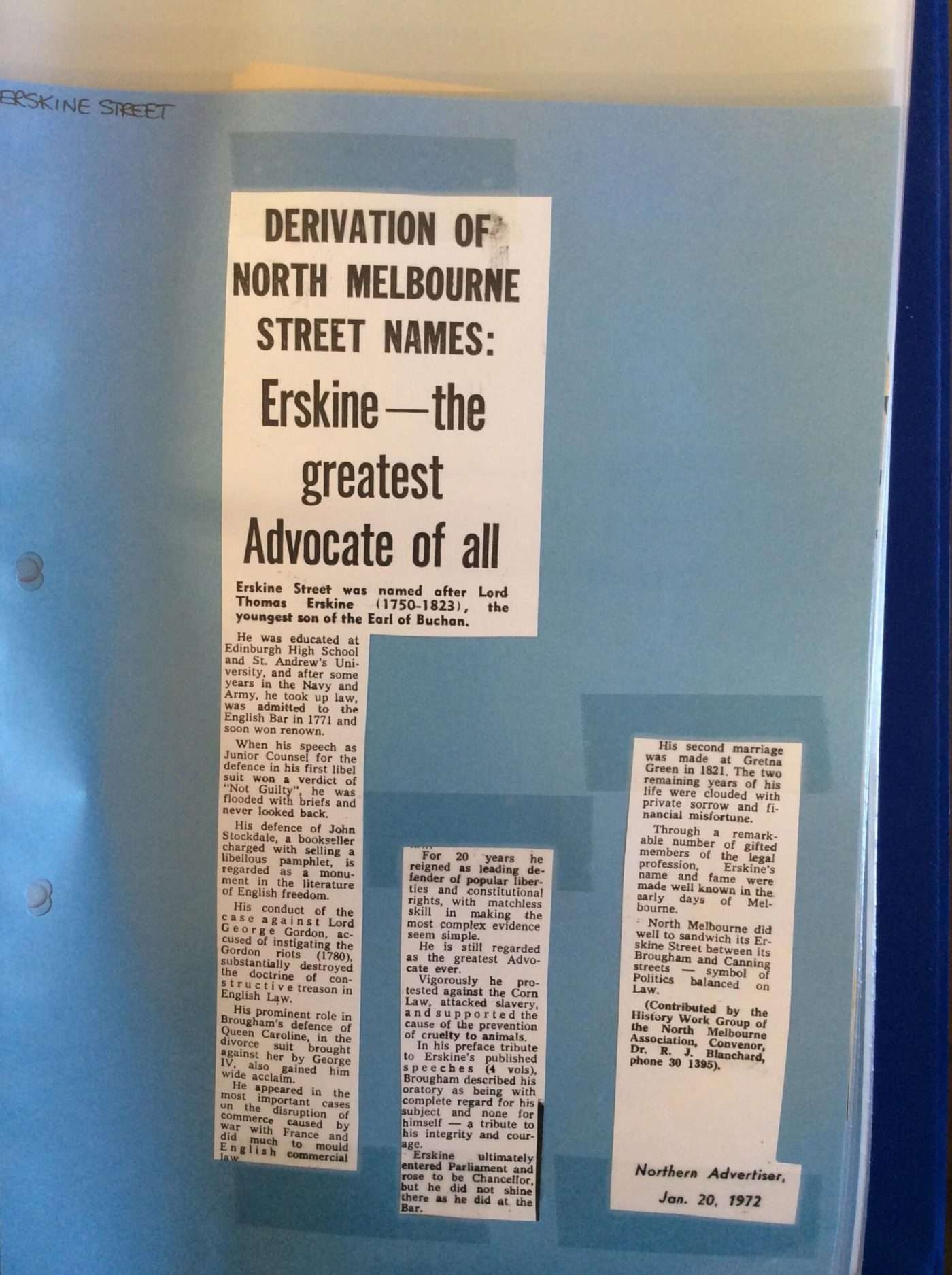
Erskine Street

Erskine – the greatest Advocate of all. Erskine Street was named after Thomas Erskine (1750-1823), youngest son of the Earl of Buchan. Vigorously he protested against the Corn Law, attacked slavery, and supported the cause of the prevention of cruelty to animals. Through a remarkable number of gifted members of the legal profession, Erskine’s name and fame were made well known in the early days of Melbourne. North Melbourne did well to sandwich its Erskine Street between its Brougham and Canning streets — symbol of Politics balanced on Law.(1) Source. (1) Northern Advertiser, Jan. 20, 1972. Blanchard collection, “What’s in a Name” at North Melbourne Library.

Elm Street

Many Melbourne suburbs have streets named after trees. To mention a few — Doveton has at least 14, Heidelberg and Blackburn 10, Bayswater, Thomastown and Caulfield 9. North Melbourne has one only. In the early days, visitors from Britain often remarked on how features of the “home” landscape were being introduced into the Australian scene. English trees, particularly oaks and elms, were planted in parks, the grounds of institutions and private gardens. The North Melbourne Benevolent Asylum, whose 10 acres straddled Victoria Street at its “T” junction with Curzon Street, was a good example of this. In July, 1849, the Argus complained that cases of destitution were committed to the city watch-house because there was no-where else for them to go. Three months later, the Victorian Benevolent Society reported that too many hospital beds were being occupied by cases more suitable for a different kind of institution, because of the “incurable nature of their diseases and the completely shattered state of their constitution”. To meet the obvious need, the Government granted the land and £1000 ($2000) for such an institution. So the Benevolent Asylum was opened on November 27, 1851, with 32 inmates. At its jubilee in 1900 there were …