Dryburgh Street

    “Burgh” is a shortened form of “borough”; obsolete in ordinary English usage since the 17th century, but retained in Scotland for a town possessing a charter. It is pronounced “borough’ not “berg”. This street is a sign of Scottish nostalgia. It was named after Dryburgh Abbey, which stands in a setting of sheer beauty on a horse shoe of land encircled by the river Tweed. It looks out on the triple peaks of the Eildon Hills (1300 feet), where sacrifices were once made to the sun-god, and, later, the Romans built a great military camp. It took 12 years to build. Meantime, the builders—English and Scottish monks— lived in wooden huts on the river-bank, feeding well on the excellent salmon the river provided. The Abbey was completed on 13th December, 1152. Years of, suffering awaited it. In 1322 the retreating army of Edward II set the place ablaze. Helped by liberal gifts from Robert the Bruce, the monks restored it. In 1385, Richard II’s men made a bonfire of it again. Once more the monks restored it. At last in 1545, the English army under Hertford left it a smoking ruin. Centuries of neglect completed the destruction. Nov …
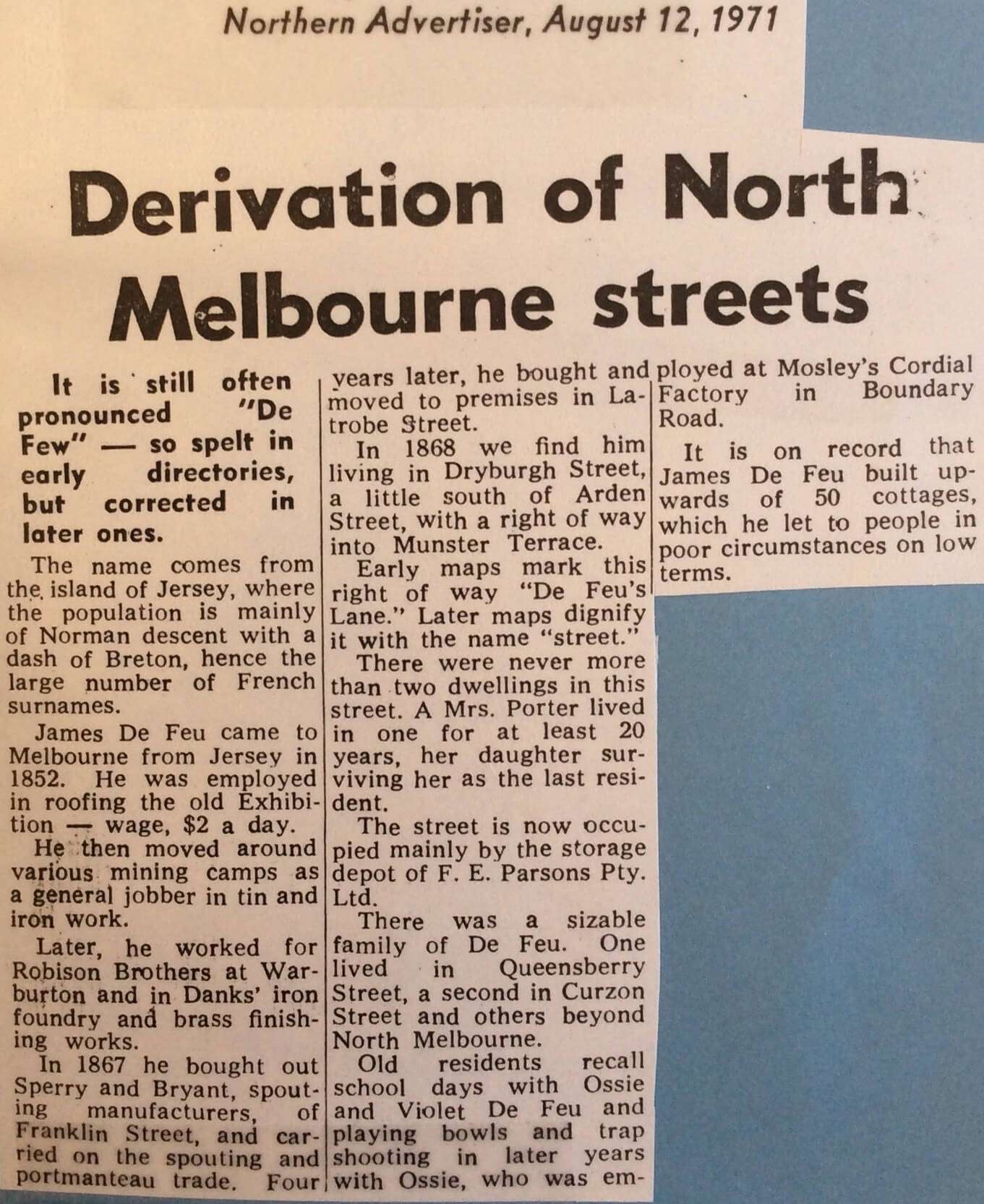
De Feu Street

It is still often pronounced “De Few” so spelt in early directories, but corrected in later ones. The name comes from the, island of Jersey, where the population is mainly of Norman descent with a dash of Breton, hence the large number of French surnames. James De Feu came to Melbourne from Jersey in 1852. He was employed in roofing the old Exhibition, wage, $2 a day. He then moved around various mining camps as a general jobber in tin and iron work. Later, he worked for Robison Brothers at Warburton and in Danks’ iron foundry and brass finishing works. In 1867 he bought out Sperry and Bryant, spouting manufacturers, of Franklin Street, and carried on the spouting and portmanteau trade. Four years later, he bought and moved to premises in Latrobe Street. In 1868 we find him living in Dryburgh Street, a little south of Arden Street, with a right of way into Munster Terrace. Early maps mark this right of way “De Feu’s Lane.” Later maps dignify it with the name “street.” There were never more than two dwellings in this street. A Mrs. Porter lived in one for at least 20 years, her daughter surviving her as the last resident. The …

Courtney Street

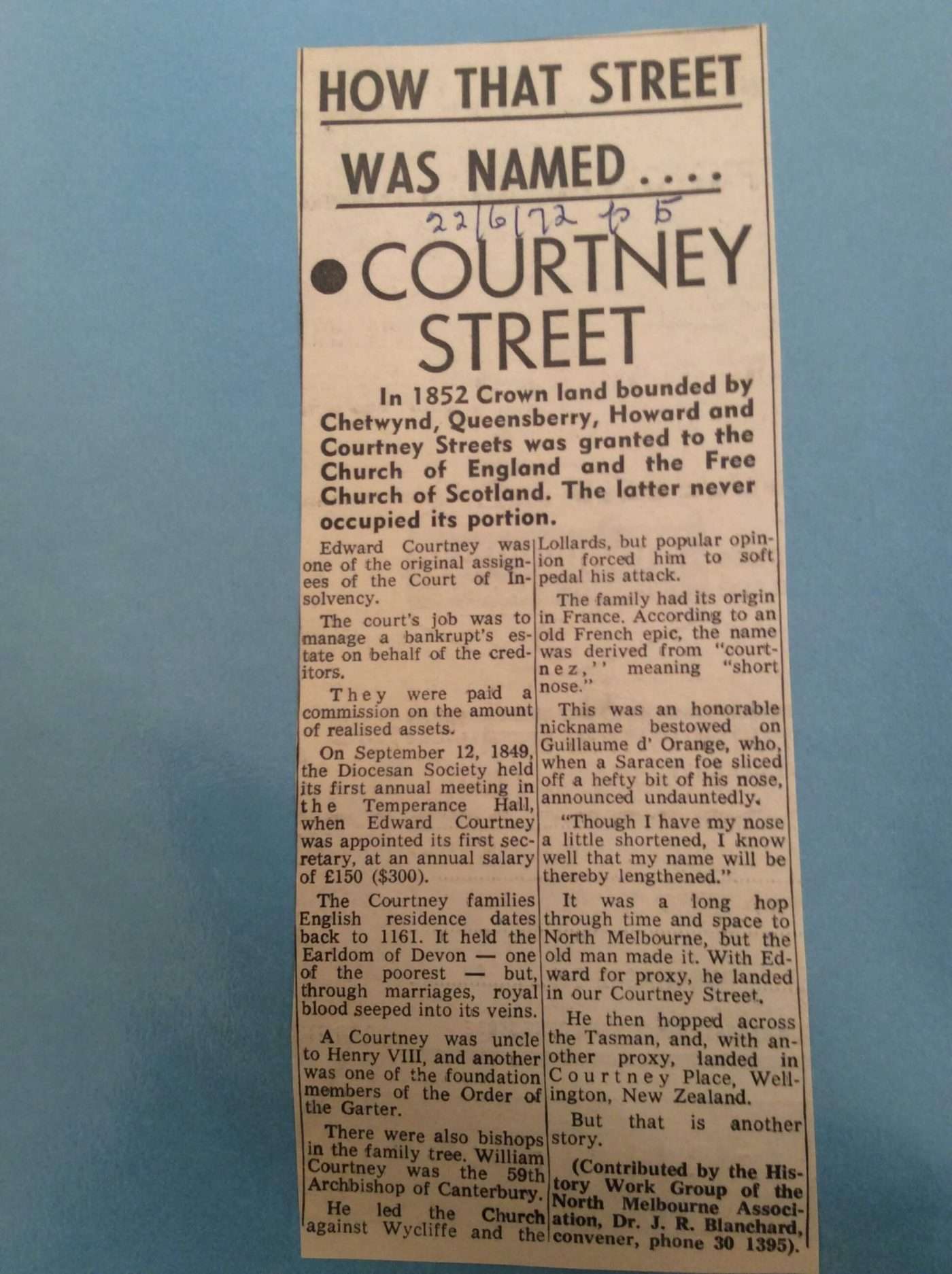
In 1852 Crown land bounded by Chetwynd, Queensberry, Howard and Courtney Streets was granted to the Church of England and the Free Church of Scotland. The latter never occupied its portion. Edward Courtney was one of the original assignees of the Court of Insolvency. The court’s job was to manage a bankrupt’s estate on behalf of the creditors. They were paid a commission on the amount of realised assets. On September 12, 1849, the Diocesan Society held its first annual meeting in the Temperance Hall, when Edward Courtney was appointed its first secretary, at an annual salary of £150 ($300). The Courtney families English residence dates back to 1161. It held the Earldom of Devon –one of the poorest — but, through marriages, royal blood seeped into its veins. A Courtney was uncle to Henry VIII, and another was one of the foundation members of the Order of the Garter. There were also bishops in the family tree. William Courtney was the 59th Archbishop of Canterbury. He led the Church against Wycliffe and the Lollards, but popular opinion forced him to soft pedal his attack. The family had its origin in France. According to an old French epic, the name …

Costello Lane

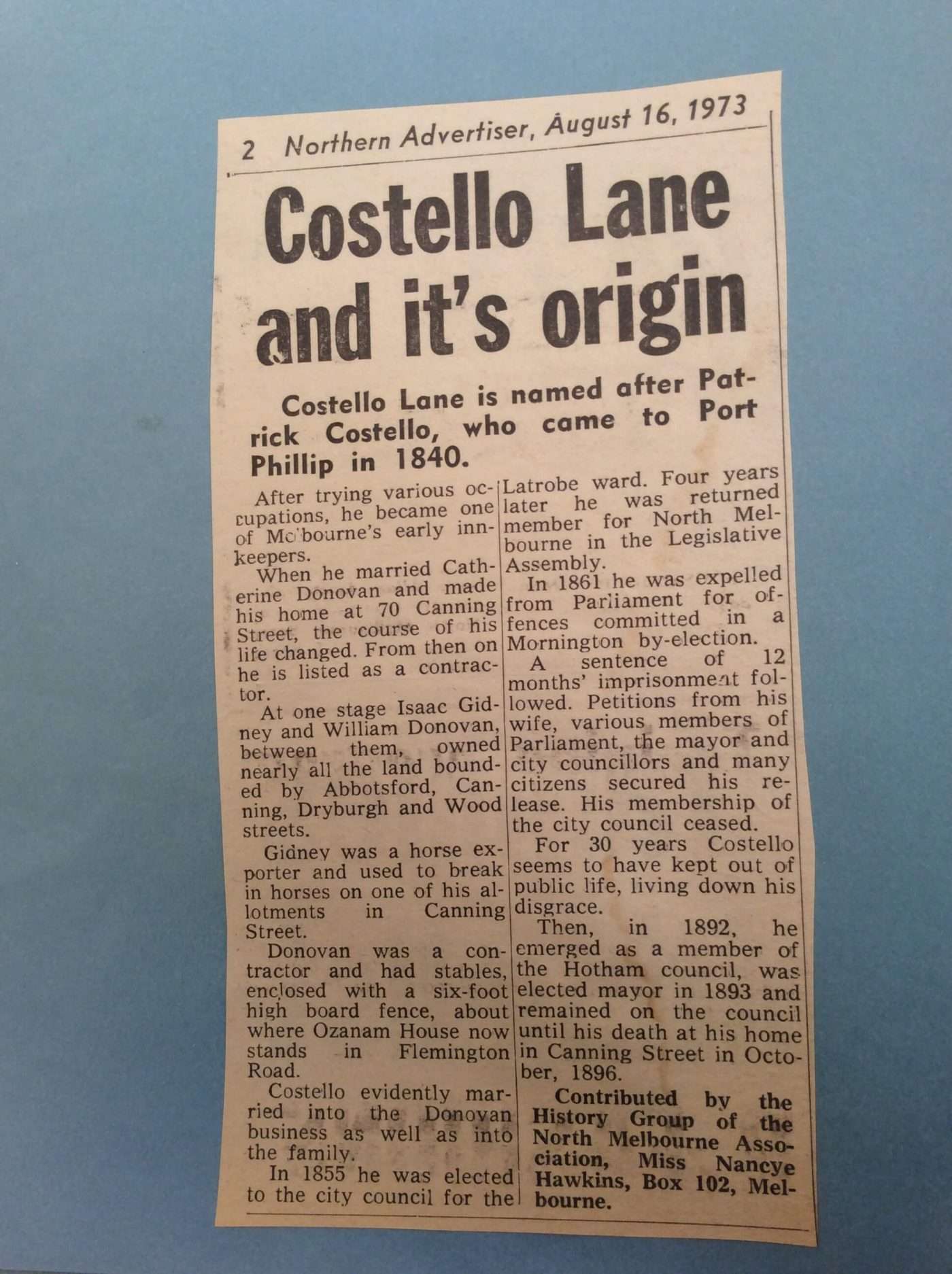
Costello Lane in North Melbourne is named after Patrick Costello, who came to Port Phillip in 1840. In 1855 he was elected to the city council for the Latrobe ward. Four years later he was returned member for North Melbourne in the Legislative Assembly. 1892, he emerged as a member of the Hotham council, was elected mayor in 1893 and remained on the council until his death at his home in Canning Street in October, 1896.(1) Source (1) Northern Advertiser, August 16,1973. by Nancye Hawkins from the Blanchard collection, “What’s in a Name” at North Melbourne Library. Recent research indicates there was no connection between Catherine Donovan, wife of Patrick Costello of Canning Street, and William Donovan of Wood Street, North Melbourne.

Chetwynd Street

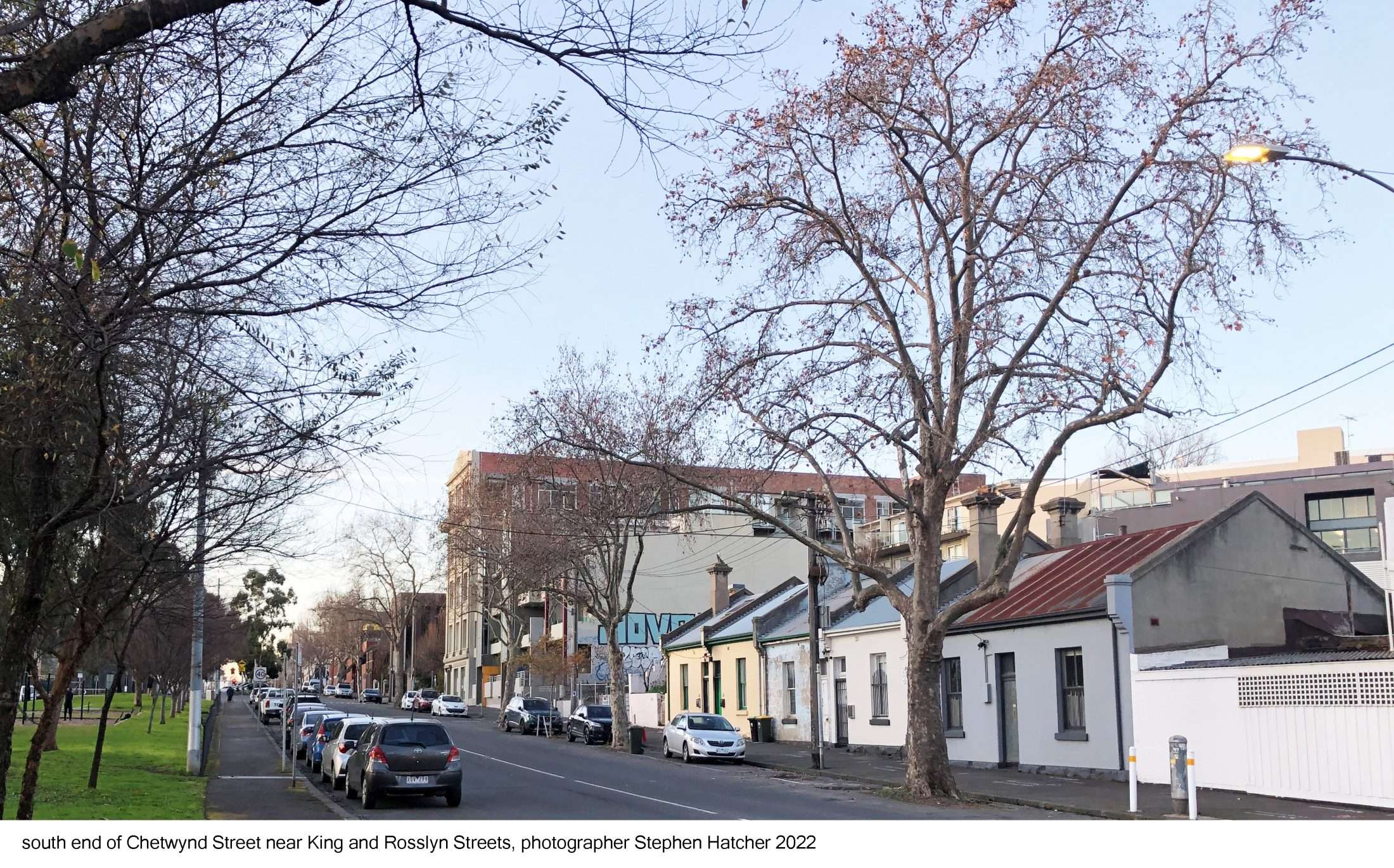
  Named after Granville William Chetwynd Stapylton. Stapylton came to Australia in 1828 as assistant surveyor in New South Wales. While engaged in surveying the coast south of Brisbane, aborigines attacked his camp, and he was killed on the 31st May 1840. His body was brought to Brisbane. Stapylton has left behind him the name of his Paternal grandfather in our Chetwrnd Street, North Melbourne.(1) Source. (1) Northern Advertiser, 18/3/1971. Blanchard collection, “What’s in a Name” at North Melbourne Library.

Chapman Street

Named after Henry Samuel Chapman (1803-1881). (1) Source. (1) Northern Advertiser 13/8/1970. Blanchard collection, “What’s in a Name” at North Melbourne Library and from the “Australian Dictionary” of Biography.

Capel Street

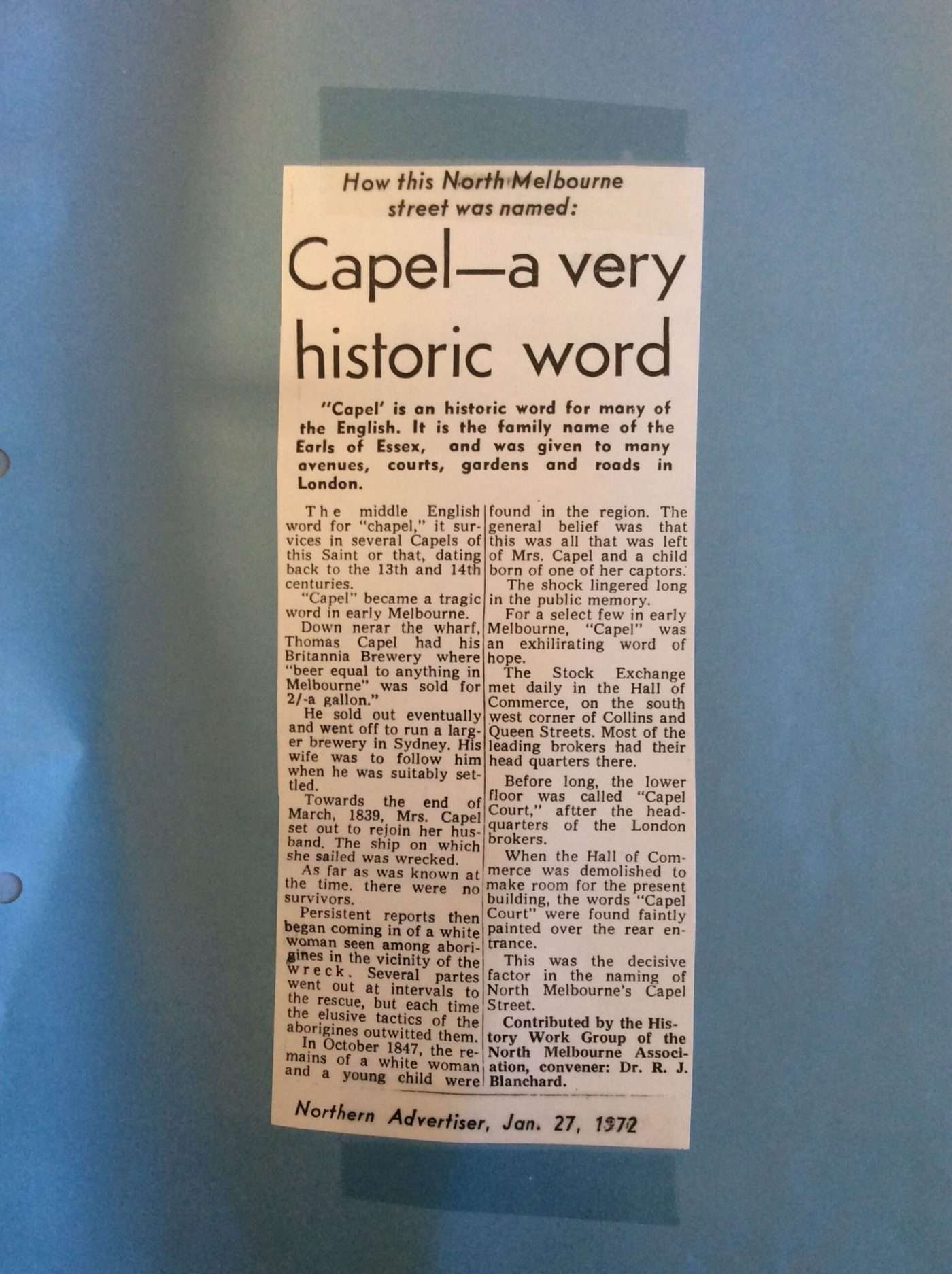
Capel Street begins in West Melbourne where it intersects with William Street before it heads north and ends when it runs into Bedford Street, North Melbourne. It is thought the street was named after Thomas Bladen Capel, a Londoner born in 1776, the son of William Capel and Harriet Bladen. He had a distinguished naval career, fighting for his king in the 1805 Battle of Trafalgar against the French and Spanish during the Napoleonic Wars. Capel Street’s earliest residents began settling in around 1854, six years before the street was officially documented in the government gazette.  The area’s first significant landmark, known then as the cattle yard, had begun even earlier, in 1842, on the corner of Elizabeth and Victoria Streets. The street was first mentioned in the Argus in August, 1854, in an advertisement placed by local resident George Holt Miller, a master wheelwright and farrier. He announced his interest in selling two superior Scottish-built Whitechapel two-wheeled spring-carts, then all the rage in London. Miller has his own intriguing story. After arriving in Port Phillip in 1833 as a six-year-old, later in adulthood, he married Sarah Lambert in 1851. After she died during child birth, George married Helen McPherson …

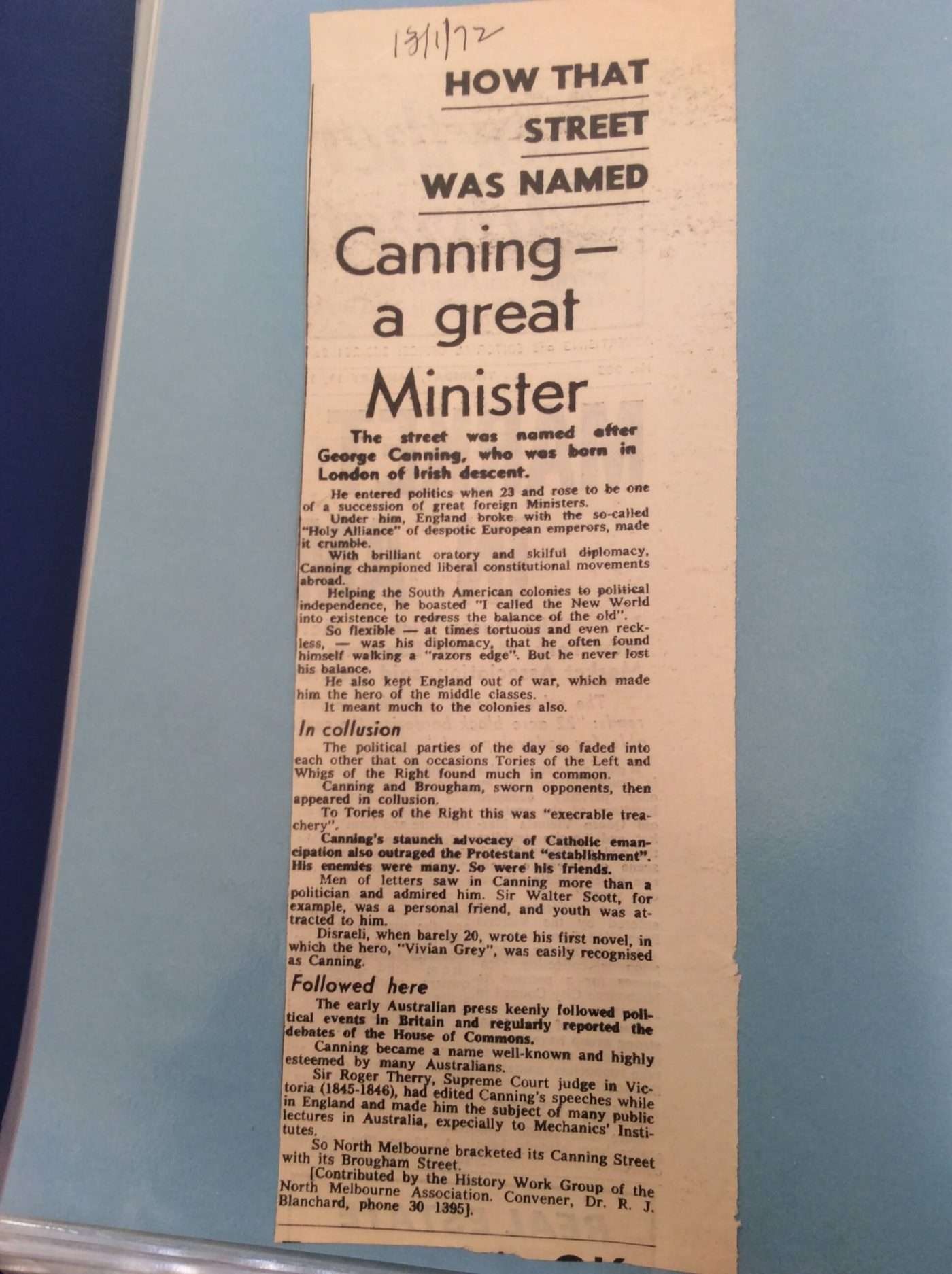
Canning Street

The street was named after George Canning, who was born in London of Irish descent. Followed here The early Australian press keenly followed political events in Britain at the time and regularly reported the debates of the House of Commons. Canning became a name well-known and highly esteemed by many Australians. Sir Roger Therry’ Supreme Court judge in Victoria (1845-1846), had edited Canning’s speeches while in England and made him the subject of many public lectures in Australia, especially to Mechanics’ Institutes. So North Melbourne bracketed its Canning Street with its Brougham Street.(1) Source. Northern Advertiser 13/1/1972. Blanchard collection, “What’s in a Name” at North Melbourne Library.

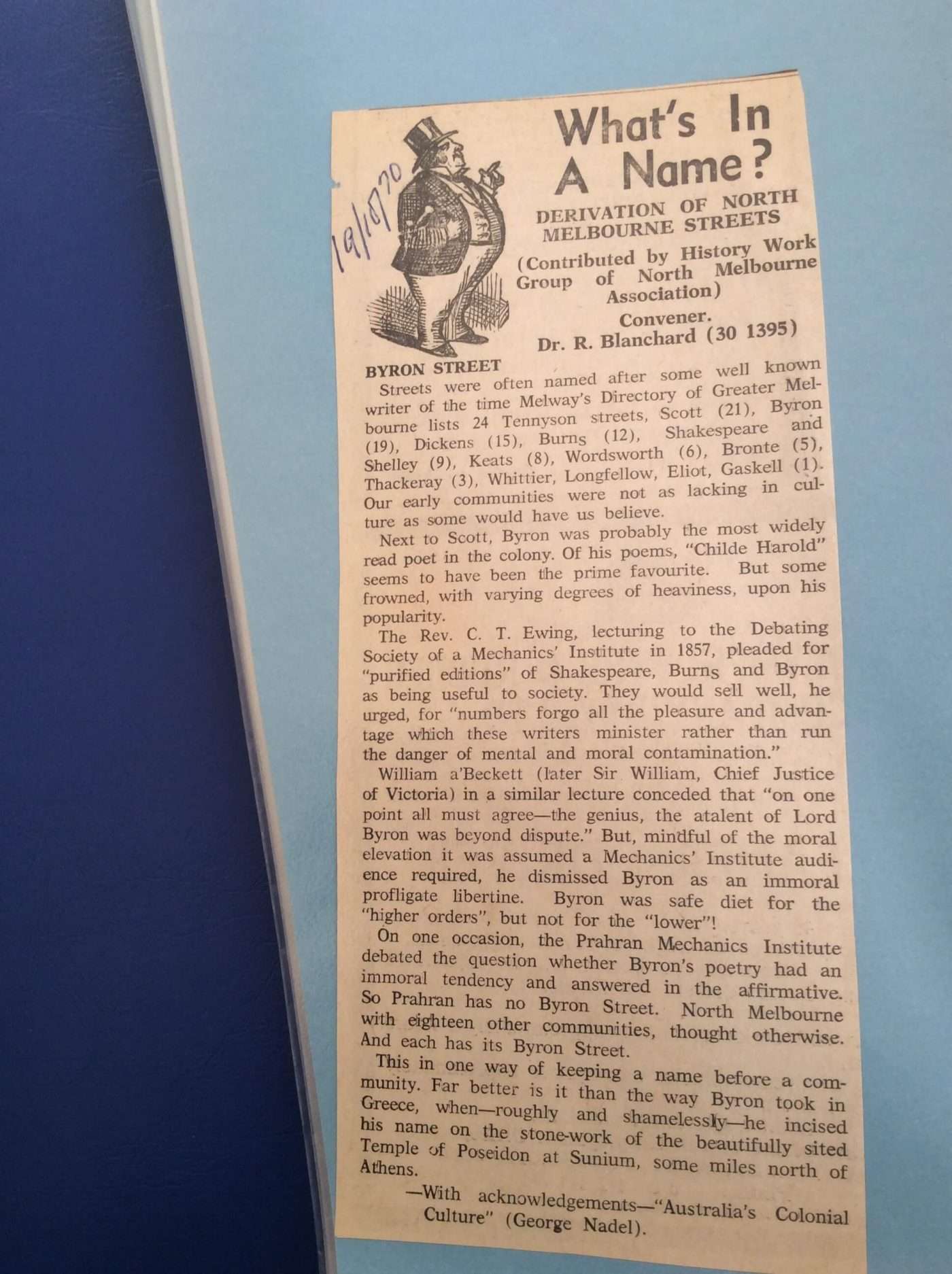
Byron Street

Streets were often named after some well known writer of the time Melway’s Directory of Greater Melbourne lists 24 Tennyson streets, Scott (21), Byron (19), Dickens (15), Burns (12), Shakespeare and Shelley (9), Keats (8), Wordsworth (6), Bronte (5), Thackeray (3), Whittier, Longfellow, Eliot, Gaskell (1). Our early communities were lacking in culture as some would have us believe. Next to Scott, Byron was probably the most widely read poet in the colony. Of his poems, “Childe Harold” seems to have been the prime favorite. But some frowned, with varying degrees of heaviness, upon his popularity. The Rev. C. T. Ewing, lecturing to the Debating Society of a Mechanics’ Institute in 1857, pleaded for “purified editions” of Shakespeare, Burns and Byron as being useful to society. They would sell well, he urged, for “numbers forgo all the pleasure and advantage which these writers minister rather than run the danger of mental and moral contamination.” William a’Beckett (later Sir William, Chief Justice of Victoria) in a similar lecture conceded that “on one point all must agree—the genius, the a talent of Lord Byron was beyond dispute.” But, mindful of the moral elevation it was assumed a Mechanics’ Institute audience required, he …

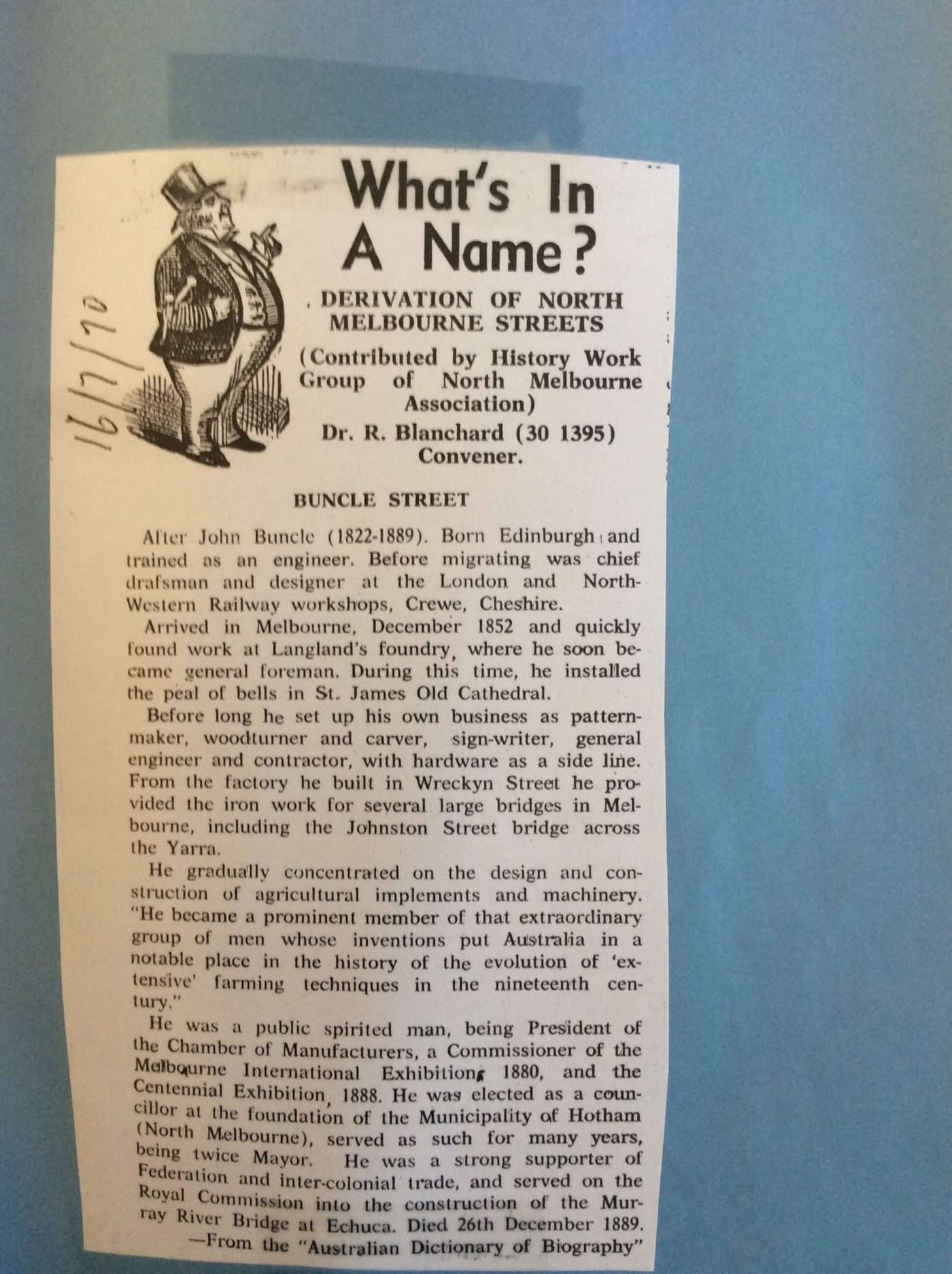
Buncle Street

Named after John Buncle (1822-1889). Born Edinburgh and trained as an engineer. Before migrating was chief draftsman and designer at the London and North-Western Railway workshops, Crewe, Cheshire.(1) Source. (1) Northern Advertise 16/7/1970. Blanchard collection, “What’s in a Name” at North Melbourne Library and from the Australian Dictionary, of Biography.