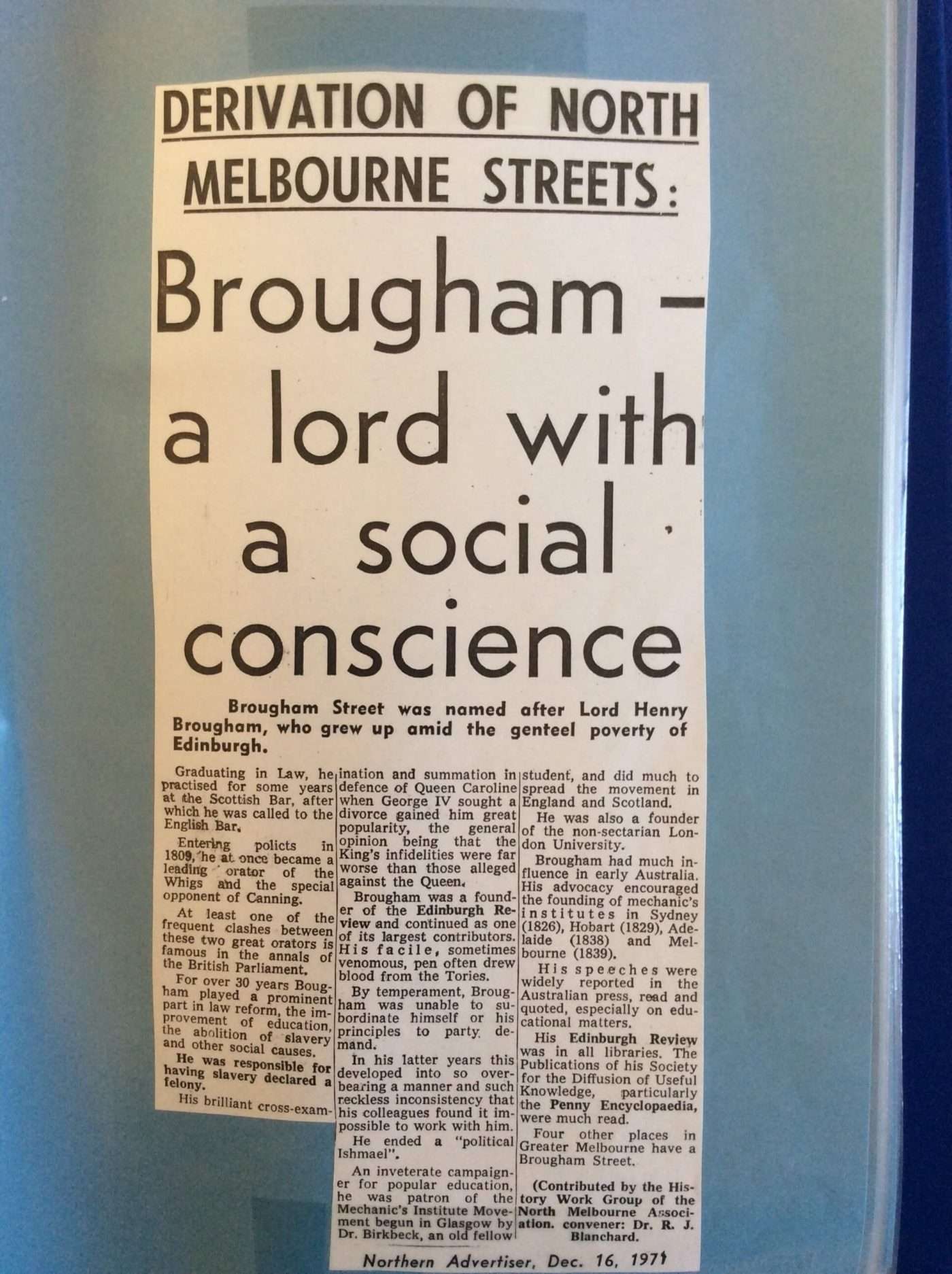
Brougham Street was named after Lord Henry Brougham, who grew up amid the genteel poverty of Edinburgh. Brougham had much influence in early Australia. His advocacy encouraged the founding of mechanic’s institutes in Sydney (1826), Hobart (1829), Adelaide (1838) and Melbourne (1839). His speeches were widely reported in the Australian press, read and quoted, especially on educational matters. His Edinburgh Review was in all libraries. The Publications of his Society for the Diffusion of Useful Knowledge, particularly the Penny Encyclopaedia, were much read. Four other places in Greater Melbourne have a Brougham Street.(1) Source. (1) Northern Advertiser, Dec. 16, 1971. Blanchard collection, “What’s in a Name” at North Melbourne Library.
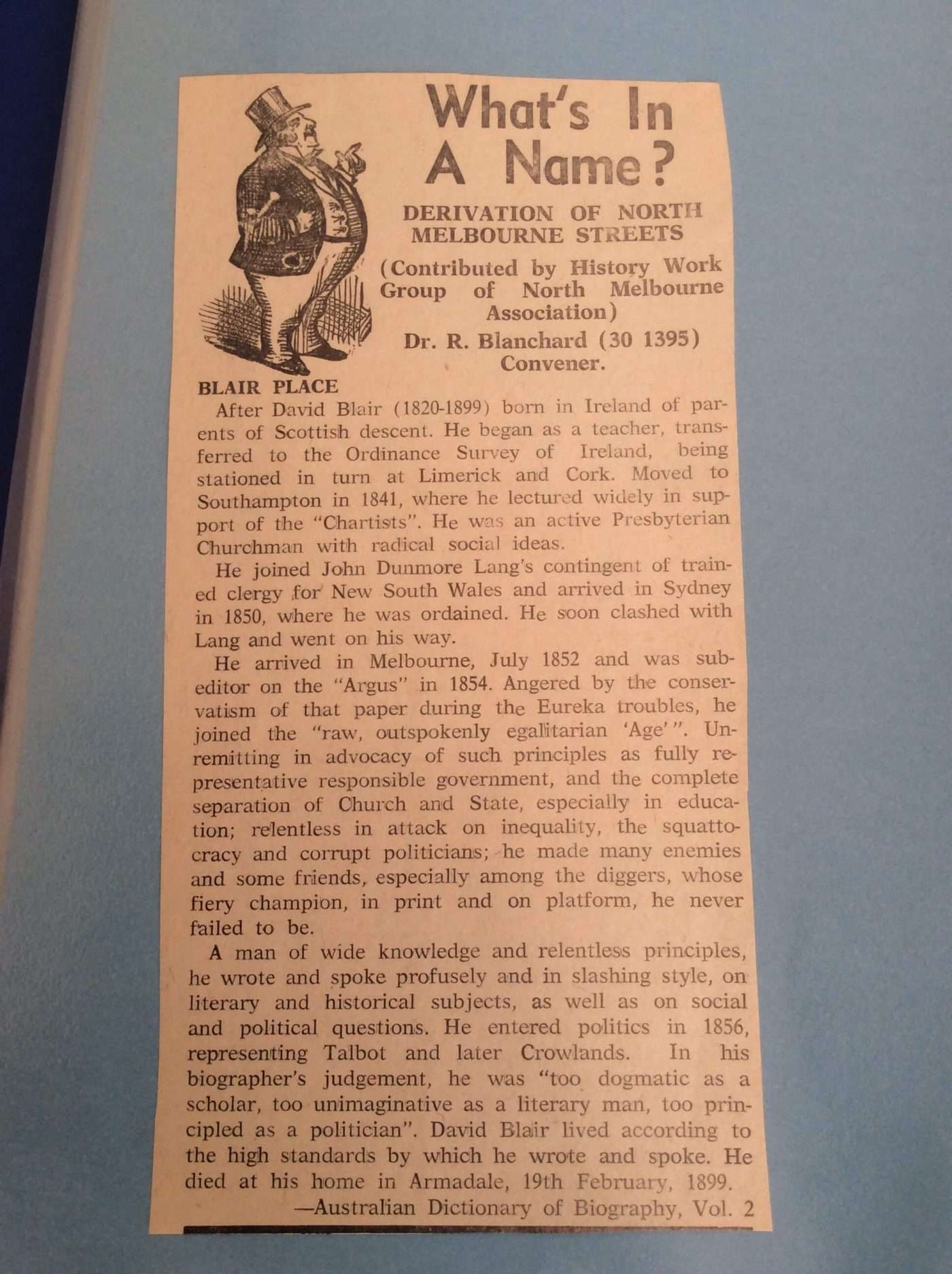
Blair Place
Named after David Blair (1820-1899) born in Ireland of parents of Scottish descent.(1) Source. (1) Northern Advertiser 1972. Blanchard collection, “What’s in a Name” at North Melbourne Library.Australian Dictionary of Biography, Vol. 2
Blackwood Street
Named after John Hutchison Blackwood (1827-1908). Born Kirkoswald, Ayrshire, Scotland. An ancestor was a Privy Councillor to Mary, Queen of Scots. Arrived Melbourne, 21st August, 1852.(1) Source. Northern Advertiser Thursday, May 7, 1970. Blanchard collection, “What’s in a Name” at North Melbourne Library.
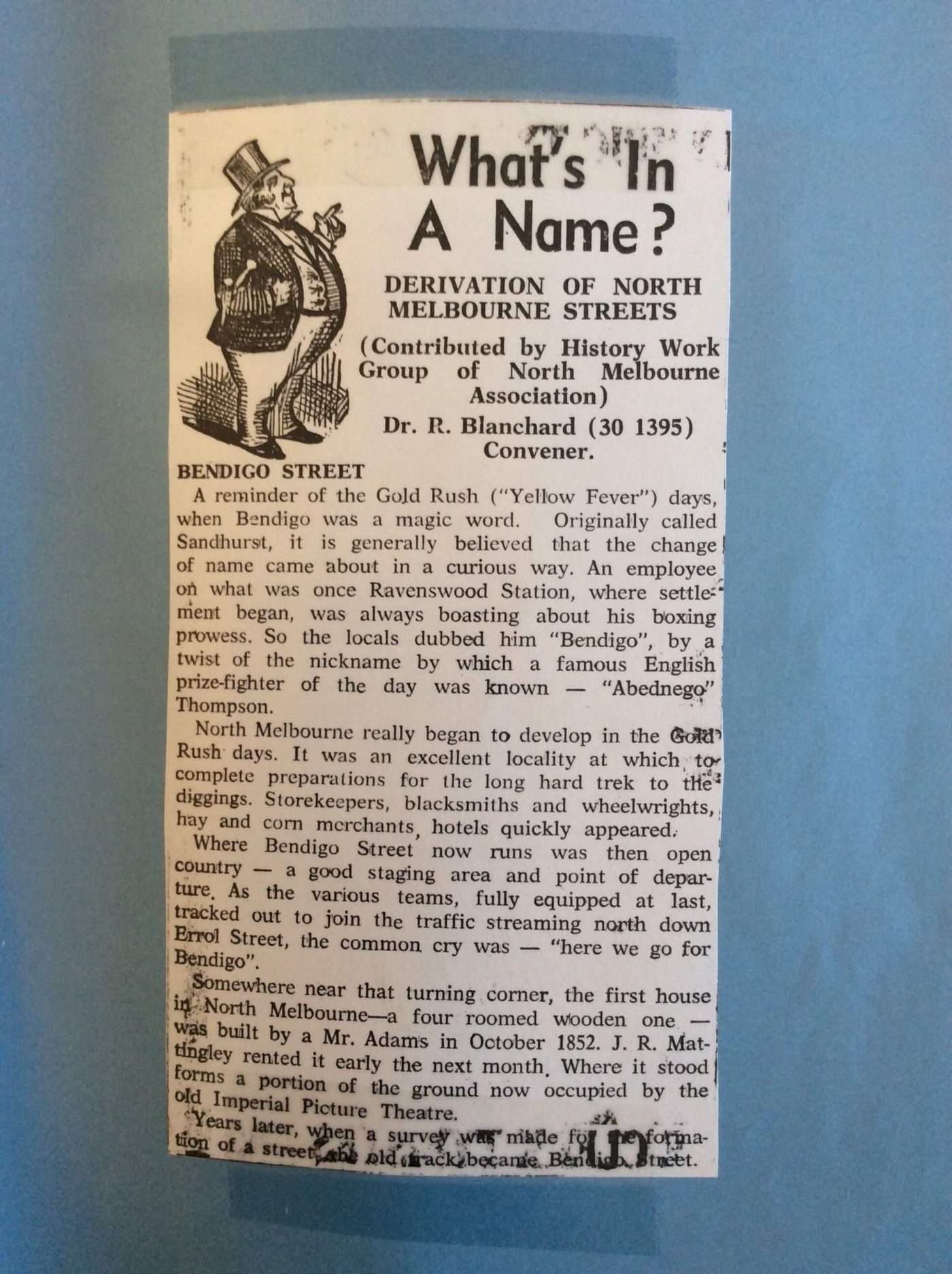
Bendigo Street
A reminder of the Gold Rush (“Yellow Fever”) days, when Bendigo was a magic word. Originally called Sandhurst, it is generally believed that the change of name came about in a curious way. An employee on what was once Ravenswood Station, where settlement began, was always boasting about his boxing prowess. So the locals dubbed him “Bendigo”, by twist of the nickname by which a famous English prize-fighter of the day was known “Abednegoe” Thompson. North Melbourne really began to develop in the Gold Rush days. It was an excellent locality at which, to complete preparations for the long hard trek to diggings. Storekeepers, blacksmiths and wheelwrights, hay and corn merchants, hotels quickly appeared. Where Bendigo Street now runs was then open country — a good staging area and point of departure. As the various teams, fully equipped at last, tracked out to join the traffic streaming north down Errol Street, the common, cry was “here we go for Bendigo”. Somewhere near that turning corner, the first house in North Melbourne-a four roomed wooden one I was, built by a Mr. Adams in October 1852. J. R. Mattingley rented it early the next month. Where it stood forms a portion …
Bedford Street
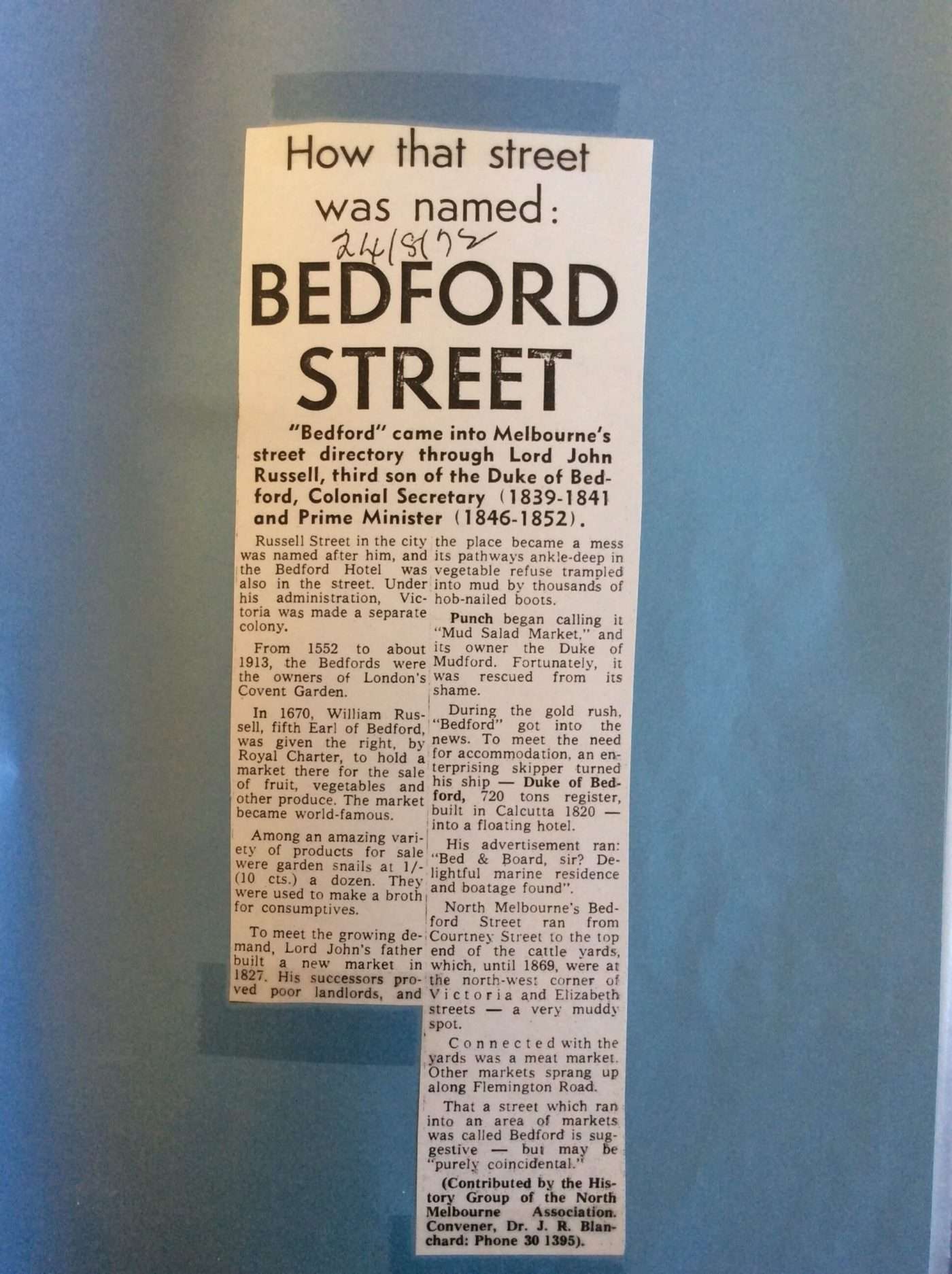
It came into Melbourne’s street directory through Lord John Russell, third son of the Duke of Bedford, Colonial Secretary (1839-1841 and Prime Minister (1846-1852). Russell Street in the city was named after him, and the Bedford Hotel was also in the street. Under his administration, Victoria was made a separate colony. From 1552 to about 1913, the Bedfords were the owners of London’s Covent Garden. In 1670, William Russell, fifth Earl of Bedford, was given the right, by Royal Charter, to hold a market there for the sale of fruit, vegetables and other produce. The market became world-famous. Among an amazing variety of products for sale were garden snails at 1/- (10 cts.) a dozen. They were used to make a broth, for consumptives. To meet the growing demand, Lord John’s father built a new market in 1827. His successors proved poor landlords, and the place became a mess its pathways ankle-deep in vegetable refuse trampled into mud by thousands of hob-nailed boots. Punch began calling it “Mud Salad Market.” and its owner the Duke of Mudford. Fortunately, it was rescued from its shame. During the gold rush, “Bedford” got into the news. To meet the need for accommodation. an …
Baillie Street
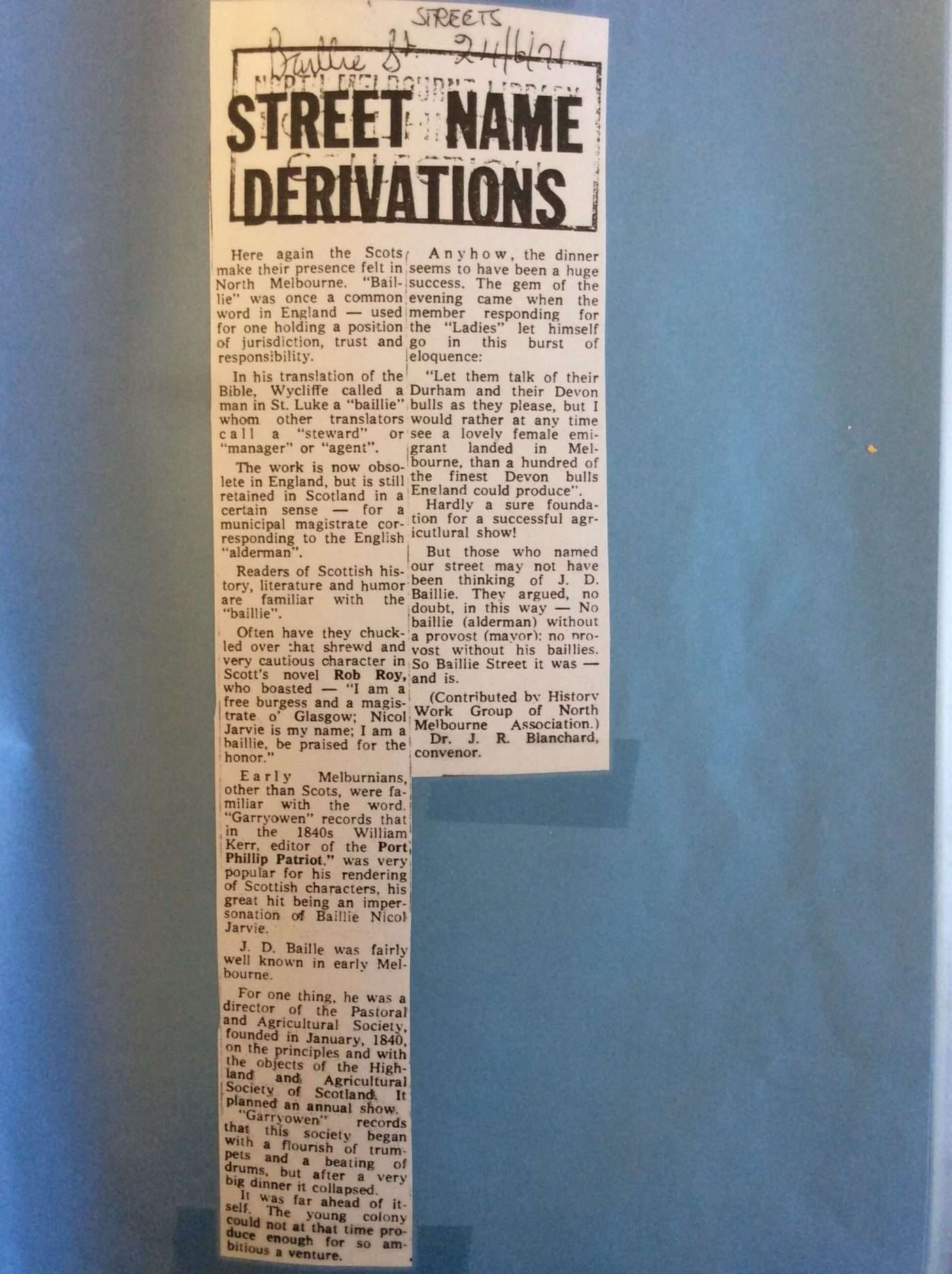
Here again the Scots make their presence felt in North Melbourne. “Baillie” was once a common in England — used for one holding a position of jurisdiction, trust and responsibility. In his translation of the Bible, Wycliffe called a man in St. Luke a “baillie” whom other translators call a “steward” or “manager” or “agent”. The work is now obsolete in England, but is still retained in Scotland in a certain sense — for a municipal magistrate corresponding to the English “alderman”. Readers of Scottish history, literature and humor are familiar with the Baillie. Often have they chuckled over that shrewd and very cautious character in Scott’s novel Rob Roy, who boasted — “I am a free burgess and a magistrate o’ Glasgow; Nicol Jarvie is my name; I am a be praised for the honor.” Early Melburnians, other than Scots, were familiar with the word. “Garryowen” records that in the 1840s William Kerr, editor of the Port Phillip Patriot.” was very, popular for his rendering: of Scottish characters, his great hit being an impersonation of Baillie Nicol Jarvie. J. D. Baillie was fairly well known in early Melbourne. For one thing, he was a director of the Pastoral’ and …
Avis Lane
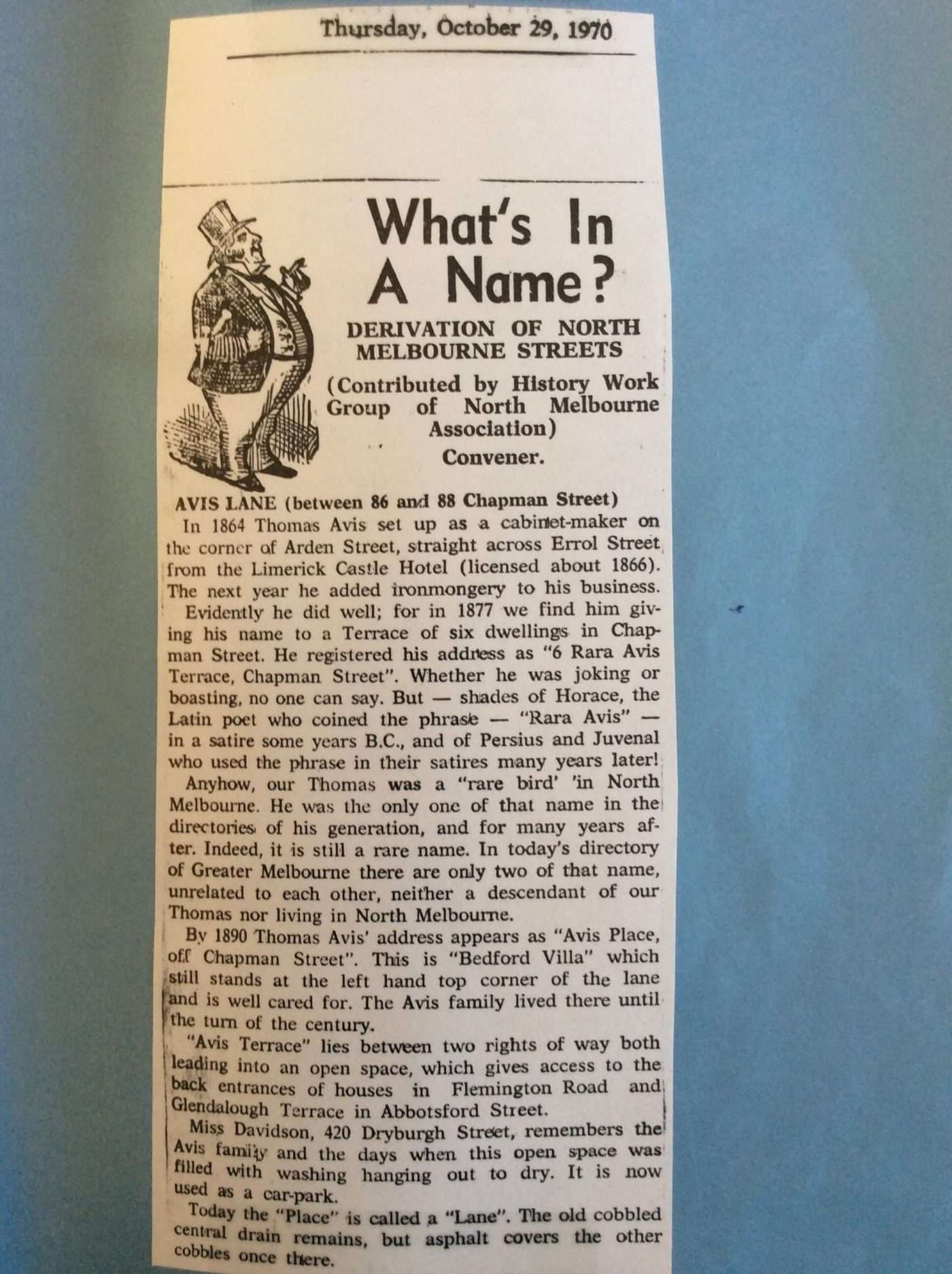
(between 86 and 88 Chapman Street) Named after Thomas Avis who in 1864 set up as a cabiniet-maker on the corner of Arden Street, straight across Errol Street from the Limerick Castle Hotel (licensed about 1866). Miss Davidson, 420 Dryburgh Street, remembers the Avis family and the days when this open space was filled with washing hanging out to dry. It is now used as a car-park. Today the “Place” is called a “Lane”. The old cobbled central drain remains, but asphalt covers the other cobbles once there.(1) Source. (1) Northern Advertiser Thursday, October 29. 1970. Blanchard collection, “What’s in a Name” at North Melbourne Library.
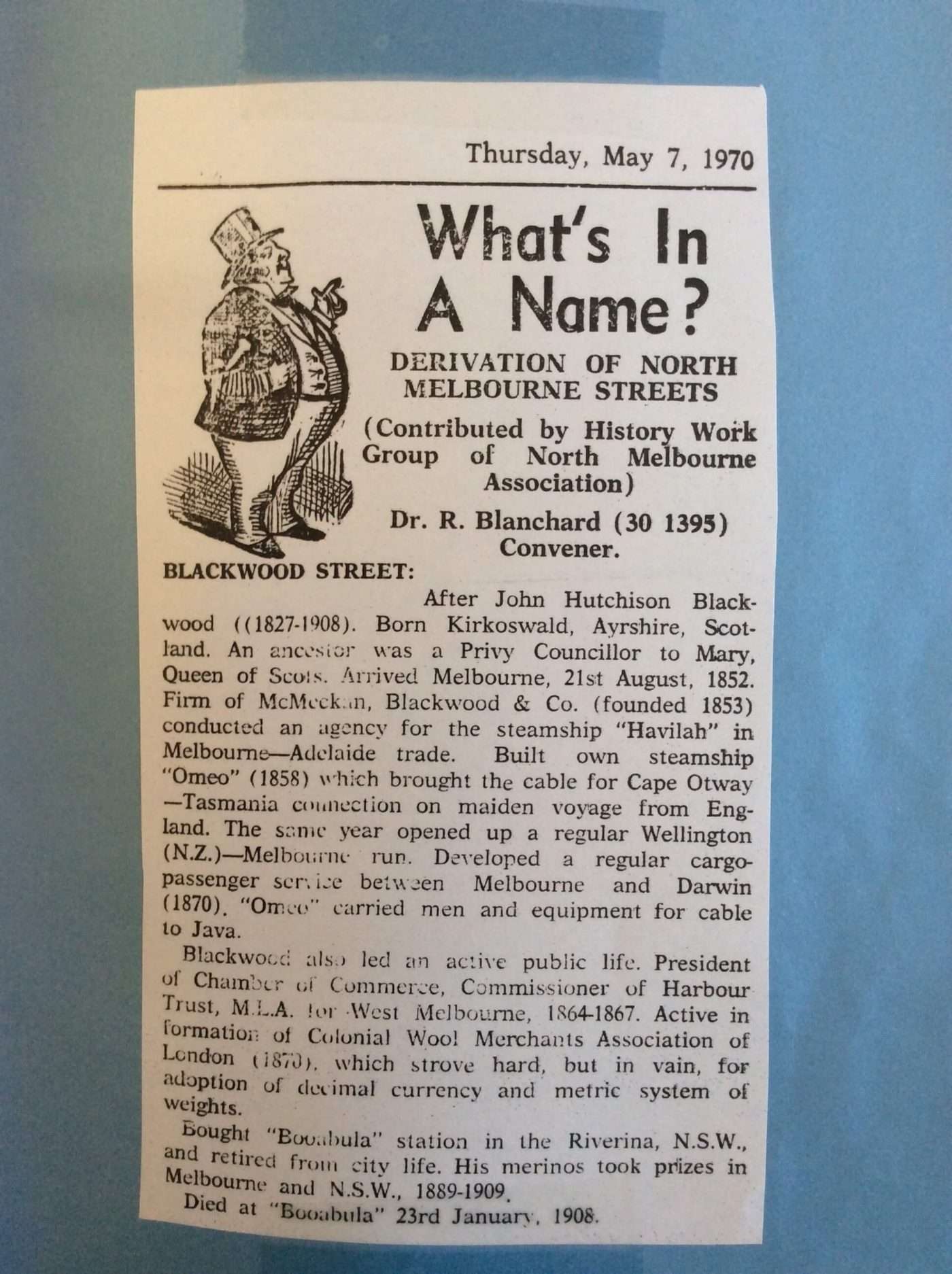
Atkin Street
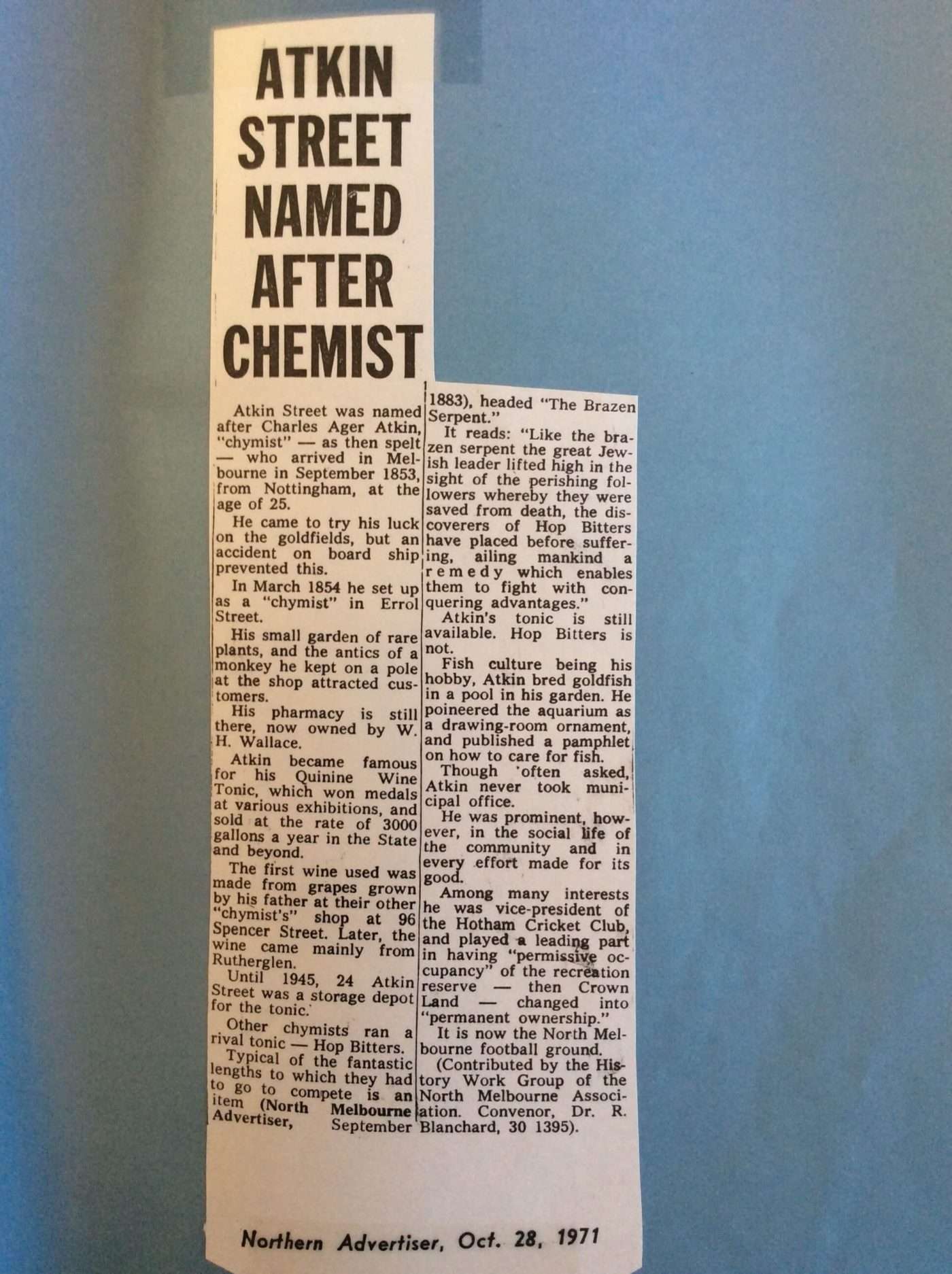
Atkin Street North Melbourne was named after Charles Ager Atkin, “chymist” — as then spelt — who arrived in Melbourne in September 1853, from Nottingham, at the age of 25. He came to try his luck on the goldfields, but an accident on board the ship prevented this.(1) Source. (1) Northern Advertiser, Oct. 28, 1971. Blanchard collection, “What’s in a Name” at North Melbourne Library.
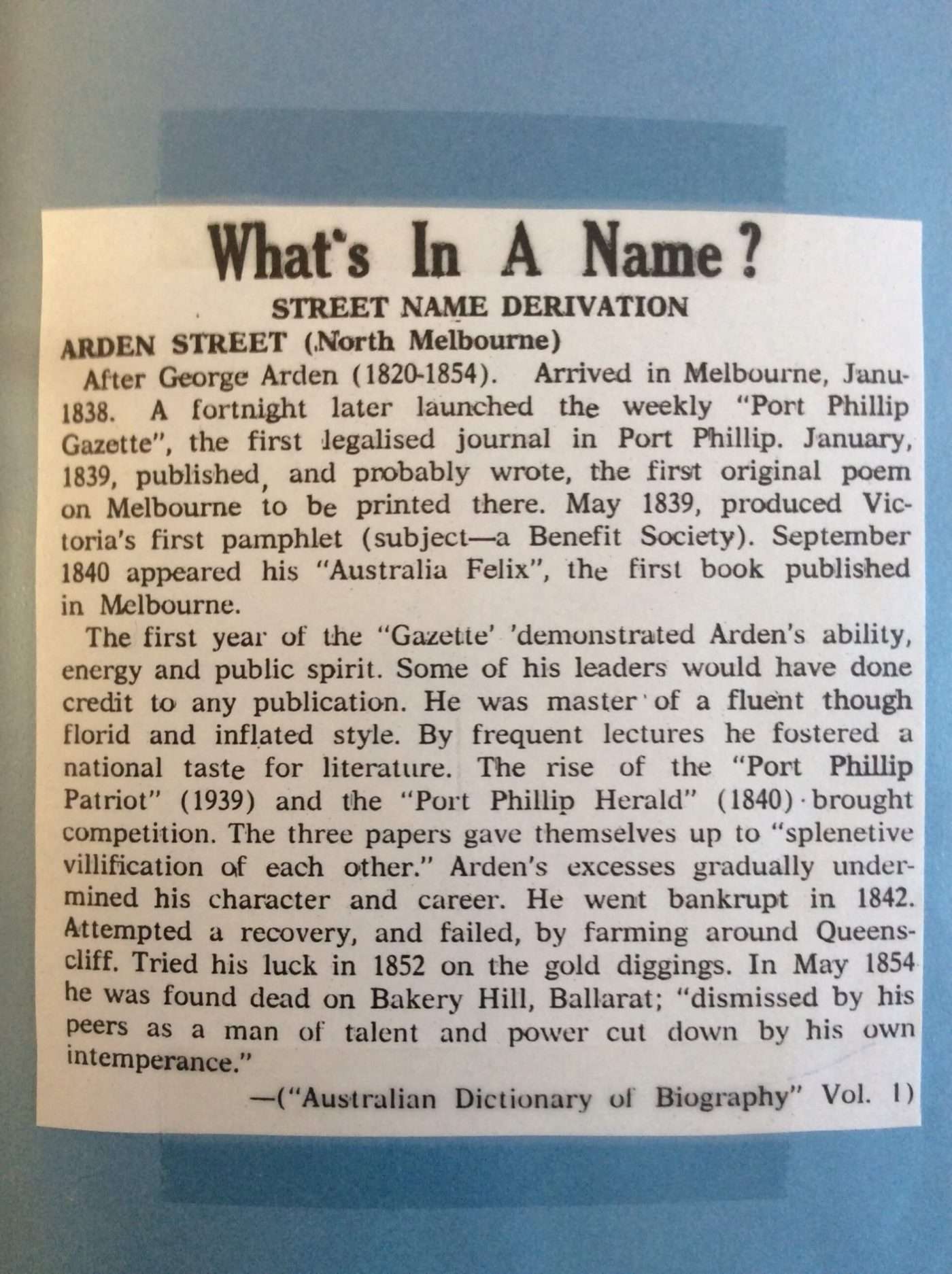
Arden Street
Named after George Arden (1820-1854). He arrived in Melbourne, January 1838. A fortnight later launched the weekly “Port Phillip Gazette”, the first legalised journal in Port Phillip.(1) Source. (1) Northern Advertiser. Blanchard collection, “What’s in a Name” at North Melbourne Library and “Australian Dictionary of Biography” Vol. 1
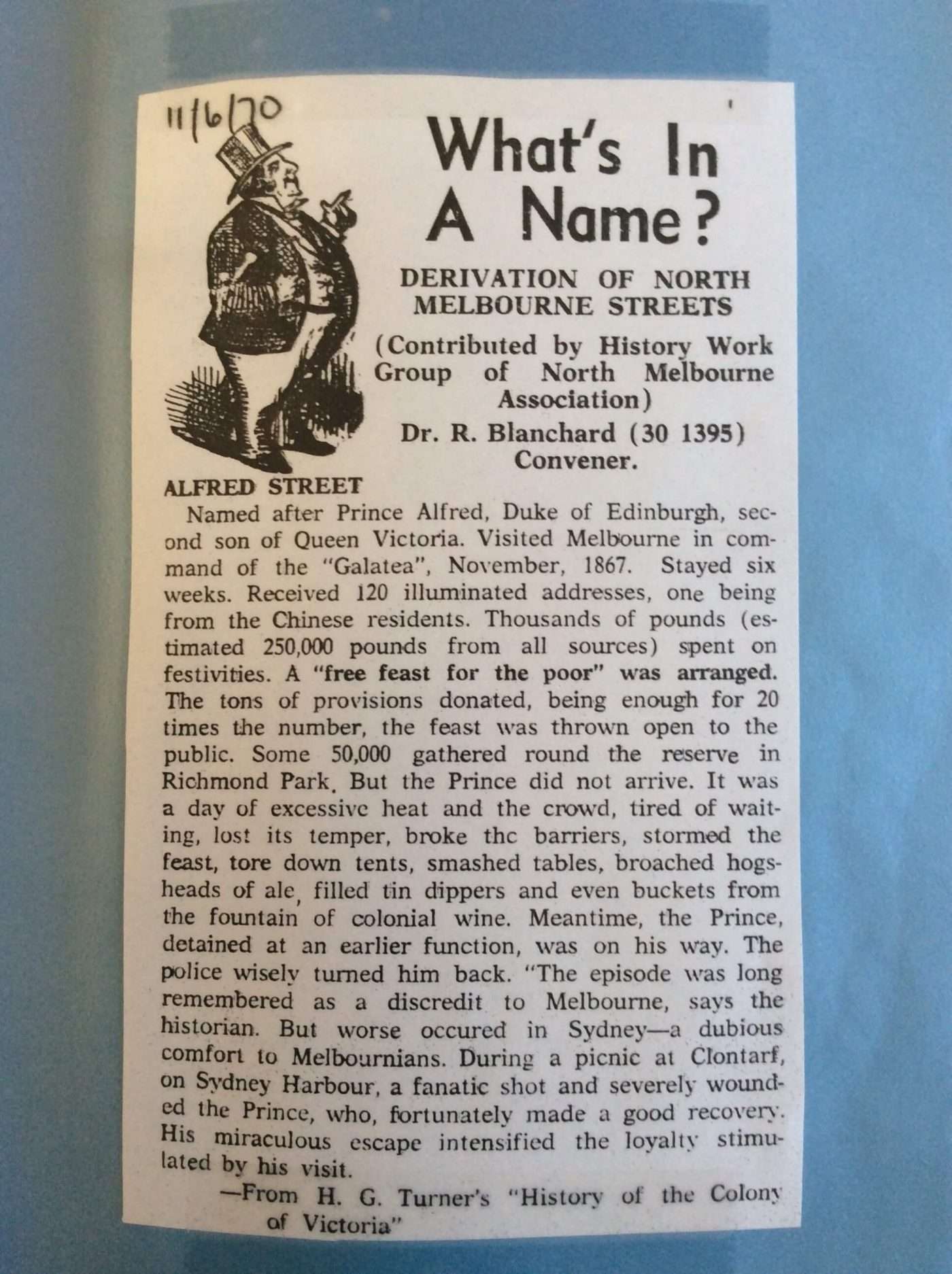
Alfred Street
Named after Prince Alfred, Duke of Edinburgh, second son of Queen Victoria. Visited Melbourne in command of the “Galatea”, November, 1867. Stayed six weeks. Received 120 illuminated addresses, one being from the Chinese residents. Thousands of pounds (estimated 250,000 pounds from all sources) spent on festivities. A “free feast for the poor” was arranged. The tons of provisions donated, being enough for 20 times the number, the feast was thrown open to the public. Some 50,000 gathered round the reserve in Richmond Park. But the Prince did not arrive. It was a day of excessive heat and the crowd, tired of waiting, lost its temper, broke the barriers, stormed the feast, tore down tents, smashed tables, broached hogs-heads of ale, filled tin dippers and even buckets from the fountain of colonial wine. Meantime, the Prince, detained at an earlier function, was on his way. The police wisely turned him back. “The episode was long remembered as a discredit to Melbourne, says the historian. But worse occurred in Sydney—a dubious comfort to Melbournians. During a picnic at Clontarf, on Sydney Harbour, a fanatic shot and severely wounded the Prince, who, fortunately made a good recovery. His miraculous escape intensified the loyalty …